3PL Billing Software: How It Works and How to Choose
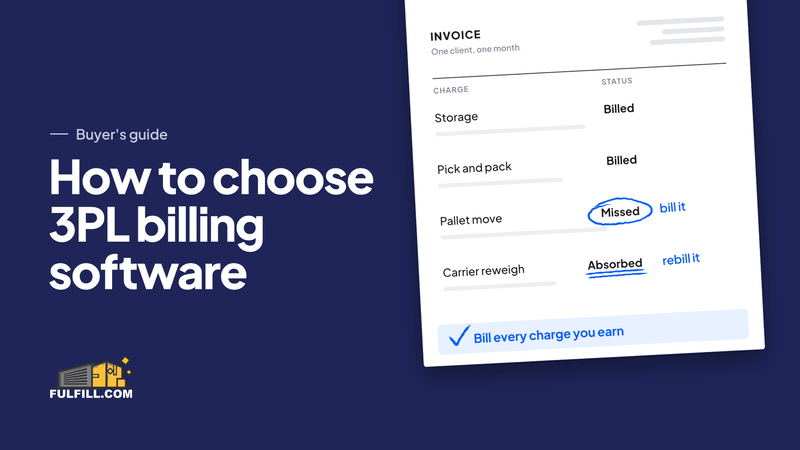
How 3PL billing software turns warehouse activity into client invoices, where billing revenue leaks, WMS billing modules vs standalone tools, and what to ask.
For 3PLsNovember 1, 20269 min read









 Fulfill Team·November 25, 2026·Add Fulfill as a preferred source on Google
This guide is for operators that run a warehouse and their own trucks: what each system does, where they hand off, the two transport jobs that catch warehouse teams out, and what to ask before you buy.
A warehouse management system (WMS) is the record of what is in the building and where: it receives goods, puts them away, directs picking and packing, and counts stock. A TMS, short for transportation management system, is the record of freight on the move: it plans loads, assigns drivers, tracks each load to delivery, keeps the proof of delivery and produces the freight bill.
| Job | WMS | TMS |
|---|---|---|
| Core record | Stock by item and location | Loads, stops, drivers and trucks |
| Work it directs | Receiving, put-away, picking, packing and counts | Load planning, dispatch, tracking and delivery |
| Paperwork | Receiving records, pick lists and packing slips | Bills of lading, proof of delivery and freight bills |
| Money it feeds | Storage and handling charges | Freight charges and driver pay |
| Rules it helps you keep | Lot and expiry records, where goods need them | Hours of Service records and owner-operator lease terms |
A warehouse that ships by parcel or hands its freight to outside carriers may never need a TMS of its own, because the carrier runs the truck. The question starts when the trucks and the drivers are yours.
The handoff has a legal document at its center. Under 49 CFR 373.101, which covers for-hire, non-exempt motor carriers, the carrier must issue a receipt or bill of lading for property tendered for interstate transport, showing the consignor and consignee, the origin and destination, the number of packages, a description of the freight, and its weight, volume or measurement where that sets the charge.
The WMS already knows most of those facts, and the TMS needs them to plan the load. With one system, the dock clerk finishes the bill of lading once. With two, the data has to cross between them, and one standard way to carry it is X12 EDI:
The diagram follows one order from the pick face to the driver's pay and marks the three steps the TMS runs.

One platform removes the handoff: the order, the stock, the load and the invoice share one record. Two systems let each side go deeper, and let you keep a WMS your team already knows. Weigh these:
Under 49 CFR 395.8, a motor carrier operating commercial motor vehicles must install and require each of its drivers to use an electronic logging device (ELD) to record duty status. The rule allows duty status to be recorded by hand in a few cases, among them a driver who needs a record of duty status on no more than 8 days in any 30-day period, and a vehicle manufactured before model year 2000. The Federal Motor Carrier Safety Administration (FMCSA) says an ELD synchronizes with a vehicle engine to automatically record driving time.
One exception matters for local fleets. Under the short-haul rule in 49 CFR 395.1(e)(1), a driver is exempt from the record of duty status requirements, ELD included, when the driver operates within a 150 air-mile radius (172.6 statute miles) of the normal work reporting location, returns there and is released within 14 consecutive hours, and, in a property-carrying vehicle, has at least 10 consecutive hours off duty separating each 14 hours on duty. The exemption also requires the carrier to keep 6 months of time records showing when each driver reports for duty, the hours on duty and the release time each day, and the total for the preceding 7 days for drivers used for the first time or intermittently.
That splits what software can do. For short-haul drivers, a TMS that keeps those time records covers the carrier's record keeping. For drivers who need an ELD, a TMS can read the device's location and duty status data into dispatch, but it does not replace the device unless it is an ELD itself.
A driver settlement is the statement of what a driver earned over a pay period, built from the loads completed in it, minus any agreed deductions. For an employee driver, it usually feeds payroll. For an owner-operator who leases a truck and driving services to your company, federal lease rules shape what the settlement has to show.
Under 49 CFR 376.12, the written lease must state the pay clearly on the face of the lease or in an addendum. The pay may be a percentage of gross revenue, a flat rate per mile, a variable rate depending on the direction traveled or the type of commodity transported, or any other method both parties agree on. The lease must also provide for:
Settlement software turns those rules into a routine: it pulls completed loads, applies each driver's pay method, itemizes deductions, attaches the delivery and freight documents, and issues statements on a fixed cycle.
Fulfill.com partner FlowOps by Lanta describes itself as the operating system for 3PLs, with inventory, routing, dispatch, yard, driver pay and billing in one platform. It is built by Lanta LLC of Glen Burnie, Maryland, which says it runs its own warehouse and trucks on FlowOps every day.
Lanta LLC has its own entry on FMCSA's public record. The SAFER company snapshot, read November 13, 2026, with information as of November 11, 2026, lists Lanta LLC at 889 Airport Park Road, Glen Burnie, under USDOT number 2868716. It gives the entity type as carrier, shipper and freight forwarder, and the one operating authority it lists is motor carrier of property, except household goods. It shows an MCS-150 form date of April 27, 2026, 1 power unit and 2 drivers, and an interstate operation carrying general freight.
On the warehouse side, FlowOps tracks stock by SKU and location, with barcode receiving from any RF or USB scanner, a yard board with a driver check-in queue, dock appointments, and bills of lading that post inventory when they are finalized. Each warehouse client signs into a scoped portal that shows only its own inventory, orders and reports, and the books sync with QuickBooks Online or Xero.
On the transport side, it assigns loads and tracks each one from scheduled through delivered, with live driver GPS, a customer tracking link, multi-stop routes and photo or signature proof of delivery. It builds weekly Sunday-Saturday driver settlements from completed loads, with approvals, automatic paid receipts and printable pay stubs, for employed drivers, owner-operators and 1099 contractors.
For Hours of Service, FlowOps says short-haul drivers under the 150 air-mile exemption can log and certify their hours in FlowOps with no ELD device, and that regulated drivers keep their existing FMCSA-registered ELD while FlowOps takes in its GPS and duty status from providers such as Samsara, Motive and Geotab. It says it is not itself the ELD of record.
Asked on its dispatch page whether it is a full enterprise TMS, FlowOps answers that it covers the dispatch, tracking, Hours of Service, driver pay and yard work that small carriers and 3PLs use. It fits a warehouse operator with a small fleet that wants one login; an operation that hands most freight to outside carriers should test that workflow in a demo first.
As listed on November 13, 2026, FlowOps has five plans: Starter at $99 a month with up to 2 team users, Professional at $349 with up to 4, Enterprise at $649 with up to 7, Corporate at $999.99 with up to 10 per location, and Custom from $1,500 a month. Starter covers inventory, transactions, dock appointments and a customer portal for 1 store. Dispatch and driver pay come with Professional, Starter can add driver dispatch and GPS tracking for $49.99 a month, and yard management, routing and the ELD and Hours of Service features come with Enterprise. Driver and customer logins carry no per-seat fee, and plans are billed monthly through Shopify in US dollars. The chart shows each plan's monthly price and the transport features it adds.

Because plans are billed through Shopify, an operator without a Shopify store should ask how billing would work before booking a demo.
The models are not like for like: FlowOps publishes monthly plans, CartonCloud prices by usage, and two systems mean two subscriptions plus integration work. For warehouse software alone, see our guide to WMS options for 3PLs.
A WMS manages stock and work inside the warehouse: receiving, picking, packing and counts. A TMS manages freight after it leaves: loads, drivers, tracking, proof of delivery and freight bills. They meet at the dock, where the bill of lading is issued.
Yes. Some platforms, FlowOps by Lanta and CartonCloud among them, run both in one system. Others pair a WMS with a separate TMS through EDI or an API.
Not for drivers who must use one. An ELD records driving time from the engine. A TMS can read ELD data into dispatch, and some keep the time records the short-haul exception requires for drivers who qualify for it.
A driver settlement is the statement of what a driver earned for the loads completed in a pay period, minus agreed deductions. For a leased owner-operator, federal rules require the lease to spell out the pay method and how each charge-back is computed.
As listed on November 13, 2026, FlowOps by Lanta starts at $99 a month, with dispatch and driver pay included from $349 a month; Starter can add driver dispatch and GPS tracking for $49.99 a month. CartonCloud prices by usage and asks US customers to contact it for pricing.
A WMS and a TMS run the work you already have. To find more of it, see the two ways Fulfill.com works for 3PLs: getting found by brands searching for a 3PL, or having brands brought to you.
We read each source on November 13, 2026:
The regulation text is title 49 as of October 28, 2026, the latest issue on eCFR when we read it. Vendor facts come from each vendor's own website. The partner card's description is ours, written from FlowOps by Lanta's website.
Disclosure: FlowOps by Lanta is a Fulfill.com vendor partner. Fulfill.com is paid when readers click through to its website.
Insights on choosing a 3PL, evaluating fulfillment partners, and scaling your eCommerce operation, from the team behind Fulfill.com.
No spam, ever. You'll get our newsletter; unsubscribe anytime.
How 3PL billing software turns warehouse activity into client invoices, where billing revenue leaks, WMS billing modules vs standalone tools, and what to ask.
For 3PLsNovember 1, 20269 min read
How 3PLs win ecommerce brands: pages for each sales channel, place and product brands search, a warehouse tour video that captures leads, and what to measure.
For 3PLsNovember 1, 20269 min read
Google's Universal Commerce Protocol (UCP) lets AI agents query fulfillment data directly. What it means for 3PLs, plus a 15-point UCP readiness checklist.
For 3PLsJanuary 11, 202610 min read