How to Sell a 3PL Company: Valuation Multiples and M&A Trends
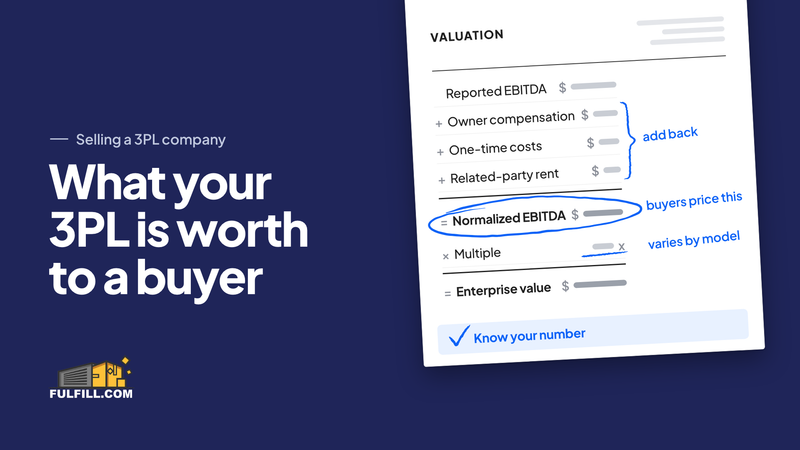
How to sell a 3PL company: 3PL acquisitions averaged 12.0x EBITDA and 1.2x revenue from 2019 to 2025. See who is buying now and how to prepare for a sale.
For 3PLsJuly 7, 20259 min read
 Joe Spisak·Updated September 29, 2026·Add Fulfill as a preferred source on Google
How AI shopping agents are creating new requirements and opportunities for fulfillment providers
• Google's UCP lets AI shopping agents query fulfillment capabilities directly
• Inventory accuracy is the new SEO for your brand partners
• AI expects delivery windows, not "3-5 business days"
• First-mover 3PLs will win business from AI-focused brands
• McKinsey sees as much as $3-5 trillion in agentic commerce by 2030
At NRF 2026, Google unveiled something that should have every 3PL paying attention: the Universal Commerce Protocol (UCP), an open-source standard that fundamentally changes how AI agents interact with e-commerce infrastructure.
Here's the simple version: when a consumer asks an AI assistant to "find me running shoes under $150 that can arrive by Friday," that AI needs to check real inventory, real shipping speeds, and real delivery estimates. UCP is the language that makes this possible.
Co-developed with Shopify, Etsy, Wayfair, Target and Walmart, and endorsed by more than 20 others including Visa and Mastercard, UCP creates a unified standard for "agentic commerce," where AI handles everything from product discovery to checkout on behalf of consumers.
For 3PLs and fulfillment providers, this isn't just another tech announcement to file away. UCP creates a new data layer that directly exposes fulfillment capabilities to AI agents, and those agents are about to become ruthless arbiters of which merchants and fulfillment partners win.
McKinsey estimates agentic commerce could reach as much as $3 trillion to $5 trillion globally by 2030, Digital Commerce 360 reported. Salesforce research found that 39% of shoppers already use AI for product discovery. The 3PLs that understand this shift will capture outsized value. Those that don't will watch their brand partners lose visibility to competitors with better fulfillment data infrastructure.
At Fulfill.com, we're already fielding questions from brands asking about "AI-ready" fulfillment partners. This is happening faster than most realize.
Imagine a customer tells Google's Gemini: "I need a birthday gift for my nephew. He likes Legos. Budget is $75, needs to arrive by Saturday."
The AI agent checks three merchants:
Merchant C wins because their fulfillment partner exposed precise, reliable data. That's UCP in action.
UCP's fulfillment extension (dev.ucp.shopping.fulfillment) exposes capabilities that directly map to 3PL operations. According to the UCP GitHub repository, here's what the schema covers:
The protocol allows AI agents to query available shipping options in real-time, including:
This means your WMS needs to provide accurate, real-time shipping calculations that can be exposed via API. If your system quotes "3-5 business days" while a competitor's 3PL returns a specific date like "arrives Thursday," the AI agent will recommend the competitor. This is why evaluating your 3PL's technology stack matters more than ever.
UCP's schema recognizes multiple fulfillment methods:
The 3PLs that can expose all of these capabilities give their brand partners a competitive advantage. Those limited to basic shipping will find their brands deprioritized by AI agents seeking the right fulfillment match for each query. Learn more about micro fulfillment strategies and how they impact your operations.
Perhaps the most significant change: UCP lets each shipping option carry an exact delivery window, not just a text range. The schema has fields for precise timestamps:
{
"fulfillment": {
"methods": [{
"id": "method_1",
"type": "shipping",
"line_item_ids": ["item_1"],
"groups": [{
"id": "package_1",
"line_item_ids": ["item_1"],
"options": [{
"id": "express",
"title": "Express Shipping",
"carrier": "FedEx",
"earliest_fulfillment_time": "2026-01-15T09:00:00Z",
"latest_fulfillment_time": "2026-01-15T17:00:00Z",
"totals": [{ "type": "total", "amount": 1000 }]
}]
}]
}]
}
}
This precision requires 3PLs to move beyond batch-processed shipping estimates toward real-time, location-aware delivery predictions. It's a fundamental shift in how shipping optimization must work.
Here's where it gets serious for fulfillment providers.
AI agents are built to optimize for successful outcomes. An agent that keeps recommending products that turn out to be unavailable loses its user's trust, so it has every reason to steer away from merchants whose stock data it cannot rely on.
Translation for 3PLs: Your inventory accuracy is now your brand partner's SEO.
Consider these industry benchmarks:
When an AI agent recommends a product and the customer discovers it's out of stock, backordered, or shipped late, the agent learns. It downgrades that merchant's reliability score. It routes future queries to competitors.
This creates a cascading effect:
The inverse is equally powerful: 3PLs with exceptional accuracy become competitive advantages that brands actively seek out. We're already seeing this in our 3PL switching conversations at Fulfill.com.
Inventory Management:
Shipping & Delivery:
Technology & Integration:
Score: 10+ checks = UCP-ready | 6-9 = Needs work | Under 6 = At risk
If you're still doing hourly or daily inventory syncs with brand partners, you're already behind. UCP-ready fulfillment requires:
Some 3PLs have already moved to systems that track, analyze, and synchronize inventory data across all fulfillment centers and sales channels in real-time. This is table stakes for modern fulfillment operations.
Work with your technology team to build APIs that can answer:
These aren't nice-to-haves. They're the data points AI agents will query when deciding which merchant to recommend. Brands evaluating how to choose a 3PL will increasingly prioritize these capabilities.
Forward-thinking 3PLs should be watching the UCP GitHub repository and considering early integration. Being among the first fulfillment providers to natively support UCP means:
Current state (January 2026): Most 3PLs are unaware of UCP's fulfillment implications. Inventory syncs are often delayed. Shipping estimates are ranges, not specific delivery dates. Fulfillment capability data is locked in WMS systems, not exposed via APIs.
18 months from now: AI shopping agents will be mainstream. Google's "Buy for Me" feature will be handling transactions autonomously. Brands will be demanding UCP-ready fulfillment partners or facing invisibility in AI-driven discovery.
The 3PLs that move now will:
For two decades, e-commerce brands obsessed over search rankings. Keywords, backlinks, page speed. All in service of visibility when a consumer searched.
Agentic commerce changes the game. When AI agents do the searching and buying on behalf of consumers, the ranking factors shift from marketing metrics to operational ones:
These are 3PL questions. Your brand partners' AI visibility now depends on your operational excellence.
The Universal Commerce Protocol isn't just a technical standard. It's a new competitive landscape where fulfillment data quality determines commercial success.
The question for every 3PL: Are you ready to be the data layer that powers your brands' agentic commerce future?
Looking for a fulfillment partner that's ready for the AI commerce era?
Get matched with 3PLs that fit your requirements. Tell us what you need, including the systems and integrations your brand depends on, and we'll connect you with providers that match.
Insights on choosing a 3PL, evaluating fulfillment partners, and scaling your eCommerce operation, from the team behind Fulfill.com.
No spam, ever. Unsubscribe anytime.
How to sell a 3PL company: 3PL acquisitions averaged 12.0x EBITDA and 1.2x revenue from 2019 to 2025. See who is buying now and how to prepare for a sale.
For 3PLsJuly 7, 20259 min read
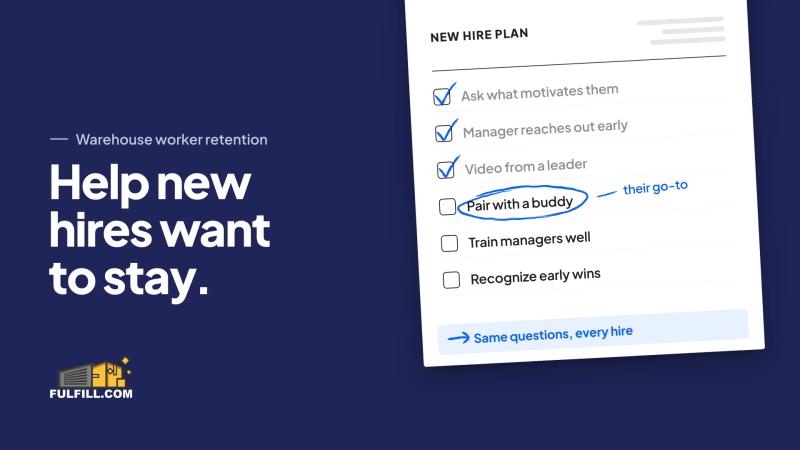
This article provides six effective strategies for retaining new hires.
For 3PLsJuly 18, 20245 min read
Discover the essential strategies and best practices for optimizing warehouse operations with our comprehensive guide to warehouse management.
For 3PLsMarch 20, 20248 min read