Ecommerce Fulfillment: The Complete Guide for 2026
 Pau Supangco·Updated July 22, 2026·Add Fulfill as a preferred source on Google
Ecommerce fulfillment is the end-to-end process of storing inventory, then picking, packing, and shipping online orders to customers, plus handling the returns that come back. It covers everything that happens between a shopper clicking "buy" and the package arriving at their door: receiving stock from your supplier, holding it in a warehouse, processing each order, choosing a carrier, and managing reverse logistics. Brands either run this themselves, outsource it to a third-party logistics provider (3PL), or blend both.
This guide is written for brand operators making a real decision, not for one warehouse trying to sell you its space. Fulfill.com is a neutral matchmaker across 2,700+ 3PLs, so the pages below explain how fulfillment actually works, what it really costs across the market, and how to compare providers objectively. Use it to figure out which model fits your volume, what questions to ask before you sign, and how to spot the warning signs early.
To put the stakes in context: U.S. ecommerce sales reached roughly $1.2 trillion in 2025, about 16% of total retail sales (U.S. Census Bureau, 2025). Fulfillment is the operational engine behind every one of those orders, and it is one of the largest controllable line items in an online business.
What is ecommerce fulfillment?
Ecommerce fulfillment is how an online order becomes a delivered package. When a customer buys from your store, the fulfillment operation pulls the right items from inventory, packs them, ships them with a carrier, and processes any return that follows. Done well, it is invisible to the shopper. Done poorly, it becomes the reason they never buy from you again.
What's included in ecommerce fulfillment:
- Receiving inbound inventory from your manufacturer or supplier and logging it into a system.
- Storage of that inventory in an organized warehouse with accurate stock counts.
- Order processing the moment a purchase syncs from your storefront.
- Picking and packing each order accurately and protectively.
- Shipping through carriers such as USPS, UPS, FedEx, DHL, and regional partners.
- Returns and reverse logistics, including inspection, restocking, and refunds.
- Inventory visibility and reporting so you always know what you have and where.
The reason fulfillment matters so much is that it directly shapes the two things customers judge most: cost and speed. Shoppers abandon carts at an average documented rate of 70.22%, and the single most common reason is extra costs like shipping being too high, cited by 40% of abandoners, with another 20% abandoning because delivery is too slow (Baymard Institute, 2025). Your fulfillment setup determines both of those numbers.
Fast, affordable delivery is not just a cost center, it is a growth lever. When your fulfillment lets you offer a free-shipping threshold and a two-day delivery promise, you convert more of the traffic you already pay to acquire. When it cannot, shoppers leave for competitors who can, and you have paid for that traffic anyway. Treating fulfillment as strategic infrastructure rather than back-office overhead is part of what separates brands that scale profitably from those that stall out as they grow.
How ecommerce fulfillment differs from warehousing
Warehousing and fulfillment are often confused, but they are not the same. A warehouse is storage: a place to hold inventory in bulk, often for long periods, measured in pallets and square footage. A fulfillment center is an active operation built for movement: inventory arrives, gets stored for a shorter window, and flows out as individual customer orders every day.
The practical difference is throughput and granularity. A warehouse optimizes for holding cost per pallet. A fulfillment center optimizes for the speed and accuracy of shipping thousands of small, mixed orders. Many 3PLs run hybrid facilities that do both, but if a provider talks only about storage rates and not pick-and-pack accuracy or shipping speed, they are thinking like a warehouse, not a fulfillment partner.
Ecommerce vs. DTC vs. B2B fulfillment
Not all fulfillment is the same shape. Direct-to-consumer (DTC) fulfillment ships single, small parcels to individual shoppers, the default for most online brands. B2B or retail fulfillment ships larger, palletized orders to businesses or retail stores, often with strict routing guides, labeling requirements, and electronic data interchange (EDI) compliance. Omnichannel fulfillment blends both, drawing from one pool of inventory to serve your website, marketplaces, and wholesale accounts at once.
The distinction matters when you choose a partner. A 3PL that excels at DTC parcel volume may struggle with a retailer's chargeback-heavy compliance rules, and vice versa. Know which mix you are running before you shortlist providers.
How ecommerce fulfillment works: the step-by-step process
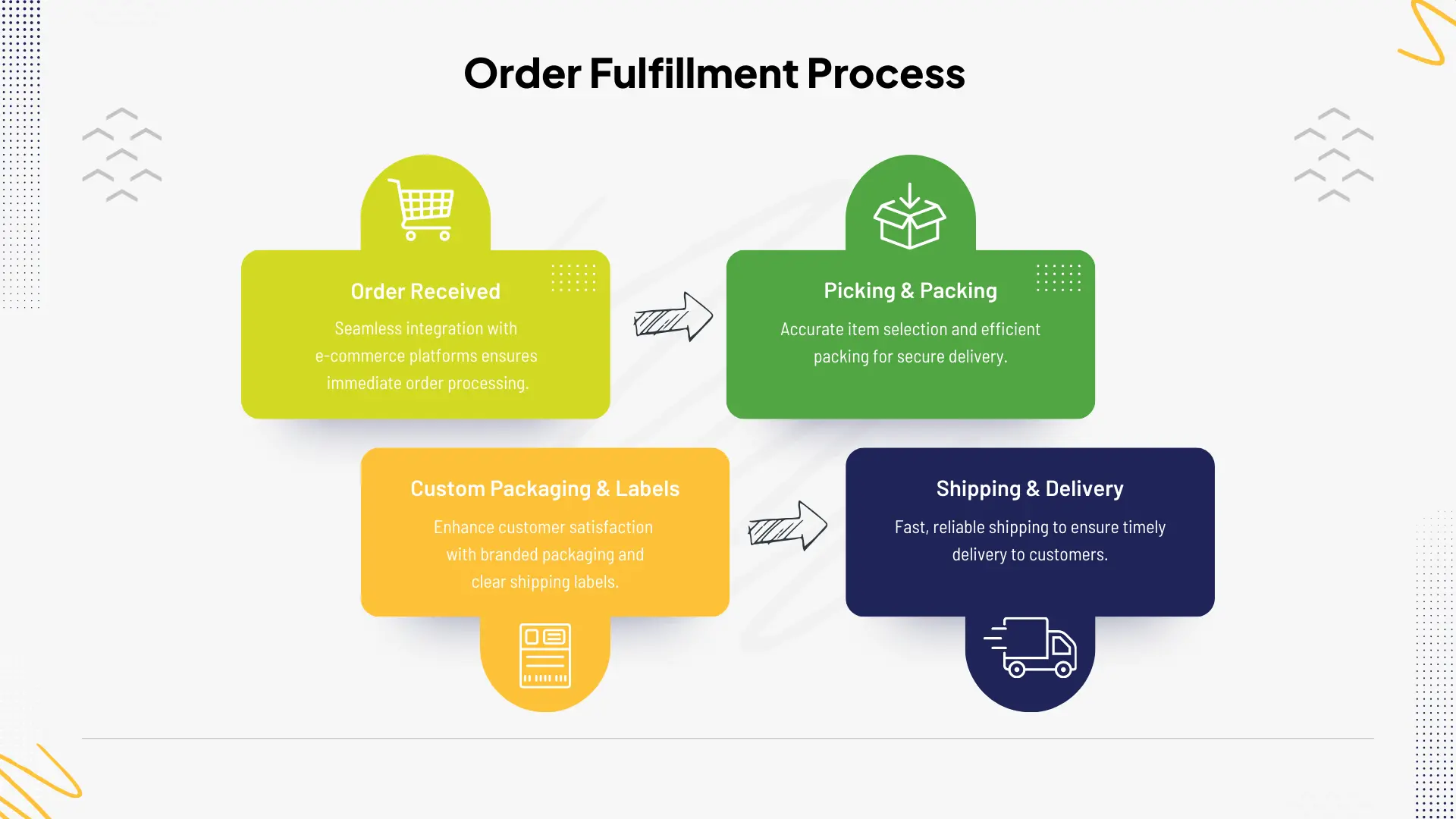
Every fulfillment operation, whether you run it in a spare room or outsource it to a national 3PL, moves through the same six stages. Understanding each one helps you diagnose where costs hide and where orders break down.
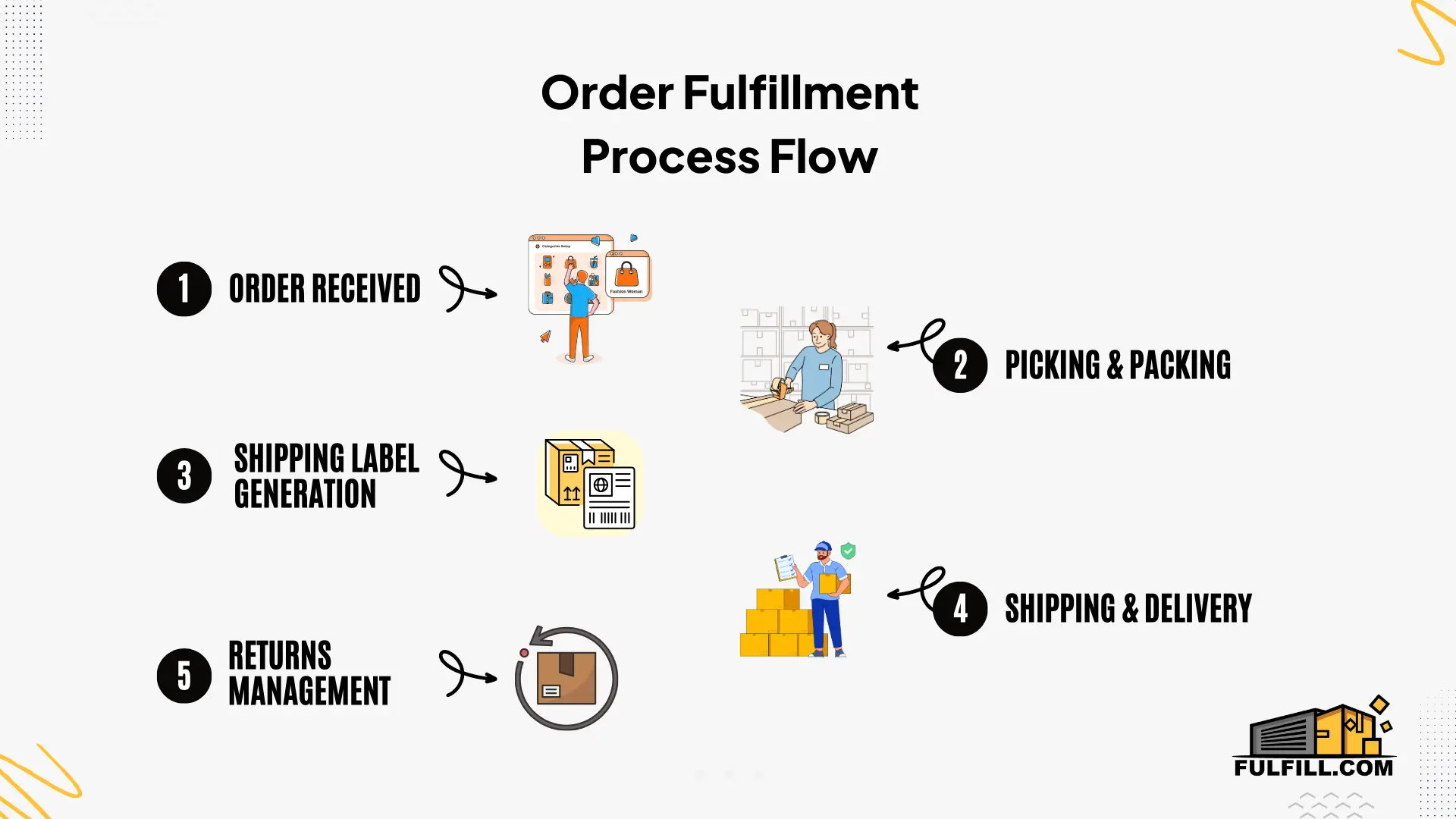
1. Receiving inventory
Inventory arrives from your manufacturer or supplier and is checked in. Best practice is a documented receiving process: count units against the purchase order, inspect for damage, and log everything into a warehouse management system (WMS) before it touches a shelf. Sloppy receiving is the original sin of fulfillment, because every downstream count depends on it being right. Most 3PLs charge for receiving by the pallet or by the unit, so tight, accurate inbound shipments save you money immediately.
2. Storage and inventory management
Once received, products are slotted into organized locations: bins, shelves, or pallet racks, each with a tracked location code. A good operation maintains real-time stock levels, sets automatic low-stock alerts, and uses cycle counts to keep the system honest. Poor inventory management shows up as oversells, stockouts, and the slow bleed of holding too much slow-moving stock. This is also where storage fees accrue, so lean, well-forecast inventory is cheaper than a warehouse full of dead SKUs.
3. Order processing
When a customer checks out, the order should flow automatically from your storefront (Shopify, WooCommerce, BigCommerce, Amazon, TikTok Shop, and others) into the fulfillment system with no manual re-entry. This integration is what makes fulfillment scalable. The system validates the order, allocates inventory, and routes it to the warehouse floor. Any friction here, manual exports, mismatched SKUs, delayed syncs, turns into shipping delays and errors.
4. Picking and packing
Pickers retrieve the ordered items from their storage locations, and packers box them with appropriate protection. High-volume operations use batch picking (grouping many orders in one pass) or zone picking (assigning pickers to areas) to move faster. Accuracy is everything: a mispick means a wrong item shipped, a return, a refund, and a lost customer. Packing choices also affect cost, since dimensional weight and the right box size directly change what a carrier charges.
5. Shipping and delivery
The packed order is labeled and handed to a carrier. Rate-shopping software compares USPS, UPS, FedEx, DHL, and regional carriers to pick the cheapest option that meets the promised delivery window. Shipping is typically the single largest fulfillment cost, so where your inventory sits relative to your customers, and how well your provider negotiates carrier rates, drives a large share of your total spend. Distributing inventory across multiple locations shortens zones and speeds delivery, which is why national 3PLs pitch multi-node networks.
6. Returns and reverse logistics
A return is not the end of an order, it is a second fulfillment cycle running backward. The item comes back, gets inspected, and is then restocked, refurbished, or discarded, and the customer is refunded. With U.S. retail returns totaling roughly $890 billion in 2024 at an average return rate near 16.9% of sales (NRF and Happy Returns, 2024), reverse logistics is a real cost center, not an afterthought. A clear return policy plus an efficient restocking process protects both margin and customer loyalty.
Common mistakes at each stage
Most fulfillment failures are not exotic. They cluster in a few predictable places, and knowing them helps you audit your own operation or a prospective partner's:
- Inaccurate receiving. Trusting supplier counts without verifying them poisons every downstream number. Count and inspect every inbound shipment.
- Overstocking slow SKUs. Buying too deep on unproven products ties up cash and racks up storage fees month after month. Let sales velocity, not optimism, set reorder quantities.
- Manual order entry. Any step that requires copying orders by hand will eventually create a wrong or delayed shipment. Automate the storefront-to-warehouse sync.
- Wrong box sizes. Oversized packaging inflates dimensional weight and carrier cost on every single order. Right-size your boxes to the product.
- Ignoring returns until they pile up. Without a defined reverse-logistics process, returned inventory sits unprocessed, unsellable, and uncounted.
- Choosing a provider on price alone. The cheapest pick-and-pack rate often hides expensive storage, minimums, or poor carrier rates.
Auditing for these six mistakes, in your own operation or a provider's, catches the majority of the problems that quietly erode fulfillment margin and customer trust.
The 5 ecommerce fulfillment models compared
There is no single right way to fulfill orders. The model that fits depends on your volume, margins, product type, and how much control you want to keep. Here are the five main ecommerce fulfillment models, side by side.
| Fulfillment model | How it works | Best for | Pros | Cons |
|---|---|---|---|---|
| In-house (self) fulfillment | You own or lease space and manage receiving, storage, picking, packing, and shipping with your own team. | Early-stage brands with low volume, or brands wanting total control and hands-on quality. | Full control, direct oversight, no third-party markup, easy custom packaging. | High fixed labor, space, and software costs; hard to scale; you own every operational headache. |
| Amazon FBA and MCF | You send inventory to Amazon; Amazon stores, picks, packs, and ships, both for Amazon orders (FBA) and, via Multi-Channel Fulfillment, for your own storefront (MCF). | Brands with strong Amazon sales that want Prime badges and Amazon's delivery network. | Fast Prime delivery, massive network, offloads labor, boosts Amazon conversion. | Fee complexity, long-term storage penalties, limited branding, and rules you do not control. |
| Third-party logistics (3PL) | You outsource storage and order fulfillment to a specialist provider that ships under your brand across all your channels. | Growing brands with fluctuating demand, or those scaling beyond what self-fulfillment can handle. | Variable cost that scales, access to better carrier rates and technology, multi-node networks, branded unboxing. | Less direct control, dependence on a partner's performance, onboarding effort, and fees to compare carefully. |
| Dropshipping | Your supplier ships orders directly to your customer; you never hold inventory. | Startups testing products, or catalogs with high SKU counts and low upfront capital. | No inventory cost, minimal startup risk, wide product range. | Thin margins, limited quality and shipping control, branding is out of your hands, stockouts you cannot see coming. |
| Hybrid fulfillment | You combine two or more of the above, for example self-fulfilling core SKUs while a 3PL handles overflow, peak season, or a specific region. | Established brands with complex needs, multi-region shipping, or seasonal spikes. | Flexibility, faster delivery, risk diversification, cost optimization per SKU or region. | Requires strong coordination and system integration; more moving parts to manage. |
Most brands do not pick one model forever. The common arc is to start self-fulfilling, add a 3PL as volume grows, and sometimes layer in Amazon FBA for a marketplace channel. If you want to see what specialized providers exist for your specific model or product type, browse the 3PL directory.
How much does ecommerce fulfillment cost?
Cost is the question competitors bury, because most of them are quoting their own rate card. Here is what fulfillment actually costs across the market, line item by line item, using published industry ranges. Treat these as directional: real quotes vary with your product size, weight, order profile, and volume.
The main fulfillment cost line items (published 3PL pricing guides, Red Stag Fulfillment and PopCapacity, 2025 to 2026):
- Receiving: roughly $25 to $45 per pallet, or about $0.35 to $1.50 per unit for hand-received items. Clean, palletized inbound shipments cost less than loose cartons.
- Storage: roughly $8 to $25 per pallet per month, with bin and shelf storage billed separately for smaller SKUs. Long-term and slow-moving inventory costs you here every month it sits.
- Pick and pack: roughly $2 to $5 per order for the first item, plus about $0.30 to $0.75 for each additional item in the order. This is the core per-order fulfillment labor charge.
- Packaging materials: boxes, mailers, dunnage, and tape, either bundled into the pick-and-pack fee or billed separately, especially for custom or branded packaging.
- Shipping: typically the single largest line, often 40% to 50% of the all-in per-order cost, driven by parcel weight, dimensions, and the zones your packages travel.
- Returns processing: a per-return handling fee to inspect, restock, or dispose of items, plus the return shipping label.
- Setup and onboarding: one-time integration and account-setup charges to connect your store and slot your inventory.
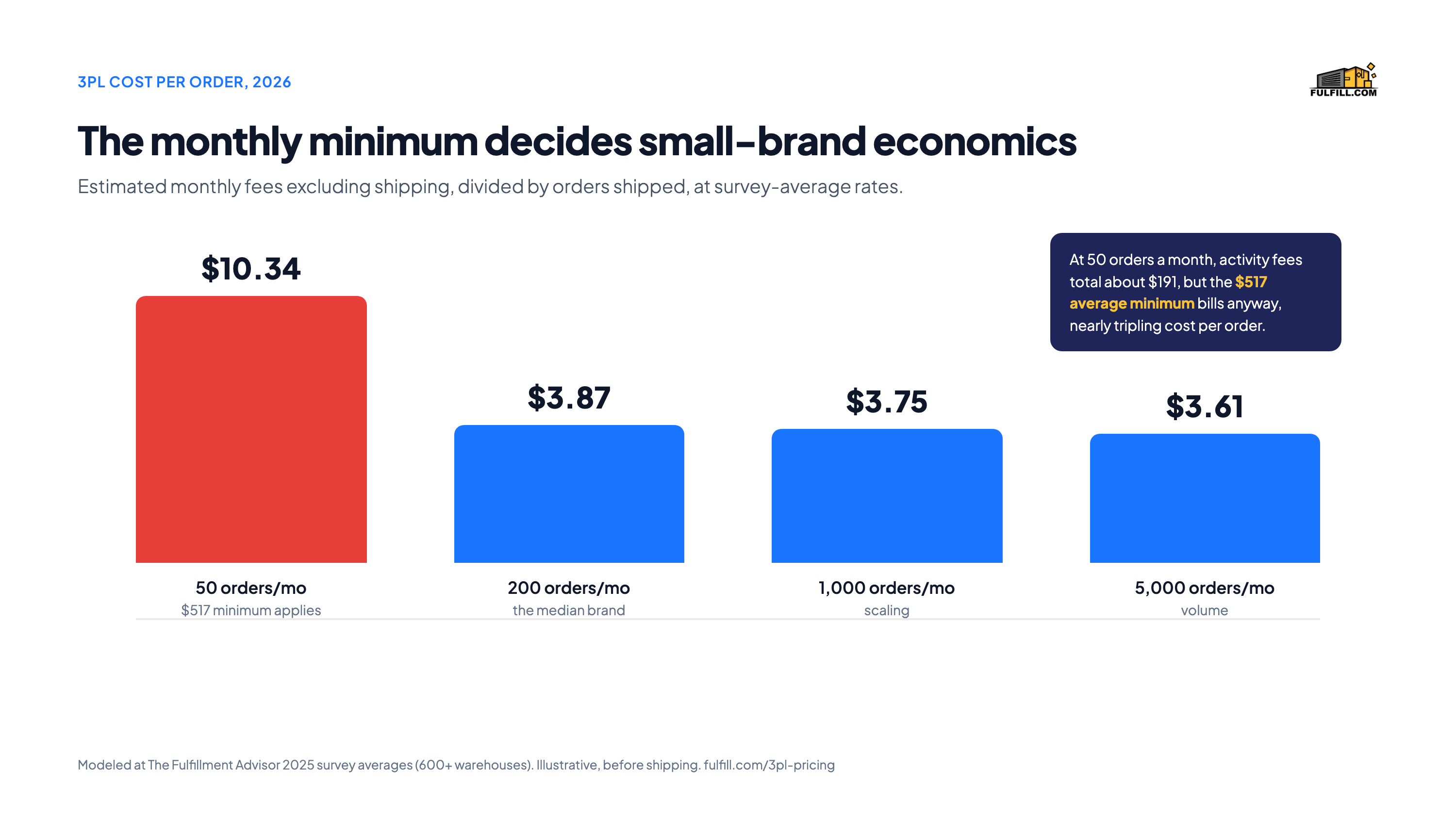
- Account minimums: many 3PLs require a monthly minimum spend, which matters most for lower-volume brands whose real usage falls below it.
As a rough all-in benchmark, standard DTC fulfillment commonly runs about $4 to $6 per order at volumes between 5,000 and 15,000 orders per month, with shipping the biggest slice (published 3PL pricing guides, 2025). Below that volume, minimums and fixed costs push your effective per-order cost higher; above it, you gain leverage to negotiate.
Because Fulfill.com sees pricing across a network of 2,700+ 3PLs rather than one provider's sheet, the neutral, cross-market picture is clearer than any single warehouse can offer.
How to compare two 3PL quotes apples to apples
Provider quotes rarely line up cleanly, which is exactly why brands overpay. To compare fairly, model each quote against your real order profile rather than the headline rate.
Start with a representative month of your own data: your average order's item count, weight, dimensions, storage footprint, return rate, and the zones your customers sit in. Then run both quotes through that same profile. A provider with a $3.00 pick fee and low storage can easily beat one with a $2.50 pick fee, high storage, and a steep monthly minimum, once you apply your real volume.
Pay special attention to four places costs hide:
- Minimums: if your usage falls below the monthly minimum, you pay the minimum regardless. Divide it across your real order count to see the true per-order effect.
- Shipping: ask each provider to estimate shipping for a sample of ten real orders using their negotiated rates, since this is your largest cost and the one that varies most between providers.
- Surcharges: peak-season surcharges, fuel surcharges, and oversized-item fees can swing the total meaningfully. The fuel surcharge calculator shows how a carrier's diesel-indexed schedule turns into that line item on freight and parcel invoices.
- Additional-item and packaging fees: a low first-item rate paired with high per-additional-item or packaging charges hurts multi-item brands.
Only after normalizing both quotes to your own order profile can you say which provider is genuinely cheaper. The headline pick-and-pack rate, on its own, tells you almost nothing.
The biggest cost mistake brands make is comparing providers on the pick-and-pack fee alone. A low per-order rate paired with high storage fees, steep minimums, and poorly negotiated carrier rates can cost more than a higher headline rate with better shipping. Compare the full stack. For a deeper breakdown of how 3PLs structure and disclose their pricing, see the 3PL pricing guide; if part of your volume ships LTL, start with the freight density calculator.
In-house vs. outsourcing to a 3PL: when to make the switch
Every growing brand eventually hits the moment when packing orders yourself stops being scrappy and starts being the bottleneck. Knowing when to outsource is one of the highest-leverage operational decisions you will make.
If you are new to the model, our What is 3PL guide covers how third-party logistics works end to end, from the services 3PLs offer to how their contracts are structured.
Signals it is time to move to a 3PL:
- Volume: you are consistently shipping enough daily orders that fulfillment eats hours your team should spend on growth. Many brands feel this pressure as sustained daily order counts climb into the dozens and beyond.
- Space: inventory has taken over your garage, office, or a leased unit that is now too small or too expensive.
- Geography: your customers are spread nationally, but you ship from one location, so delivery is slow and expensive to half the country.
- Peak pain: seasonal spikes overwhelm you, and you are hiring and training temporary packers you cannot retain.
- Error rate: mispicks, late shipments, and inventory mistakes are climbing as volume grows.
- Opportunity cost: the founder or core team is still packing boxes instead of building the business.
The true cost of self-fulfillment is easy to undercount because so much of it is your own time. When you tally warehouse rent, shelving and equipment, packing materials, software, labor (including your own hours at a real wage), carrier rates you cannot negotiate down at low volume, and the cost of errors and returns, self-fulfillment is rarely as cheap as it looks. A 3PL converts most of those fixed costs into a variable cost that scales with your orders, and brings carrier discounts and technology you could not access alone.
That said, outsourcing is not automatically right. If your volume is still low, your margins are thin, or your product needs hands-on custom assembly you cannot yet document, staying in-house a while longer can be the disciplined choice. The decision is about readiness and unit economics, not ego.
What onboarding to a 3PL actually involves
Switching to a 3PL is a project, not a switch you flip, and planning for it prevents a painful gap in shipping. A typical onboarding runs a few weeks and moves through predictable stages:
- Integration setup. Connect your storefront and any marketplaces to the provider's system, then test that orders, inventory, and tracking sync correctly in both directions.
- Inventory transfer. Ship your stock to the new facility, where it is received, counted, and slotted. Time this so you are not out of stock during the move, often by sending inventory in waves rather than all at once.
- SKU and data setup. Confirm every SKU, barcode, kit, and product dimension is loaded accurately, since errors here surface later as mispicks and billing disputes.
- Test orders. Run live test orders end to end before go-live to confirm picking, packing, labeling, and tracking all work as expected.
- Go-live and monitoring. Cut over real order flow, then watch accuracy and on-time metrics closely for the first few weeks and raise issues fast.
Ask any prospective provider for their onboarding timeline and exactly what they need from your team. A partner with a clear, documented onboarding process is signaling operational maturity, while vague answers here often predict vague service later. Planning the transition around your inventory levels and a lower-volume window keeps customers from ever noticing the change.
Ready to compare providers against your specific volume and product needs? Get matched with 3PLs that fit your business.
Ecommerce fulfillment technology and automation
Modern fulfillment runs on software as much as on shelves. The technology layer is what separates a provider that scales cleanly from one that drowns as your order count climbs.
The core systems:
- Warehouse management system (WMS): directs receiving, slotting, picking paths, and packing, and keeps inventory counts accurate in real time. The WMS is the operational brain of the warehouse.
- Order management system (OMS): aggregates orders from every channel, allocates inventory, and routes each order to the best fulfillment location. This is what makes omnichannel and multi-node fulfillment possible.
- Storefront and marketplace integrations: direct connections to Shopify, WooCommerce, BigCommerce, Amazon, Walmart, TikTok Shop, and others so orders flow automatically with no manual re-entry.
Where automation earns its keep:
- Inventory forecasting: software analyzes sales velocity to recommend reorder points and flag slow-moving stock before it becomes dead inventory, reducing both stockouts and overstocking.
- Distributed inventory placement: splitting stock across multiple fulfillment centers so most orders ship from a nearby node, shortening carrier zones and speeding delivery.
- Rate-shopping and label automation: automatically choosing the cheapest carrier and service that hits the delivery promise on every single order.
- Barcode-driven picking: scanning at each step to catch the wrong item before it is packed, cutting mispicks and the returns they cause.
- Real-time order tracking: automated tracking notifications reduce "where is my order" support tickets and raise customer confidence.
Data, reporting, and API access
The best fulfillment relationships are transparent by default. A capable provider gives you a live dashboard showing inventory on hand, order status, shipping performance, and returns, so you are never guessing about your own operation. Ask what reports you get, how often, and whether you can pull data yourself rather than requesting it.
For brands with more technical needs, API access matters. A documented API lets you connect fulfillment data to your own analytics, enterprise resource planning, or custom tooling, and it supports EDI for retail partners. This is the difference between a provider you can build on and one you are boxed in by. Even if you do not need it on day one, choosing a provider with open, well-documented data access preserves your options as you grow, and protects you from being locked into a black box you cannot see into or migrate away from.
When you evaluate a provider's technology, do not just ask whether they have a WMS. Ask whether it integrates natively with your exact storefront, whether it gives you real-time visibility into your own inventory, and whether the integration is maintained. A provider whose tech requires manual CSV exports is a scaling problem waiting to happen.
Advanced and specialized fulfillment
Once the basics are handled, the difference between a good and a great fulfillment partner shows up in the specialized capabilities your product or channel demands. Not every 3PL offers these, and the ones that do vary widely in competence.
- Returns and reverse logistics. Beyond basic restocking, advanced providers offer branded return portals, automated inspection rules, and refurbishment. If returns are a meaningful share of your orders, this capability protects margin. Explore providers strong in returns processing.
- International and cross-border fulfillment. Shipping globally means customs documentation, duties, and often Delivered Duty Paid (DDP) service so customers are not surprised by fees on delivery. Cross-border adds complexity that not every domestic 3PL handles. See international fulfillment specialists.
- B2B and retail fulfillment (EDI). Selling into retailers means routing guides, specific labeling, palletization, and EDI compliance, and getting it wrong triggers chargebacks. This is a distinct skill from DTC parcel shipping. See B2B and retail providers.
- Kitting, bundling, and customization. Assembling multi-item kits, building retail displays, adding inserts, embroidery, or engraving, and other value-added services turn raw inventory into finished, differentiated orders. See providers offering kitting and assembly.
- Subscription-box fulfillment. Recurring, dated, curated shipments have their own cadence and kitting demands that generalist 3PLs often mishandle. See subscription-brand specialists.
- Temperature-controlled and cold-chain fulfillment. Food, beverages, supplements, cosmetics, and other perishables need refrigerated or frozen storage and validated cold-chain handling. See cold-chain and temperature-controlled storage providers.
- Amazon-channel fulfillment. If Amazon is a major channel, providers experienced with FBA prep and Seller-Fulfilled Prime keep you compliant with Amazon's exacting rules. See Amazon FBA specialists.
- Vertical expertise. Categories like apparel carry their own norms around sizing, exchanges, and packaging. Matching a provider to your vertical beats a generalist every time.
If your business needs one of these, filter for it early. A provider that is excellent at plain DTC parcel shipping can be genuinely poor at cold chain or EDI, and discovering that after you onboard is expensive.
How to choose an ecommerce fulfillment partner
This is where a neutral, buyer-first perspective matters most. The following framework is written to protect you, not to steer you toward any one warehouse.
Key factors to weigh
- Location and network. Choose a provider whose facilities sit near your customer base, or one with multiple nodes so orders ship from close by. This is the biggest lever on both delivery speed and shipping cost. Regional match matters, so a brand shipping heavily to the West Coast should weigh providers with facilities in states like California, just as a Sun Belt brand might weigh Texas.
- Speed and carrier partnerships. Ask which carriers they use, what discounts they have negotiated, and what percentage of your customers they can reach in two days or less.
- Scalability. Confirm they can absorb your peak-season volume without service degradation. Ask specifically how they staffed and performed during the last holiday peak.
- Accuracy and reliability. Ask for their order accuracy rate and on-time shipping rate, in writing. Vague answers are a warning sign.
- Technology and integration. Confirm native, maintained integration with your exact storefront and real-time inventory visibility.
- Pricing transparency. Insist on the full fee schedule, not just the pick-and-pack rate.
Questions to ask a 3PL before you sign
- What is your order accuracy rate and on-time shipping rate over the last 90 days?
- What are all of your fees, including receiving, storage, per-order, per-additional-item, returns, minimums, and any surcharges?
- Which carriers do you use, and what discounts will my brand receive?
- How do you integrate with my storefront, and who maintains that integration?
- How did you perform during last year's peak season, and how did you staff for it?
- What is your onboarding timeline, and what does it require from my team?
- Can you handle my specific needs (cold chain, kitting, EDI, international) natively?
- How do you handle inventory discrepancies, damages, and mis-shipments?
Red flags to watch for
- Poor communication. Delayed responses, no dedicated account manager, and limited communication channels are early warning signs of how they will treat you once you are locked in.
- Hidden fees. Unclear pricing with surprise charges for returns, storage, or setup means you cannot forecast your costs, and it usually means more surprises later.
- Lack of transparency. A provider unwilling to share performance reports, shipping timelines, or real-time inventory data is hiding something, or does not track it, and both are problems.
- Outdated technology. No automation, no real-time inventory tracking, and manual data handling lead to delays and errors as you scale.
How to verify reliability
- Industry experience. Favor providers with a real track record in your sector, since category-specific know-how compounds into efficiency.
- Proven success. Look for case studies, verified client reviews, and third-party certifications that validate their claims rather than taking marketing at face value.
- Scalable solutions. Choose a partner built to support your long-term growth and expansion, not just your volume today.
Understand the contract before you sign
The operational fit matters, but so do the terms, and this is where buyers most often get caught. Read the agreement closely for the clauses that will matter when something goes wrong:
- Contract length and termination. How long are you committed, and what does it take to leave? Favor reasonable terms with a clear exit, and be wary of long lock-ins with steep early-termination penalties.
- Liability for lost or damaged inventory. Confirm who is responsible when your goods are damaged or lost in the provider's care, and at what valuation. Ask whether they carry insurance and what it covers.
- Service level commitments. Get accuracy and on-time targets written into the agreement, along with what happens if the provider misses them.
- Fee changes. Understand how and how often rates can change, and whether you get advance notice.
- Inventory ownership and access. Confirm you can retrieve your inventory promptly if you decide to leave.
A provider confident in their service will put commitments in writing. Reluctance to commit to accuracy targets, or to spell out liability and exit terms, tells you how a dispute would likely go. Treat the contract as part of your due diligence, not a formality.
For a broader, structured walk-through of your options, the 3PL directory lets you filter providers by capability, location, and specialty.
How Fulfill.com helps you find the right 3PL
Everything above is the hard part: knowing what to look for, what it should cost, and which red flags to trust. Fulfill.com exists to do that comparison work for you, without the bias of a single warehouse trying to fill its own shelves.
Fulfill.com is a neutral matchmaker across 2,700+ 3PLs. You tell us your volume, product type, channels, and special requirements, and we hand-match you to a free shortlist of providers that genuinely fit. There is no cost to you, and because we are provider-agnostic, the recommendations are based on fit, not on advertising spend.
That neutrality is the whole point. A single 3PL's guide will always conclude that the answer is that 3PL. Fulfill.com can tell you when self-fulfillment is still the right call, when a regional specialist beats a national brand name, or when your Amazon channel needs a different partner than your DTC store. You can see the outcomes brands have had in our case studies and client portfolio.
Ready to see your matches? Get matched with 3PLs tailored to your business.
Ecommerce fulfillment FAQ
What is ecommerce fulfillment?
Ecommerce fulfillment is the process of storing inventory and then picking, packing, and shipping online orders to customers, plus handling returns. It covers everything between a shopper's purchase and the delivered package: receiving stock, warehousing it, processing orders, choosing carriers, and managing reverse logistics for any items that come back.
How does ecommerce fulfillment work?
An order syncs from your storefront into a fulfillment system, which allocates inventory and routes it to the warehouse. Staff pick the items from their storage locations, pack them protectively, and hand the labeled parcel to a carrier. The system updates stock counts and tracking, then manages any return that follows through inspection and restocking.
How much does ecommerce fulfillment cost?
Costs are billed per line item: receiving (about $25 to $45 per pallet), storage (about $8 to $25 per pallet monthly), and pick and pack (about $2 to $5 per order plus $0.30 to $0.75 per extra item), with shipping typically the largest expense (published 3PL pricing guides, 2025). All-in DTC fulfillment often runs about $4 to $6 per order.
What's included in ecommerce fulfillment?
It includes receiving inbound inventory, warehousing and inventory management, order processing, picking and packing, carrier shipping, and returns or reverse logistics. Most providers also include real-time inventory visibility, storefront integrations, order tracking, and reporting. Advanced services such as kitting, cold-chain handling, and international shipping may cost extra.
What is the difference between a 3PL and a fulfillment center?
A fulfillment center is a physical facility where orders are stored, picked, packed, and shipped. A third-party logistics provider (3PL) is the company that operates one or more of those centers and manages the full service on your behalf, often including technology, carrier relationships, and multi-location networks, not just the building.
What are the main types of ecommerce fulfillment?
The five main models are in-house (self) fulfillment, Amazon FBA and Multi-Channel Fulfillment, third-party logistics (3PL), dropshipping, and hybrid fulfillment. Each differs in how much you control, how it scales, and its cost structure. Most brands start in-house and add a 3PL or Amazon as volume grows.
How does ecommerce fulfillment handle returns?
Returned items ship back to the fulfillment center, where staff inspect them and then restock sellable goods, refurbish, or dispose of the rest, and the customer is refunded. With U.S. retail returns near $890 billion in 2024 (NRF and Happy Returns, 2024), an efficient reverse-logistics process with clear policies protects both margin and loyalty.
When should I switch from self-fulfillment to a 3PL?
Consider outsourcing when order volume consistently eats your team's time, inventory outgrows your space, customers are spread nationally but you ship from one location, peak seasons overwhelm you, or error rates climb. The real trigger is unit economics and readiness: when a 3PL's variable cost and carrier discounts beat your true, fully loaded self-fulfillment cost.
How do I choose an ecommerce fulfillment provider?
Compare providers on location and network reach, carrier speed and discounts, scalability, order accuracy, technology integration, and full pricing transparency. Ask for accuracy and on-time rates in writing, request the complete fee schedule, and confirm they handle any special needs natively. Watch for hidden fees, poor communication, and a lack of performance data.
What does ecommerce fulfillment cost as a share of an order?
Shipping is typically the largest component, often 40% to 50% of the all-in per-order cost, with pick-and-pack labor and materials next, then storage and receiving (published 3PL pricing guides, 2025). The exact split depends on product weight and size, order profile, how far parcels travel, and your monthly volume, which drives negotiating leverage.
This guide was last updated in July 2026. Fulfill.com is a neutral 3PL matchmaking service; the guidance above is written to help brand operators compare providers objectively, not to promote any single warehouse.