An ecommerce brand that hands its inventory to a third-party logistics provider is buying an operation it will not watch every day. Your marketing has one job before any other: make that operation easy to check. A brand comparing warehouses wants to know where you ship from, which sales channels and platforms you connect to, which products you can handle, how you price and what your floor looks like.
How people search for a 3PL
We pulled the 100 most-searched US queries that contain 3pl from Ahrefs on October 30, 2026. Most of them name no need at all: 38 are the bare term or a synonym, such as 3pl services or 3pl companies, and they draw 62,800 of the 118,250 monthly searches the 100 queries share. Another 13 ask what a 3PL is.
The 26 queries that do name a need name one of three things: a sales channel or the platform it runs on (12 queries, 6,100 searches a month), a place (12 queries, 5,450) or a product or service (2 queries, 1,150).
Each bar adds the US monthly searches Ahrefs lists for the queries in that group. The other 74 of the 100 name no need, ask what a 3PL is, or look for software, news, a job, a named company or dated research.
Each of those needs is a page you can build. A brand that searches shopify 3pl or amazon 3pl wants to see that you connect to its store and its marketplace. A brand that searches 3pl los angeles wants a building in the right place. A brand that searches 3pl kitting services or 3pl warehouse food grade wants proof you handle its product. Four of the place queries end in near me, and Ahrefs records Google's local map pack on three of those four results pages, so give each building its own Google Business Profile with its street address.
Build pages that answer a brand's first questions
Give every location, sales channel and specialty its own page, and put the facts a brand compares on that page rather than behind a contact form:
Location pages: the city and region, the building, the carriers that pick up there and the areas it ships to by ground.
Channel and platform pages: each store platform and marketplace you connect to, how its orders reach your floor, and any retail or wholesale work you take on.
Product and service pages: the products you are set up to store, such as food-grade goods, and the services you run, such as kitting.
Write each page for the brand that searched for it. Name the platform, the city or the product in the page title and the first paragraph, so the page says what the brand typed.
Warehouse marketing that shows the floor
A page can list your services. A short tour video lets a brand see them: the receiving dock, the storage, the pick and pack stations, the outbound staging and the returns area. It is the closest a brand gets to a site visit before it books one.
Plan the tour around what a brand needs to see, not around the building's layout:
Open on the payoff. Start with the packing line or a finished order, not a logo animation.
Give each step a chapter. Receiving, storage, pick and pack, shipping and returns, each titled so a viewer can skip to the step it cares about.
Caption it. A captioned tour works with the sound off. Put a short summary of the tour on the page as well, so search engines have text to read.
Ask once, at the right moment. Put the call to action after the part that proves your point, such as a packed order leaving the dock.
Then put the video on your own location and service pages, where the brand already is, rather than only on a video channel.
How Videokr runs a warehouse tour video
Videokr, a Fulfill.com partner based in Byron, Minnesota and founded in 2026, is a hosted video-marketing platform. Its partner profile describes it as helping 3PLs host warehouse-tour, sales, onboarding and customer-education videos on their own sites. You add a video by pointing Videokr at a source you already have (an MP4 or WebM file, an HLS stream, or a YouTube or Vimeo link), and Videokr wraps it in a player you brand, with a marketing layer and analytics on top.
What a 3PL gets from it, per Videokr's documentation:
A branded player. Set the skin, accent color, corner radius and logo watermark, and choose which controls show, per video.
Chapters and captions. Chapters are titled timestamps shown in the player; captions are a WebVTT track you upload or paste. On a video's public page, chapters are written into the page's structured data as key moments.
A marketing layer. A timed overlay or banner, an end screen, and an email gate that pauses playback until the viewer leaves an address, set as required or skippable.
Lead handling. Each email is stored against the video with its timestamp, listed in Leads with a CSV export, sent as an email notification, and pushed to any webhook subscribed to lead events, signed with HMAC-SHA256.
Analytics. Impressions, plays, completions and a retention curve that shows the share of viewers still watching at each 1% of the runtime, plus device, country and referrer breakdowns and clicks on each call to action.
Access control. A video can be public, unlisted or password-protected, and its embed can be locked to the domains you list.
Setting up a tour follows Videokr's quickstart, plus one step for leads:
Create an account and add the tour by its URL: a file link, an HLS stream, or the YouTube or Vimeo link you already have.
Pick a thumbnail, or let Videokr take a frame from the video.
Brand the player, then add the chapters, the captions and one call to action.
Copy the iframe or the one-line script embed from the video's Share panel and paste it into your page. It works on any site that accepts HTML, and a WordPress plugin adds a shortcode and a block editor block.
Subscribe a webhook to lead events, so your CRM or automation tool can create a contact from each lead the tour captures.
When you re-cut the tour, you can swap the video's source and keep its embed code and its analytics history, so the new cut is measured against the old one.
Where Videokr fits, and where it does not
Videokr suits a 3PL that wants its tour, service explainers and onboarding videos on its own site, with the viewer kept on the page and every lead traced to a video. Its listed integrations are WordPress, website embeds, webhooks and an API.
It is a website video and marketing tool, not warehouse software: it does not manage inventory, orders, shipments, carriers or returns, and it is not a WMS, EDI or shipping integration. It does not edit video either, so you bring a finished cut. Videokr's own pages also say to look elsewhere for live streaming, studio-grade DRM or building an audience on a public network.
Beside the alternatives, as Videokr's comparison pages frame them, YouTube is where public discovery happens, but a YouTube embed carries YouTube's branding and suggested videos, and the analytics stay with YouTube. Wistia covers the same core job with more webinar, enterprise integration and team tooling, and Vidyard is built around one-to-one sales video and CRM integrations. A bare video tag on your own server leaves delivery, transcoding and measurement to you. If your tour already sits on YouTube, Videokr can wrap that same link in your own player, though YouTube's own terms still apply to that stream.
Turn tour views into sales conversations
A tour earns its place when it starts conversations. Use it in three places:
On the page a brand searched for. Embed the tour on each location and service page, with one call to action after the proof point. Videokr's guidance is to place a gate or overlay right after the video has proved something, not at the start, before the viewer has any reason to stay.
In the follow-up. After a first call, send an unlisted tour of the building you quoted. An unlisted video is reachable only by its link and stays out of search indexes and sitemaps.
In your CRM. Videokr does not score or nurture leads. It captures the email, records which video and which moment produced it, and passes it to the tools you already use. Connect the lead webhook to the CRM your sales team works in; our 3PL guide to CRM success covers that side.
Get listed where brands compare 3PLs
Your own site is one place a brand finds you. 3PL directories are another: a brand comparing providers sees your listing beside the others. Keep each listing's locations, services and platforms the same as your site, and point each one to the page that matches it. Fulfill.com's directory is one of those places. See how to list your warehouse on Fulfill.com, and browse the ecommerce brands Fulfill.com has matched with 3PLs to see the kinds of brands that search.
Measure what turns into a quote
Judge each page and video by the quote requests it produces, not by its views. Videokr's analytics separate the problems: a low play rate (plays divided by impressions) points at the thumbnail or the placement, a sharp drop early in the retention curve means the opening is not the video the thumbnail promised, and the clicks and leads each call to action collects show whether it earns its place. Videokr can also test two thumbnails against each other for plays. Record the page and the video behind every inquiry in your CRM, then build more of the pages and videos that produce quotes.
3PL marketing FAQ
What is 3PL marketing?
3PL marketing is how a third-party logistics provider gets found, checked and chosen by brands that need fulfillment. It covers the pages brands find in search, the proof on them, such as a warehouse tour video, the directories where they compare providers, and the path to a quote.
How do 3PLs win new ecommerce brands?
By matching how brands search: a page for each sales channel, place and product you serve, a captioned warehouse tour on those pages, accurate listings in 3PL directories, and a clear quote for each inquiry. Then track which pages and videos produce quote requests.
Should a 3PL put a warehouse tour video on its website?
Yes, on the pages brands land on. A chaptered tour of receiving, storage, pick and pack, shipping and returns shows the operation before a site visit. Captions let it work with the sound off, and one call to action after the proof point asks for the inquiry.
What is Videokr?
Videokr is a hosted video-marketing platform and a Fulfill.com partner. It wraps a video you already have in a player you brand, adds chapters, captions, calls to action and email capture, and reports plays, completions and retention. It is not a WMS and does not edit video.
Disclosure: Videokr is a Fulfill.com vendor partner. Fulfill.com is paid when readers click through to its website.
Get 3PL Insights in Your Inbox
Insights on choosing a 3PL, evaluating fulfillment partners, and scaling your eCommerce operation, from the team behind Fulfill.com.
No spam, ever. You'll get our newsletter; unsubscribe anytime.
Google's Universal Commerce Protocol (UCP) lets AI agents query fulfillment data directly. What it means for 3PLs, plus a 15-point UCP readiness checklist.
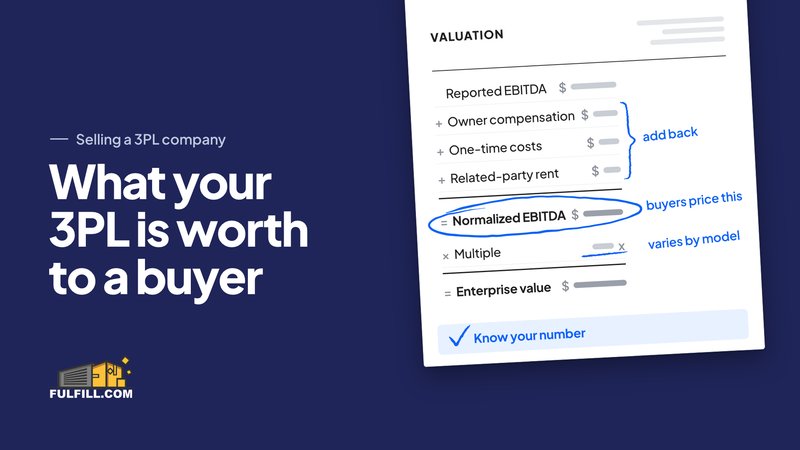
How to sell a 3PL company: 3PL acquisitions averaged 12.0x EBITDA and 1.2x revenue from 2019 to 2025. See who is buying now and how to prepare for a sale.