Boosting Warehouse Worker Retention
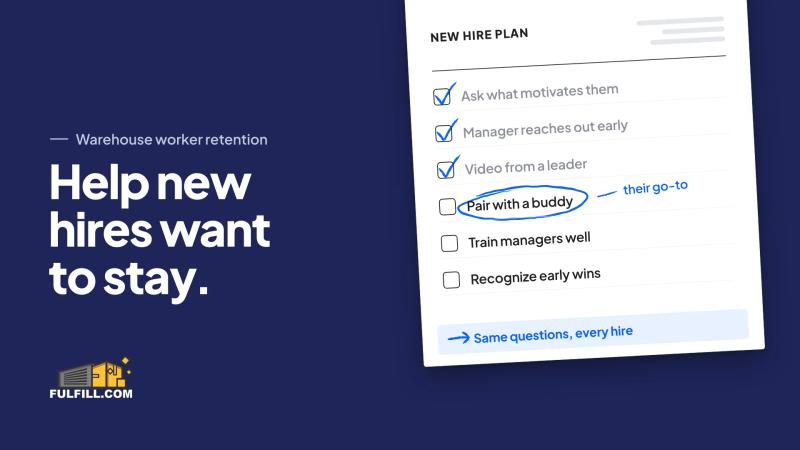
This article provides six effective strategies for retaining new hires.
For 3PLsJuly 18, 20245 min read



 Greg Airel·Updated September 23, 2026·Add Fulfill as a preferred source on Google
The logistics industry is in a consolidation period. After a freight recession that began in late 2022, 3PL M&A activity is picking up again, led by private equity and privately owned strategic buyers. The difference from the last cycle is selectivity: buyers are paying for differentiated, well-run operations and passing on commodity capacity. If you are thinking about how to sell a 3PL company, start with where the market actually is.
Key Market Facts:
Since late 2022 the 3PL sector has worked through a long freight recession that compressed margins and stalled deals that had been in the works. Armstrong & Associates now says that recession is nearing its conclusion and forecasts growth through 2027. Capacity has tightened in 2026: the FreightWaves SONAR Outbound Tender Rejection Index averaged 12.7% year to date, which Capstone reads as carriers and 3PLs regaining pricing leverage. Freight volumes are still weak, so the recovery is uneven.
Recovery Signs:
Large logistics providers keep reshaping their portfolios around profitable core services: selling units that no longer fit and buying capabilities that do. Strategic buyers have increasingly prioritized targets that provide mission-critical logistics support with little exposure to macroeconomic volatility (Capstone, September 2025).
Notable Strategic Moves:
Fulfill keeps a running list of announced deals on its 3PL M&A tracker.
Capstone attributes the 2026 rise in private equity deals to the late 2025 interest rate cuts and to the opportunity to deploy technology-enabled 3PL capabilities across a highly fragmented market. Sponsor deal flow has grown every year since 2023, although it is still below the 2021 and 2022 peak.
PE Investment Themes:
There is no single 3PL multiple. What a buyer pays depends on whether you own trucks, how much of your revenue repeats, and what you specialize in. Two reference sets are worth knowing: what buyers paid in private deals, and what public logistics companies trade at.
| Target type | Average EV/Revenue | Average EV/EBITDA |
|---|---|---|
| 3PL targets | 1.2x | 12.0x |
| Trucking targets | 0.9x | 5.5x |
| 3PL and trucking targets | 0.9x | 11.3x |
Source: Capstone Partners, average M&A multiples from 2019 to July 28, 2025, drawn from Capital IQ, FactSet and PitchBook.
Individual deals show how wide the range runs. UPS agreed to 3.6x revenue and 14.4x EBITDA for Andlauer Healthcare. DP World's March 2025 deal for logistics provider Unique Logistics International came in at 0.2x revenue and 9.2x EBITDA. Thoma Bravo's WWEX deal was valued at 1.0x revenue.
| Public segment (median) | EV/NTM Revenue | EV/NTM EBITDA |
|---|---|---|
| Asset-light 3PL (C.H. Robinson, Expeditors, GXO, Radiant, RXO) | 0.8x | 14.5x |
| Asset-light transportation (Forward Air, Hub Group, J.B. Hunt, Landstar) | 1.1x | 10.0x |
| Less-than-truckload carriers | 2.4x | 14.3x |
| Full truckload carriers | 0.8x | 6.7x |
Source: Capstone Partners using Capital IQ data as of July 28, 2025. NTM = next twelve months.
For a more recent cross-check, Aswath Damodaran's January 2026 data puts the U.S. transportation industry at 12.55x EV/EBITDA (19 companies) and trucking at 10.41x (26 companies), counting companies with positive EBITDA.
How to Read These Numbers:
Every figure here comes from public companies or from deals that disclosed their price, and those skew toward larger businesses. Treat them as reference points, not a quote for your company. For a first estimate based on your own numbers, try Fulfill's 3PL valuation tool.
Key Factors Driving Premium Valuations:
Private equity firms want 3PLs with strong fundamentals and room to grow, either as a new platform or as an add-on to a company they already own. In 2026 sponsors have aimed both kinds of deal at targets that bring technology integration, automation and AI-enabled efficiencies, according to Capstone.
Strategic buyers pursue 3PL acquisitions to add services, expand geographic reach across North America and globally, and gain operating scale. Privately owned strategics, meaning other 3PLs, carriers and brokers, completed 22 deals in 2026 to date, according to Capstone's June 2026 update, their first year-over-year gain since 2022, mostly bolt-ons for scale and regional coverage. Public strategics completed only three, down from nine a year earlier (Capstone, June 2026).
Strategic Acquisition Drivers:
Buyer activity in 2026 has clustered around managed transportation providers, 3PLs with specialized services, and technology-enabled platforms. Acquisitions of businesses offering managed transportation tripled year over year to 19 deals (Capstone, June 2026).
Specializations Buyers Look For:
"The M&A market is bifurcated. High-quality, differentiated and technology-enabled 3PL platforms are commanding strong buyer interest, while commoditized operators have more limited access to capital," Capstone managing director Gordon Mackay wrote in June 2026. That is the most useful sentence in this article for a seller. Which side of that line you sit on matters more than the calendar.
With private equity and private strategics both adding deals, a well-positioned 3PL can draw more than one type of buyer. That creates competitive tension that benefits sellers, particularly those with diversified customer bases and a clear specialty.
Seller Advantages:
Buyers are focused on 3PL companies with strong financial discipline, solid cash flow, diverse customer bases, and relatively low debt. Well-run operators with those fundamentals get the premium; the rest get a longer process or a lower number.
Most private company sales take 6 to 12 months from preparation to closing, and roughly two to four months of that falls between signing a letter of intent (LOI) and closing, according to Beacon Advisors. Here is how that time is spent when a regional 3PL sells to a larger buyer:
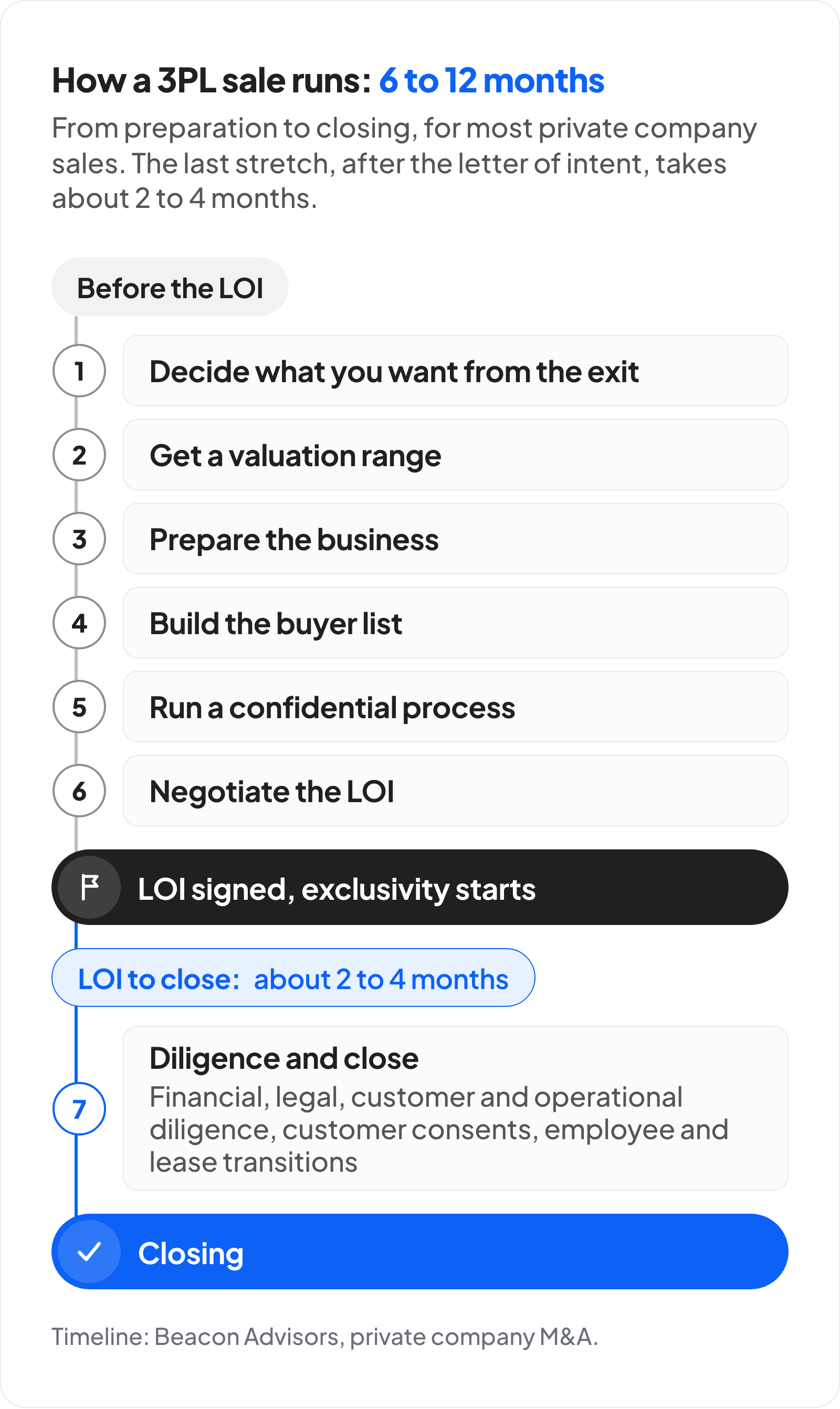
Fulfill's 3PL M&A team works with owners on each of these steps, from valuation and EBITDA normalization to buyer introductions and deal execution.
If a few accounts carry most of your revenue, a buyer will price that risk in, often through an earnout. Adding customers in the year before a sale is one of the most direct ways to protect your number. Fulfill's network for 3PLs introduces brands to 3PLs that fit what they ship.
Operational Excellence:
Strategic Positioning:
There is no perfect quarter. Go to market when your trailing twelve months show the business at its best and when you have the capacity to run a process without letting operations slip. Avoid launching a process heading into peak season, when your team cannot support diligence and a service failure would show up in the numbers buyers are reading.
In a selective market, buyers use structure to bridge the gap between what they will pay today and what you believe the business is worth. Sellers should expect:
Common Deal Terms:
An earnout pays part of the price later if the business hits agreed targets, usually revenue or EBITDA. Read the definitions closely: who controls pricing, hiring and customer decisions after close decides whether you can hit the target.
Capstone lists what a durable freight recovery still needs: sustained improvement in U.S. manufacturing output, stable fuel costs, reduced tariff volatility and clearer trade policy, and a recovery in consumer demand. Until those arrive, it expects pockets of pricing strength alongside weak demand. Potential sellers should consider:
Policy and Economic Risks:
Operational Headwinds:
For a 3PL with clean financials, a diversified customer base and a clear specialty, 2026 is a workable market: deal volume is up, private equity and private strategics are both adding deals, and the freight recession is easing. For a commodity operator, the same market is harder, because capital is concentrating on the best assets. The question is less "when" than "which side of the line am I on, and what would it take to move?"
Key Success Factors:
From 2019 through July 2025, 3PL acquisition targets averaged 12.0x EV/EBITDA and 1.2x EV/revenue, against 5.5x EBITDA for trucking targets and 11.3x for mixed 3PL and trucking targets (Capstone Partners). Individual deals range widely around those averages.
Most buyers start from normalized EBITDA and apply a multiple that reflects your model (asset-light or asset-based), customer concentration, contract length, specialization and growth. Revenue multiples matter more for fast-growing businesses with thin current earnings. Fulfill's 3PL valuation tool gives a first estimate from your own numbers.
Most private company sales take 6 to 12 months from preparation to closing, with about two to four months between a signed LOI and close (Beacon Advisors). Preparation you do before going to market shortens diligence.
Private equity firms (as platforms or add-ons) and strategic buyers such as larger 3PLs, carriers and brokers. So far in 2026, private equity has done 23 3PL deals, private strategics 22 and public strategics 3 (Capstone Partners, June 2026).
As of July 28, 2025, public asset-light 3PLs traded at a median 14.5x next-twelve-months EBITDA and 0.8x revenue, full truckload carriers at 6.7x EBITDA, and less-than-truckload carriers at 14.3x (Capstone Partners). Damodaran's January 2026 data puts U.S. transportation at 12.55x EV/EBITDA and trucking at 10.41x.

This analysis is based on market data available as of September 2026. Market conditions can change rapidly, and potential sellers should conduct thorough due diligence and consult with experienced M&A professionals before making strategic decisions.
Insights on choosing a 3PL, evaluating fulfillment partners, and scaling your eCommerce operation, from the team behind Fulfill.com.
No spam, ever. You'll get our newsletter; unsubscribe anytime.
This article provides six effective strategies for retaining new hires.
For 3PLsJuly 18, 20245 min read
Discover the essential strategies and best practices for optimizing warehouse operations with our comprehensive guide to warehouse management.
For 3PLsMarch 20, 20248 min read
Who owns logistics real estate, such as Prologis and Link Logistics, which industrial brokers represent 3PLs, 2026 vacancy, and how to lease a warehouse.
For 3PLsJune 29, 202310 min read