Below are 17 ecommerce platforms small businesses use. For the 13 whose vendors publish a US price, we list the entry price and fees shown when we checked in September 2026. Five questions then help narrow the list, and a later section covers how to connect your store to a 3PL once you outsource fulfillment. Prices are US list prices and change often, so confirm on the vendor's page before you commit.
In this article (23 sections)
2026 Prices at a Glance
Platform
Entry plan that sells online
What to watch
Shopify
$39/mo, or $29/mo billed yearly
2% fee on Basic if you use an outside payment provider
BigCommerce
$39/mo, or $29/mo billed yearly
Core covers up to $30K in yearly sales, then auto-upgrades; outside payment providers carry a fee
WooCommerce
No platform subscription
Hosting, which WooCommerce estimates at $25 to $350/mo
Squarespace
$19/mo billed yearly
2% online store fee on Basic; 0% from Core ($29)
Wix
$29/mo billed yearly (Core)
The $17 Light plan does not list payments
Volusion
$35/mo
Up to $50K in yearly sales and 100 products
Shift4Shop
$41/mo
One plan listed
Weebly
$0 plan; paid from $13/mo billed yearly
Now part of Square
Ecwid
$5/mo billed yearly
Starter caps you at 10 products
Sellfy
$29/mo, or $22/mo billed yearly
Up to $10K in yearly sales
Webflow
$29/mo billed yearly
500 items and a 2% fee on Standard
Hostinger (formerly Zyro)
Unlimited plan, renews at $16.99/mo, plus the Ecommerce add-on at $8.99/mo
Selling is a paid add-on, and the intro plan price needs a long prepaid term
droplinked
$0 Starter plan; Pro $5/mo, or $4.50/mo billed yearly
Warehouse integration is listed from Pro
Adobe Commerce, PrestaShop, OpenCart and GoDaddy are covered below without a list price in this table: the open-source options have no platform subscription, and the others did not show a checkable US price when we looked.
Shopify
Ease of Use and Scalability
Shopify remains a dominant force in the ecommerce world, known for its user-friendly interface and scalability. It's perfect for both small and large businesses, offering extensive app integrations that allow you to customize your store to meet your specific needs. With Shopify, you can start small and scale up as your business grows, making it a versatile choice for any entrepreneur.
Price and fees: Basic is $39 a month billed monthly or $29 a month billed yearly. Grow is $105 ($79 yearly) and Advanced is $399 ($299 yearly). Card rates start at 2.9% plus 30 cents on Basic. If you use a payment provider other than Shopify Payments, Shopify adds a third-party transaction fee of 2% on Basic, 1% on Grow and 0.6% on Advanced.
BigCommerce is a robust platform that offers advanced customization options and scalability for growing brands. Its strong SEO performance and built-in features make it an excellent choice for businesses looking to enhance their online presence. BigCommerce is ideal for brands that need a powerful platform to support their growth and marketing efforts.
Price and fees: BigCommerce reworked its plans for 2026 around trailing 12-month sales. Core is $39 a month ($29 billed yearly) for stores with up to $30K in sales, Growth is $105 ($79) up to $100K, and Scale is $399 ($299) with a 0.9% charge on sales above $33,333 a month. Performance starts at $1,499 a month billed annually. Plans move up automatically as sales grow, so budget for the tier you will reach within a year, not the one you start on. Orders paid through BigCommerce's embedded payment providers carry no extra fee; orders through other payment providers carry a monthly fee that varies by plan.
Built on WordPress, WooCommerce is a flexible, open-source platform that gives you complete control over your online store. It's ideal for brands that want to customize every aspect of their ecommerce site. With a vast array of plugins and themes, WooCommerce allows you to create a unique shopping experience tailored to your brand's identity.
Price and fees: The WooCommerce plugin has no monthly subscription and no revenue share. You pay for hosting, which WooCommerce itself estimates at $25 to $350 a month for most stores, paid extensions at $29 to $299 a year each, and payment processing.
Start selling with WooCommerce and enjoy complete control over your online store with this flexible, open-source platform.
Magento (Adobe Commerce)
Highly Customizable and Powerful
Magento, now known as Adobe Commerce, is a highly customizable and powerful platform suitable for enterprise-level businesses. It offers advanced features for large-scale ecommerce operations, making it a top choice for companies with complex needs. Magento's flexibility and scalability ensure that it can handle the demands of a growing business.
Squarespace is best known for its visually appealing design options and quick setup process. It's ideal for creative industries, smaller stores, and businesses that need a beautiful online presence without extensive customization. Squarespace's built-in design tools make it easy to create a stunning store that attracts customers.
Price and fees: On annual billing, Basic is $19 a month and charges a 2% online store transaction fee. Core ($29), Plus ($49) and Advanced ($99) charge 0% on online store sales. Card rates start at 2.9% plus $0.30 and drop to 2.5% plus $0.30 on Advanced.
Wix Ecommerce is renowned for its drag-and-drop simplicity, making it a great option for small businesses or beginners. It offers a variety of templates and customization options, allowing you to create a professional-looking store with ease. Wix is perfect for those who want a straightforward, user-friendly platform.
Price and fees: Core, at a $29 a month list price on yearly billing, is the lowest Wix plan that lists accepting payments and ecommerce. Business is $39 and Business Elite is $159, also billed yearly. The $17 Light plan does not list payments. Wix often shows a promotional discount off these list prices, so check what the price renews at.
Create your store with Wix and take advantage of their drag-and-drop simplicity to build a professional ecommerce site with ease.
PrestaShop
Flexibility and Affordability
PrestaShop is an open-source ecommerce platform that offers flexibility and customization. It's suitable for small to medium-sized businesses looking for an affordable option. With a wide range of modules and themes, PrestaShop allows you to tailor your store to your specific needs without breaking the bank.
Price and fees: PrestaShop comes two ways: Classic, where you download the open-source code and install the store yourself, and Hosted, where PrestaShop runs a ready-to-use store for you. With Classic, your spend goes to hosting, modules and whoever maintains the site.
Start your journey with PrestaShop and customize your ecommerce store with this flexible and affordable open-source platform, ideal for small to medium businesses.
Volusion
Straightforward and Effective
Volusion provides a straightforward ecommerce experience with built-in marketing tools. It's ideal for small businesses that need a simple but effective platform. Volusion's user-friendly interface and integrated features make it easy to manage your store and grow your business.
Price and fees: Volusion is still selling new stores in 2026. Personal is $35 a month for up to $50K in yearly sales and 100 products, Professional is $79 (up to $100K and 5,000 products), Business is $299 (up to $400K), and Prime is priced on sales volume.
Launch your store with Volusion and manage your ecommerce business with built-in marketing tools and a user-friendly interface.
Shift4Shop (formerly 3dcart)
Feature-Rich and Value-Driven
Shift4Shop is a feature-rich ecommerce platform with powerful SEO and marketing tools. It's great for merchants looking for value and built-in tools to enhance their online store. Shift4Shop offers a comprehensive solution for businesses that want to maximize their online presence.
Price and fees: Shift4Shop's site lists one plan at $41 a month. It includes real-time carrier rates and label printing for USPS, UPS, FedEx and other carriers.
Grow your store with Shift4Shop and enjoy powerful SEO and marketing tools in this feature-rich platform for value-driven merchants.
Weebly
Simple and Mobile-Responsive
Weebly focuses on simplicity and mobile responsiveness, making it suitable for smaller businesses looking for a quick setup. Its intuitive interface and mobile-friendly designs ensure that your store looks great on any device. Weebly is perfect for those who want to get their store up and running quickly.
Price and fees: Weebly is now part of Square. It has a $0 plan, and paid plans at $13, $15 and $32 a month billed yearly ($16, $20 and $36 month to month). Every plan, including the $0 one, lists a shopping cart.
Build your store with Weebly and get a mobile-responsive, simple-to-use platform to launch your ecommerce business quickly.
OpenCart
DIY Customization
OpenCart is a free, open-source platform with a wide range of customization options. It's suitable for developers or businesses looking for a DIY approach to building their online store. OpenCart's flexibility allows you to create a unique shopping experience tailored to your brand.
Price and fees: The self-hosted software has no monthly fee. If you do not want to run a server, OpenCart also sells OpenCart Cloud, a hosted version. Its marketplace lists more than 13,000 modules and themes.
Customize your store with OpenCart and build a unique online shopping experience with this free, open-source platform tailored to your needs.
Ecwid
Seamless Integration
Ecwid is ideal for businesses that want to add a store to an existing website. It integrates well with platforms like WordPress, Wix, and Squarespace, making it a versatile choice for those who want to expand their online presence without starting from scratch.
Price and fees: On annual billing, Starter is $5 a month for up to 10 products, Venture is $29 (100 products), Business is $49 (2,500 products plus marketplace selling) and Unlimited is $119. Ecwid says it charges no setup or transaction fees on any plan.
Sellfy is a great platform for selling digital products, subscriptions, or physical goods. It's simple to set up and best suited for creatives, artists, or influencers looking to monetize their work. Sellfy's user-friendly interface makes it easy to manage your store and sell your products.
Price and fees: Starter is $29 a month, or $22 billed yearly, for up to $10K in yearly sales; Business is $79 ($59 yearly) for up to $50K; and Premium is $159 ($119 yearly) for up to $200K. Sellfy takes no transaction fee; you pay PayPal or Stripe processing. If you pass your plan's sales limit and do not upgrade, Sellfy may charge a 2% overage fee on the excess.
GoDaddy Online Store offers a quick and easy way to set up an online store. It's best for small businesses looking for an affordable solution. With GoDaddy, you can quickly get your store up and running without needing extensive technical knowledge. The platform provides essential ecommerce features and integrates seamlessly with GoDaddy's other services, making it a convenient choice for those already using GoDaddy for their domain and hosting needs.
Set up your store with GoDaddy and quickly launch an affordable, user-friendly ecommerce site, ideal for small businesses.
Hostinger Website Builder (formerly Zyro)
AI Site Builder With a Store Option
Zyro no longer runs as a separate product: zyro.com now redirects to Hostinger Website Builder. The builder can draft a store from a short description or a template, and it manages physical and digital products, orders, inventory and shipping from one dashboard. It suits a very small store that wants a site up quickly and does not expect to need many integrations.
Price and fees: Selling needs Hostinger Ecommerce, an add-on offered on the Unlimited and Cloud Startup plans at $1 for the first 3 months, then $8.99 a month. The plans themselves are paid up front for a long term (48 months in the offer we saw); Unlimited renews at $16.99 a month and Cloud Startup at $25.99.
Webflow Ecommerce stands out for its design flexibility and customization options. It's perfect for businesses that want to create a highly customized online store without compromising on design quality. Webflow allows you to build a visually stunning ecommerce site with advanced design tools and a responsive interface. It's an excellent choice for designers and developers who want complete control over their store's appearance and functionality.
Price and fees: Selling needs an Ecommerce site plan. Standard is $29 a month billed yearly for up to 500 items with a 2% transaction fee. Plus is $74 (5,000 items, 0%) and Advanced is $212 (15,000 items, 0%).
Design your store with Webflow and unlock complete control over your ecommerce site’s design and functionality with advanced customization options.
droplinked
One Catalog, Many Places to Sell
droplinked is a commerce platform. You can launch a storefront on it or connect the store you already run, then sell physical products, digital products and services from one catalog that it syndicates to shopping feeds, affiliate partners and AI shopping agents. Checkout takes cards, wallets, regional payment methods and stablecoins, and it can sync stock from your WMS or inventory system so counts stay current everywhere you sell. It suits a seller who wants to push one catalog to several channels rather than build a traditional website.
Price and fees: droplinked lists a $0 Starter plan, Pro at $5 a month ($4.50 a month billed yearly, or $54 a year) and Premium at $20 a month ($18 a month billed yearly, or $216 a year). Warehouse integration is listed from Pro.
Most small businesses can narrow this list with five questions:
What will it cost at your sales volume? Add the plan, any platform transaction fee and card processing. BigCommerce, Volusion and Sellfy tie plans to yearly sales, so price the tier you will be on in a year.
Hosted or self-hosted? Shopify, BigCommerce, Squarespace, Wix, Weebly, Ecwid, Sellfy, Volusion, Shift4Shop and Webflow run the software for you. WooCommerce, PrestaShop Classic and OpenCart put hosting, updates and security on you or your developer.
How many products? Several entry plans cap items: Ecwid Starter at 10, Volusion Personal at 100 and Webflow Standard at 500.
Where else will you sell? If marketplaces or wholesale are in your plan, check channel support before launch. Ecwid, for example, adds marketplace selling only from its Business plan.
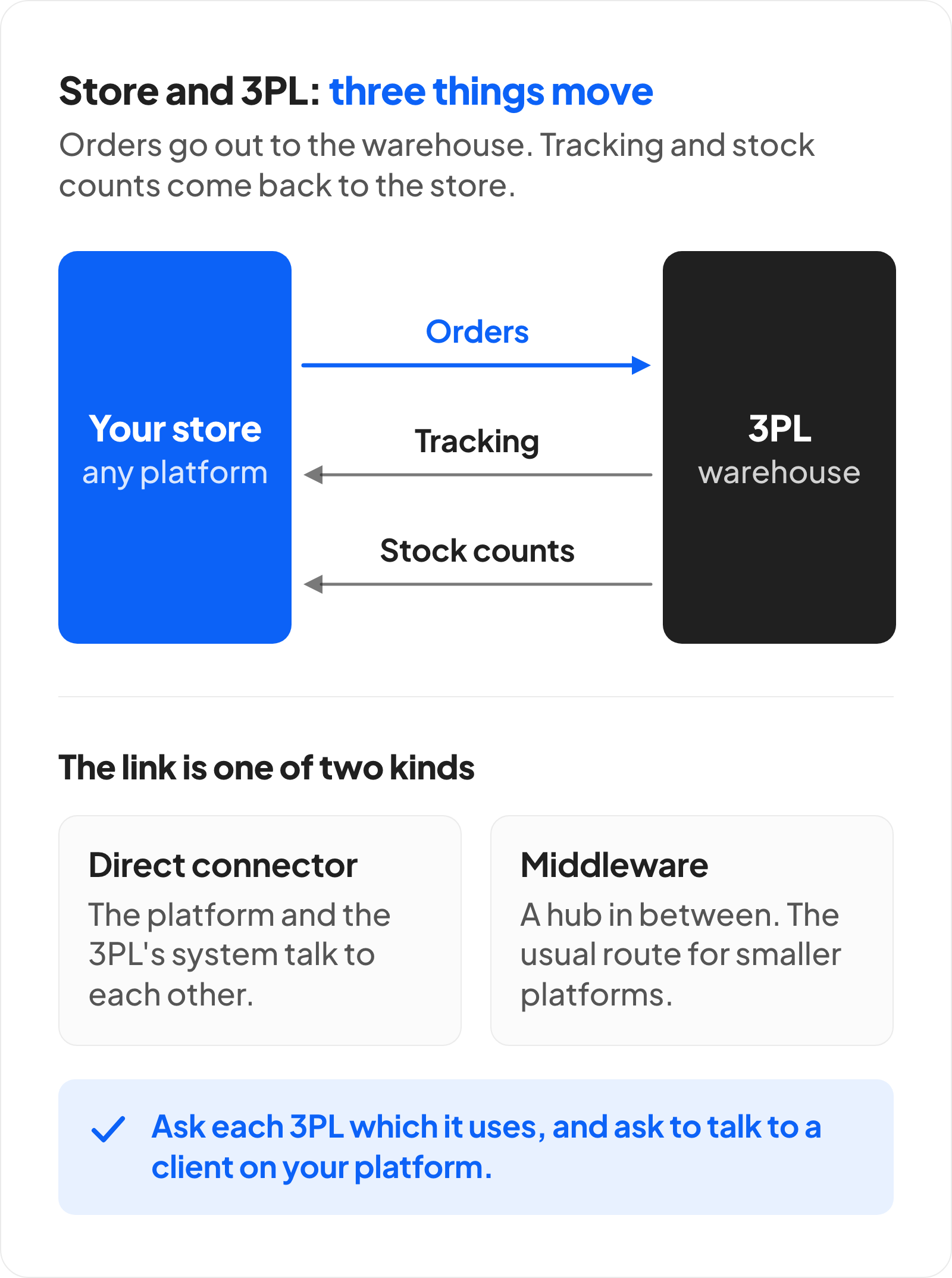
Will a warehouse connect to it? Once you ship more orders than you can pack yourself, the platform has to pass orders to a 3PL and take tracking and inventory back. Check this before you build the store, not after.
Connecting Your Store to a 3PL
When orders outgrow your spare room, the platform becomes the front end of a fulfillment operation. The store sends each order to the warehouse, the warehouse sends tracking back, and inventory counts have to stay in sync between the two. How easily that works depends on the platform. Fulfill.com lists providers by the platforms they connect to:
We do not have a dedicated page yet for Shift4Shop (3dcart), PrestaShop, OpenCart, Ecwid, Volusion or Weebly. For those, ask each 3PL whether it has a direct connector to your platform or works through middleware, and ask to talk to a client that runs the same platform.
Middleware is the usual route for the smaller platforms. Pipe17 connects storefronts to 3PLs and ERPs through more than 300 connectors it maintains, and it handles order routing and inventory visibility. Its integration list covers Shopify, BigCommerce, Magento, WooCommerce, Wix, Squarespace, PrestaShop and Ecwid.
If you still ship in-house from ShipStation, the step before a 3PL is often automating the shipping decisions your team makes by hand. String builds and maintains rate selection, box selection and warehouse routing rules inside an existing ShipStation account, so your team keeps working in ShipStation.
Choosing the right ecommerce platform is just one piece of the puzzle. To truly optimize your operations, you need the best apps and tools tailored to your brand's needs. That’s where 1800DTC comes in.
As the go-to directory for DTC brands, 1800DTC helps businesses discover and connect with the industry’s top tools, services, and platforms. Whether you’re looking for marketing automation, fulfillment solutions, or analytics software, 1800DTC simplifies the search and ensures you find the perfect fit to scale your operations.
FAQ
Which ecommerce platform is best for a small business?
It depends on what you sell and who will maintain the site. For a hosted store selling physical products, Shopify and BigCommerce have entry plans, app ecosystems and 3PL connections to grow into. If you already run WordPress, WooCommerce avoids a platform subscription. For a small catalog, Weebly has a $0 plan and Ecwid Starter is $5 a month billed yearly, and Sellfy fits digital products.
What is the cheapest ecommerce platform to start with?
By published price, Weebly has a $0 plan with a shopping cart, and Ecwid Starter is $5 a month billed yearly for up to 10 products. WooCommerce, OpenCart and PrestaShop Classic charge no platform subscription, but you pay for hosting and extensions. Check transaction fees as well as the monthly price: Squarespace Basic and Webflow Standard each take 2% of online sales.
Do ecommerce platforms charge transaction fees?
Some do. Squarespace Basic and Webflow Standard charge 2%, and Shopify and BigCommerce add a fee when you use a payment provider outside their own or embedded options. Ecwid and Sellfy say they charge none, though Sellfy may charge 2% on sales above your plan's cap if you do not upgrade. Card processing is a separate cost on every platform; on the entry plans of Shopify and Squarespace it starts at 2.9% plus 30 cents.
Which ecommerce platforms work with 3PLs?
Fulfill.com lists 3PLs that connect to Shopify, BigCommerce, WooCommerce, Magento, Squarespace and Wix (see the 3PL section above). For other platforms, ask the 3PL directly or connect through middleware such as Pipe17.
Next Steps for Scaling Your Brand
Choosing the right ecommerce platform is essential for the success of your online store. Each platform offers unique features and benefits tailored to different business needs. Whether you're a small business owner looking for an affordable and easy-to-use solution, a creative professional seeking a visually appealing store, or an enterprise-level brand needing advanced customization and scalability, there's an ecommerce platform that fits your requirements.
As you compare platforms, consider your business goals, technical expertise, and budget when selecting an ecommerce platform. With the right choice, you can create a powerful online presence that drives sales and growth for your business.
Once you've chosen the perfect ecommerce platform, the next step is ensuring your logistics and fulfillment processes are seamless. Partnering with a reliable third-party logistics (3PL) provider can significantly enhance your operational efficiency and customer satisfaction. At Fulfill.com, we specialize in connecting ecommerce brands with top-tier 3PL providers tailored to your specific needs.
Don't let logistics be a bottleneck in your growth journey. Visit Fulfill.com today to find the perfect 3PL partner and take your ecommerce business to the next level. Your success is just a click away!
Get 3PL Insights in Your Inbox
Insights on choosing a 3PL, evaluating fulfillment partners, and scaling your eCommerce operation, from the team behind Fulfill.com.
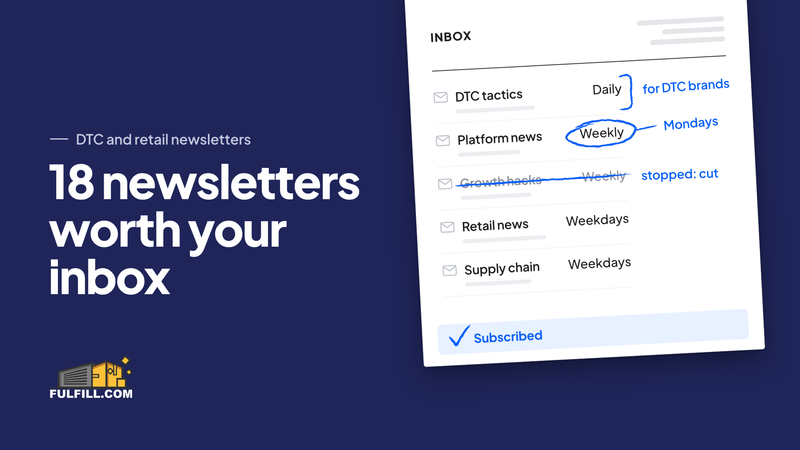
18 ecommerce newsletters for DTC and retail brands, from DTC Newsletter and Shopifreaks to Retail Dive, with how often each one sends and who it is for.
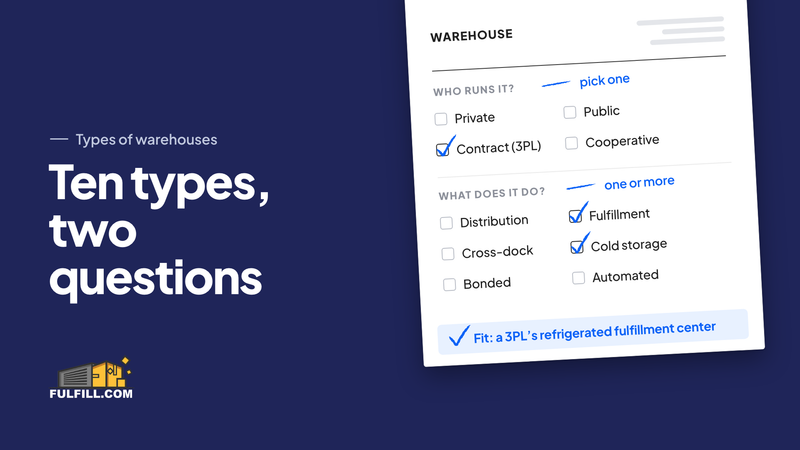
The 10 main types of warehouses in logistics, from private, public and 3PL to distribution, fulfillment, cold storage and bonded, and what each one does.