Both models put your inventory in a provider's warehouse, worked by the provider's people. What differs is who the
operation is set up for, how it is priced, and how long you commit to it. This guide sets contract warehousing and a
shared 3PL side by side, using the definitions and annual reports of companies that run contract operations, then
shows what volume the 3PLs on Fulfill.com say they take on, from their own profiles.
What is contract warehousing?
The term is used in two ways. Broadly, any warehouse a 3PL runs for you under a service agreement can be called a
contract warehouse, which is how Fulfill.com's guide to warehouse types uses it. In the narrower sense this guide uses,
contract warehousing is the warehousing side of contract logistics. GEODIS defines contract logistics as the
long-term outsourcing of warehousing and distribution, including facility design, labor, IT systems and value-added
services, to a specialist provider that commits to service-level and cost targets under a multi-year agreement. A
contract warehousing agreement bundles four things:
Space. A warehouse, or part of one, set up and run for your operation. The provider supplies it,
and GEODIS notes it can be dedicated or shared.
People. The provider recruits and trains the workforce that runs your operation.
Systems. The provider implements a warehouse management system (WMS) and any automation the
operation uses.
Targets. Service levels and KPIs, such as on-time shipping, inventory accuracy and cost per order,
defined jointly with you and written into the agreement.
Contract logistics is the wider term. DHL describes it as long-term cooperation between a company and a logistics
provider, based on a division of labor and governed by a service agreement, and its list of what such a provider
handles runs from supply chain design and warehousing to transportation, distribution and order processing. A contract
logistics provider may run your transport as well as your warehouse; contract warehousing is the part that happens
inside the building.
The building itself can be the provider's or yours. GXO, which describes itself as a contract logistics provider,
reported that 479 of the 1,043 facilities it operated at the end of 2025, offices included, were owned or leased by its
customers, and that its warehouse leases generally align with the length of its customer contracts. If you are weighing
a lease of your own against outsourcing, see what renting a
warehouse costs next to using a 3PL.
How is contract warehousing different from a shared 3PL?
A shared 3PL, also called a multi-client warehouse, runs many brands through the same building. The 3PL supplies the
building, the staff, the equipment and the software, and each brand pays for the space and services it uses instead of
signing a lease of its own. Some providers sell both models: Ryder's annual report lists dedicated distribution and
multi-client distribution as separate offerings.
Contract warehousing and a shared 3PL on the five points where a brand feels the difference.
Space. Under a contract, the building or zone is run for your operation. In a shared building your
stock sits beside other brands' stock, and you pay for the space you use, by the pallet or the cubic foot.
Labor. A contract provider staffs your operation with a team it recruits and trains for it. A
shared 3PL's staff work across its clients, and its warehouse management system keeps each brand's orders and stock
apart.
Systems. A contract operation gets a WMS, processes and automation set up for its products and
orders. A shared 3PL runs its clients on the software it supplies.
Pricing and commitment. A contract is priced to cover an operation built for you, over a term of
years. A shared 3PL bills each activity at a unit rate and can run on much shorter terms. The next two sections take
each in turn.
How is contract warehousing priced?
GEODIS describes the typical mix as fixed facility and management fees plus variable rates per pallet, order line or
labor hour. GXO's annual report names the two contract types behind that mix. Under a fixed-price contract, which GXO
calls closed book or hybrid, the provider agrees to perform the specified work for a pre-determined price. Under a
cost-plus contract, which it calls open book, the client pays the allowable costs incurred plus a specified margin. An
open-book contract is one in which the provider discloses its costs and margin
to the customer.
Most of GXO's customer contracts carry both a fixed component, typically designed to cover warehouse, technology and
equipment costs, and a variable component based on expected volumes and labor costs. Ryder describes the same range
for its supply chain contracts: fixed and variable billing rates, cost-plus billing rates, or variable-only or fixed-only
rates.
A shared 3PL prices by the unit instead: per order picked and packed, per additional item, per pallet or cubic foot
stored each month, per pallet received, and per labor hour for some work. The 3PL pricing
guide sets out each unit with current benchmark ranges. Each brand pays for the space and services it uses, which
is why shared space suits most small and midsize brands.
What does each model ask you to commit?
Time, mostly. GEODIS puts typical contract logistics terms at three to seven years: shorter terms suit fast-growth
ecommerce brands that want flexibility, and longer ones justify automation investments. The term follows the provider's
own commitments. GXO says its warehouse leases generally align with contract length, that it often bills customers over
the expected length of the relationship for the shelving, racking and other systems it puts in for them, and that it
could take a significant loss on the unrecovered part if a customer defaults.
A shared 3PL works the other way round. Ryder makes real estate commitments for its multi-client warehouse network
based on the demand it expects, and says that if demand is lower than expected it may have excess capacity. In a shared
building the provider carries the risk of empty space; in a contract operation, your term carries it. A 3PL may provide
warehousing month to month, as GEODIS notes, and its floor, if it sets one, is a monthly minimum: the amount you pay
whether or not your volume covers it.
The clauses that set your commitment in either model, from the initial term and renewal to notice, termination and
liability, deserve a line-by-line read before you sign. The 3PL contract
guide walks through each one.
Is there a middle ground between dedicated and shared?
Yes. The line between the models runs through buildings, not only between them. GEODIS notes that a contract
provider's warehouse can be dedicated or shared, and Fulfill.com's guide to what a 3PL is
notes that larger clients of a shared 3PL can get dedicated space or a dedicated team. Some providers sell both side by
side: Ryder offers dedicated and multi-client distribution, and Kuehne+Nagel's U.S. warehousing page lists dedicated
and shared fulfillment operations.
Two more options sit at the flexible end. On-demand warehousing lets a
business rent warehouse space as and when it needs it, rather than committing to long-term leases, which suits seasonal
peaks. And a brand that needs stock in several regions can spread it across warehouses in different locations, an
approach called multi-warehousing, and choose the model site by site.
What volume do 3PLs on Fulfill.com say they take on?
Most set no minimum, or one in the low hundreds of orders a month. A 3PL on Fulfill.com can state the lowest
and highest monthly order volume it takes on, and its profile shows the range. On November 1, 2026, 469 profiles showed a monthly order range. Of those, 212 (45%) set no
minimum: 159 take any volume and 53 state only a maximum. The other 257 set a minimum, and the median minimum was 250
orders a month. In all, 355 of the 469 (76%) set no minimum or one below 400 orders a month, and 59 (13%) start at 1,000
orders a month or more. A brand shipping 400 orders a month meets the stated minimum of four in five of
them.
The smallest monthly order volume each 3PL says it takes on, as its Fulfill.com profile shows it. A 3PL that takes any volume, or states only a maximum, counts as no minimum.
Storage reads the same way: of 571 profiles that showed a range of pallet positions, 334 (58%) set no minimum, and
the median minimum among the other 237 was 10 pallets.
These are the 3PLs' own statements, not audited figures, and a volume minimum is not a price: a 3PL that takes any
volume may still charge a monthly minimum fee. Nor do they say whether a 3PL runs shared or dedicated operations.
One dedicated service shows up in the profile data: a dedicated fleet. Ryder's dedicated transportation
business supplies dedicated vehicles, professional drivers, management and administrative support, the transport side
of the same idea. Among 3PLs whose Fulfill.com directory cards carry the Enterprise size label, 43 of 243 (18%) list a
dedicated fleet on their profiles, against 78 of 1,013 labeled Mid-Market (8%) and 64 of 1,284 labeled Boutique (5%).
The label describes the provider's size, not its contract model, so read these as who lists the service, not as a
count of contract warehouses. You can compare enterprise 3PLs and 3PLs that run
domestic FTL and LTL freight in the directory.
Which model fits your business?
Contract warehousing tends to fit when:
Volume is high and steady. The fixed component is owed whatever you ship, so a dedicated operation
pays off when there is enough volume to keep it busy for the whole term. Ryder prices its supply chain contracts on
assumptions that include production volumes and the mix of fixed versus variable costs.
The work needs special handling or strict security. Those, with high volume, are the cases the
guide to what a 3PL is gives for dedicated space.
You want automation or a facility designed around your products. Longer terms are what justify
automation investments, in GEODIS's account.
You want to see the numbers. Jointly defined KPIs and, under an open-book contract, the provider's
costs and margin.
A shared 3PL tends to fit when:
Volume is small, growing or seasonal. You pay for the space and services you use, and GEODIS adds
that shorter terms suit fast-growth ecommerce brands that want flexibility.
You cannot forecast far ahead. A month-to-month arrangement is easier to change than a term of three
to seven years.
You would rather not carry fixed cost. Unit rates move with your orders.
Questions that settle it:
How many orders and pallets will you ship each month, and how sure is that forecast across a multi-year term?
Does your product need handling, security or a process a shared floor does not offer?
Would you rather pay fixed fees for capacity or unit rates for activity?
If the contract is cost-plus, which costs are allowable and how is the margin set? If it is fixed-price, what volume
and scope does the price assume?
Who pays for equipment and space bought for your operation if you leave early?
For a shared 3PL: is there a monthly minimum fee, and what volume range does the 3PL say it takes on?
Contract warehousing FAQ
What is the difference between contract logistics and a 3PL?
A 3PL may provide warehousing transaction by transaction, even month to month. Contract logistics is a multi-year
arrangement with a facility, IT, labor and KPIs set up for one client. Some providers offer both.
How long does a contract warehousing agreement last?
GEODIS puts typical contract logistics terms at three to seven years. Longer terms let a provider recover investments
such as automation, shelving and racking over the life of the contract.
Is contract warehousing cheaper than a 3PL?
Neither model is cheaper by default. A dedicated operation's fixed fees are owed whatever you ship, so its cost per
order falls as volume rises. Shared unit rates move with your activity, which is why shared space suits most small and
midsize brands.
What is an open-book contract?
A cost-plus contract in which the provider discloses its costs and margin. GXO describes its cost-plus contracts as
paying the allowable costs incurred plus a specified margin, and its fixed-price contracts as closed book or
hybrid.
Can a dedicated operation run inside a shared warehouse?
Yes. GEODIS notes that a contract provider's warehouse can be dedicated or shared, and Fulfill.com's guide to 3PLs
notes that larger clients of a shared 3PL can get dedicated space or a dedicated team.
Do 3PLs have minimum order volumes?
Many do not. Of 469 Fulfill.com profiles that showed a monthly order range on November 1, 2026, 212 set no minimum.
Among the 257 that set one, the median was 250 orders a month.
How do you find a 3PL that takes on your volume?
Once you know your volume and handling needs, you can tell Fulfill.com what you ship and get
matched with 3PLs that take it on.
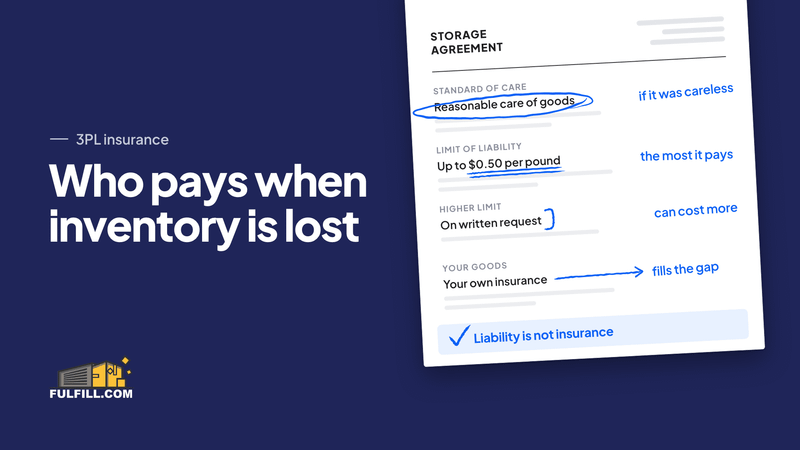
A 3PL is liable for lost or damaged stock if it failed to take reasonable care, up to your agreement's cap. What warehouse legal liability covers, and the gap.