How Much Does It Cost to Rent a Warehouse in 2026?
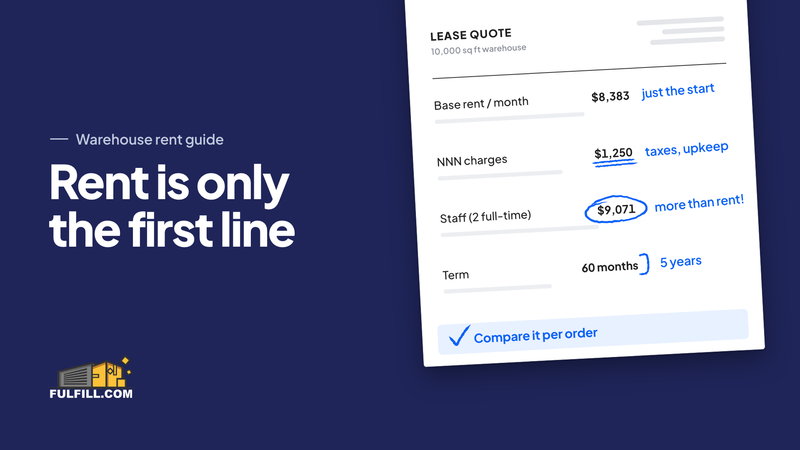
Average U.S. warehouse asking rent was $10.06 per sq ft a year in Q3 2026, plus NNN. Rent by market, the full monthly cost, and when a 3PL costs less.
Choosing a 3PLOctober 23, 202611 min read
 Fulfill Team·October 29, 2026·Add Fulfill as a preferred source on Google
Compare the work each operation performs; a single building can support more than one column.
| Comparison | Warehouse | Fulfillment center | Distribution center |
|---|---|---|---|
| Main job | Hold goods | Fill individual customer orders | Move bulk inventory onward |
| Who it ships to | Depends on its outbound services | Consumers; sometimes B2B accounts | Stores, wholesale accounts or other warehouses |
| Typical order or shipment | Stock released as needed | Individual packed order | Cases or pallets |
| How long stock stays | Longer-term holding | Until needed for customer orders | Short-term holding between movements |
| Typical user | Businesses needing storage | Online sellers | Retailers, wholesalers and manufacturers |
A warehouse is a building for keeping goods safe until someone needs them. Storage is the broad function, and the other two facility types build on it. A warehouse might hold seasonal stock, overflow inventory, materials for production or finished goods waiting to be sold. It releases them when the owner calls for them, and what it ships, and to whom, depends on the outbound services it offers. For the many kinds of storage building, see our guide to the types of warehouses.
A fulfillment center is organized around individual customer orders. Each online order becomes its own packed parcel, addressed to one person and handed to a carrier. Inventory is kept ready for those orders rather than held for the long term. Many fulfillment centers also take back returns, check what comes in and put sellable items back into stock. Online sellers are the typical users, and some fulfillment centers also ship orders to business accounts.
A distribution center holds stock for a short time while moving it on to where it is needed next. Its outbound shipments usually go to stores, wholesale accounts or other warehouses, packed as cases or loaded on pallets rather than sent as single orders. Throughput, the pace at which goods pass through the building, matters more than how long they stay. Retailers, wholesalers and manufacturers use distribution centers to keep stores and accounts supplied.
The main difference is the outbound order. A fulfillment center is organized around individual customer orders. A distribution center is usually organized around replenishing stores, supplying wholesale accounts or moving stock to other warehouses. Both receive and hold inventory. Their main job differs once that inventory leaves storage.
Start with the recipient. If your website sends an order to a customer's home, you need the picking, packing and parcel shipping that a fulfillment center provides. If a retail account needs cases or pallets of stock, you need a facility that can prepare bulk shipments. The label on the building is less useful than the work it performs.
Next, look at the unit being handled. A consumer order calls for the items in that order to be selected and packed for the customer. A store replenishment shipment moves stock in bulk. This is why a facility designed around pallets should not be assumed to support individual consumer orders. Ask the operator to explain how it handles each order type you send.
Storage does not settle the comparison. Fulfillment centers keep inventory available for online orders. Distribution centers hold stock while moving it onward, with throughput as their main purpose. Neither label gives you a fixed storage period or a delivery promise.
The distinction is a starting point, not a rule that every building does only one job. Some fulfillment centers also handle B2B orders, and a distribution building can include a separate ecommerce operation. If your brand sells through both channels, show providers examples of your customer orders and retail shipments. Confirm that the proposed operation supports both before deciding whether you need separate facilities.
The question is whether your goods mainly sit or mainly move. A warehouse is built to hold stock until its owner needs it. A distribution center is a warehouse with a distribution function: inventory arrives, stays briefly and leaves in bulk for stores, wholesale accounts or other facilities.
For a brand, that makes the choice about flow rather than floor space. Stock you will not sell soon, such as seasonal goods or a production run bought ahead, needs storage. Retail accounts you supply on a schedule need a building that turns stock around and ships cases or pallets, which is the work a distribution center is set up for. If you have both kinds of stock, ask whether one site can run both, or whether the provider splits them between buildings.
A warehouse answers a storage requirement. A fulfillment center answers an order requirement: it turns each online order into a packed parcel for one customer. From the outside the two can look the same, with racking, a dock and inventory inside. The difference is the work done on the way out.
An online seller that keeps its stock with a provider needs both, which is why providers often sell warehousing and fulfillment together: stock is stored in the building it ships from, ready to pick when an order arrives. When you talk to a 3PL warehouse, ask how much of the operation runs individual orders and how much is storage alone. A building run mainly for long-term storage may not be staffed or laid out for a steady flow of small orders.
Walmart shows why the building name does not tell the whole story. In 2020, Walmart used space in 42 Regional Distribution Centers to create pop-up eCommerce Distribution Centers. Its account explains that RDCs traditionally sent pallets to stores, while the pop-up operations sent packages to customer homes. The example shows different outbound jobs sharing a building.
Amazon's facilities overview separates jobs another way. Sortable and non-sortable fulfillment centers pick, pack and ship customer orders. Receive centers take in inventory and allocate it to fulfillment centers. Sortation centers group orders by destination, while delivery stations prepare orders for last-mile delivery. Amazon does not call these facilities distribution centers on that page.
Of the 2,118 3PLs on Fulfill.com that list a fulfillment type, 1,111 list both DTC fulfillment and retail or wholesale fulfillment.

For a brand comparing 3PLs, the same distinction matters. A 3PL that lists both may run them in separate buildings, so ask whether the proposed building supports both workflows. Compare B2B and retail fulfillment with omnichannel fulfillment when your brand needs both.
Before you compare providers, write down what leaves the building for each sales channel. A short brief lets a provider say which of its facilities, and which workflows inside them, fit your orders.
For pricing, use our 3PL pricing guide. For the separate cost decision, read about renting a warehouse versus using a 3PL.
Amazon describes several facility types rather than using one label for every job. Its fulfillment centers pick, pack and ship customer orders. Receive centers allocate incoming inventory to fulfillment centers. Sortation centers group orders by destination, and delivery stations prepare last-mile orders. Amazon's facilities overview does not label these as distribution centers.
Walmart describes distribution centers as receiving, storing and distributing products to its stores. Its fulfillment centers store items that are picked, packed and shipped directly to customers. The distinction is the destination and order type. Walmart's pop-up ecommerce operations also show that these different jobs can share a building.
Show a provider examples of the individual orders going to consumers and the bulk shipments going to retail accounts. Ask it to explain how the proposed building handles each. Some fulfillment centers support B2B orders too, so confirm the work rather than assuming you need separate buildings for each channel.
No. These labels describe a facility's main function, but the work can overlap. A fulfillment center may also handle retail orders, and Walmart's pop-up example shows ecommerce work inside distribution buildings. Ask the operator which outbound order types it handles in the proposed facility before choosing it for your brand.
Start with your sales channels and the orders you need to ship. Tell us whether you need consumer parcels, retail shipments or both, and we will match you with 3PLs that fit. Fulfill.com is a free 3PL matchmaking platform for ecommerce brands.
Insights on choosing a 3PL, evaluating fulfillment partners, and scaling your eCommerce operation, from the team behind Fulfill.com.
No spam, ever. You'll get our newsletter; unsubscribe anytime.
Average U.S. warehouse asking rent was $10.06 per sq ft a year in Q3 2026, plus NNN. Rent by market, the full monthly cost, and when a 3PL costs less.
Choosing a 3PLOctober 23, 202611 min read
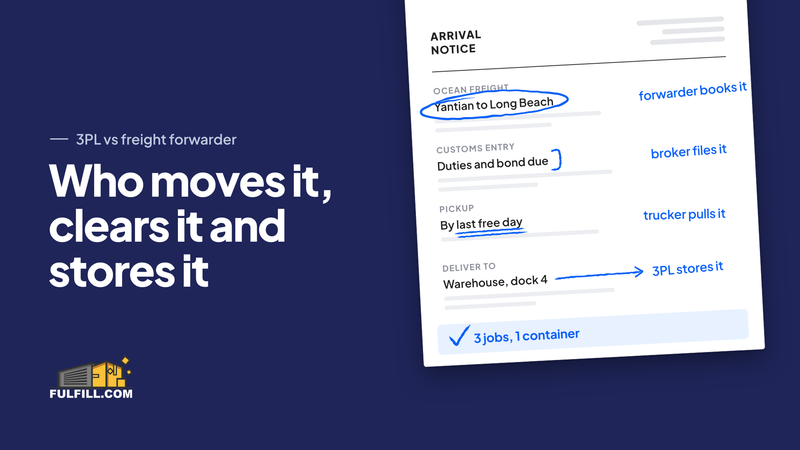
A freight forwarder books the move to a US port, a customs broker clears it, and a 3PL stores and ships it. The handoff, the costs, and network data.
Choosing a 3PLOctober 23, 202611 min read
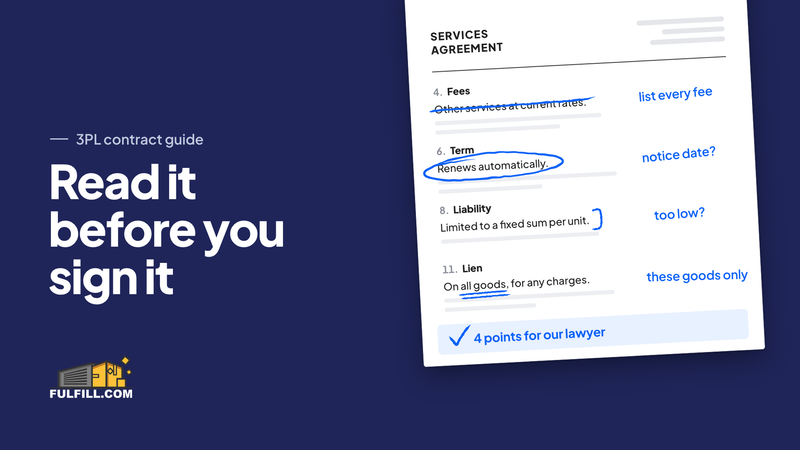
What a 3PL contract (or agreement) should cover, clause by clause, red flags to catch, plus a template to review with your lawyer.
Choosing a 3PLOctober 23, 202612 min read