The quote tells you the pick fee. The contract decides whether that fee can change mid-term, what the 3PL owes
you when it misses a ship date, and whether you can take your inventory with you when you leave. Those terms are
far easier to change before you sign than after.
This guide is for brands with a 3PL's draft agreement in hand. Earlier in the process? Start with
what a 3PL is, use our questions to
ask on first calls and our RFP template to
collect quotes you can compare, and build a longlist from our top 3PLs. Below: the
nine areas a 3PL contract should cover, the red flags to catch, what to ask for, and a checklist and term sheet for
your lawyer.
What a 3PL (fulfillment) agreement covers
A 3PL agreement often arrives as a main contract plus schedules: a fee schedule or rate card, a service level
agreement, and sometimes a statement of work or operating procedures. Read them as one document, because a promise
in one can be limited in another. Whatever the format, it should settle nine things.
Which state's law applies, and how a disagreement gets resolved
Then find the order-of-precedence clause in the boilerplate. It says which document wins when the main contract
and a schedule disagree.
3PL contract clauses, one by one
Scope of services
The scope is the list of work the 3PL has agreed to do. Anything outside it can be quoted later as extra work, so
a thin scope is where surprise charges begin. A complete one names:
Receiving: how your inbound stock arrives (parcel, pallet or container), what a standard receipt
looks like, and what happens to a shipment that arrives without paperwork.
Storage: the type of space (shelf, bin, pallet, climate controlled) and how it is measured.
Order fulfillment: which order types it covers, such as direct to consumer, wholesale or
marketplace orders, and whose packaging it uses.
Returns: what the 3PL does with a return: inspect, restock, refurbish or dispose, and how it
reports each one to you.
Kitting and special projects: bundles, inserts, relabeling, and how a new project is quoted.
Systems: the store, marketplace and carrier connections the 3PL will set up and maintain.
Ask for one more sentence: new work starts only after a written quote you approve.
Pricing and fees
The fee schedule should be attached to the contract and name every charge that can appear on an invoice, each
with its unit (per order, per item, per pallet, per hour) and what triggers it. Expect lines for receiving,
storage, pick and pack, packaging, returns, kitting, accessorial
charges and peak season surcharges.
Then settle who owns the carrier rates. If the 3PL ships on its own carrier accounts, the contract should say how
it bills you for postage: at its cost, at its cost plus a stated markup, or at a rate card it sets. If you ship on
your own accounts, it should say what the 3PL charges to use them. Finally, find the clause that says how and when
any rate can change, and how much notice you get.
For typical rates and where fees hide, see our 3PL pricing guide. If you want to see
the 3PL's own costs behind each rate, ask about an open-book contract.
SLAs and KPIs
The service level agreement turns the 3PL's sales promises
into commitments. For each metric, the contract should state the target, how it is measured (from which timestamp,
over what period, in whose system), how it is reported to you, and what you get when it is missed. Metrics worth
writing in:
Dock to stock: how soon received inventory is available to sell.
Ship time: the daily order cutoff, and the share of orders received by it that ship the same or
the next business day.
Order accuracy: the right items, in the right quantity, to
the right address.
Inventory accuracy: how closely the system count matches the shelf, checked by cycle counts.
Returns processing: how soon a return is inspected and back in stock or reported.
Response time: how quickly the 3PL answers your team's tickets and escalations.
Remedies make the targets mean something: service credits on the next invoice, a written corrective plan after
repeated misses, and the right to leave if misses continue (see term and
termination). Read the exclusions too. An SLA that is suspended during peak, after a late inbound shipment or
"for reasons beyond our control" should list those cases, not leave them open.
Liability and insurance
This clause decides what you recover when stock is lost, damaged or stolen in the warehouse. Under
UCC § 7-204, a warehouse is liable for loss or damage caused
by its failure to take reasonable care of your goods, and the storage agreement can cap that amount. The same
section lets you ask in writing, when you sign, for a higher limit on some or all of your goods, and lets the
warehouse charge more for it. States adopt the UCC with their own changes, and the version enacted by the state
whose law governs your agreement is the one that controls.
Read the cap closely: how it is calculated (per item, per pound or per incident), what value a lost item is
paid at, and how long you have to file a claim and with what proof. Some agreements also allow a level of
shrinkage before the 3PL pays anything; if yours does, check how it is measured
and over what period.
Indemnity should run both ways: the 3PL covers losses caused by its negligence or breach, and
you cover losses caused by your products.
Insurance: ask which policies the 3PL carries for goods in its care, then set what your own
policy must cover, since your inventory may be worth more than the 3PL's cap.
In transit: once a package leaves the dock, the carrier's
liability limits usually apply, unless your agreement keeps the 3PL responsible in transit.
Cargo insurance is how brands cover the gap.
Term, renewal and termination
Settle these before you sign; each one is harder to change later.
Initial term: how long you are committed, and whether an onboarding period comes before any
monthly minimum applies.
Auto-renewal: whether the contract renews itself, and for how long each time.
Notice: how notice to leave or not renew must be given (in writing, to whom, by what date).
Termination for cause: what counts as a material breach, and how long the other side has to fix
it.
Termination for missed SLAs: the right to leave without an early-exit fee after repeated misses
you have documented.
Exit transition: what the 3PL must keep doing while you leave: ship orders, release inventory and
hand over records.
Inventory and lien
The contract should state that you keep title to your inventory: the 3PL holds it for you and cannot use it as
its own. It should also set how stock is counted (cycle counts, a periodic full count) and let you request or attend
a count.
Under UCC § 7-209, a warehouse has a lien on goods in its
possession for unpaid storage, transportation, labor and related charges. Check whether the agreement claims a lien
for charges on all your goods; § 7-209 allows that only if the warehouse receipt or storage agreement says so. If
the charges stay unpaid, UCC § 7-210 lets the warehouse sell
the goods to satisfy the lien, after notifying you and anyone else known to claim an interest in them. The lien is
why the final invoice matters if you ever move; our guide on switching
3PLs covers planning for it.
Data ownership and export
Your order, inventory, returns and shipment records should belong to you by contract. Look for the right to
export them at any time and at exit, in a documented format your next system can import, at no charge or a stated
one. Also check that the 3PL may use your data only to serve you, that it must tell you promptly about a security
breach, and who owns any custom integration built for your account.
Confidentiality
The duty should be mutual: your pricing, product plans and sales data stay private, and so does the 3PL's rate
card. Check that it covers your customers' personal data, how long it lasts after the contract ends, and whether
the 3PL may name you as a client or show your logo.
Disputes and governing law
The contract names which state's law governs it, where disputes are heard, and the route there: talks between
named contacts first, then mediation, arbitration or court. A clause that sends every dispute to a court near the
3PL raises your cost of enforcing anything. Also look for a rule for the meantime: you pay the undisputed part of an
invoice, and the 3PL keeps shipping while the rest is resolved.
3PL contract red flags
Each of these is a sign that a clause above protects the 3PL and leaves you exposed.
Service levels with no remedy, or no stated way to measure them. A missed target costs the 3PL
nothing, and you cannot show it happened (SLAs and KPIs).
Auto-renewal with an easy-to-miss notice window. One missed date commits you to another full
term (term and renewal).
Fees the 3PL can change by notice alone. Your cost per order can rise mid-term with nothing to
negotiate (pricing and fees).
A small fixed liability amount per unit or per pound, and no claims process. A lost pallet is
paid at a fraction of what it cost you, if at all (liability).
Indemnity that only you give. You cover claims your products cause, and nothing makes the 3PL
cover claims its own errors cause (liability).
A right to hold all your stock for charges on any goods. One disputed invoice can freeze your
whole inventory (inventory and lien).
No right to audit invoices or count inventory. You cannot check what you are billed or what is
on the shelf (inventory).
Data export only in the 3PL's own format, or for a fee. Leaving means rebuilding your order and
stock history by hand (data).
Nothing on what happens while you leave. The 3PL has no duty to keep shipping or to release stock
on a schedule during the move (termination).
What to push for
These asks answer the red flags. Raise them with your lawyer, who can word them to fit the rest of the
agreement.
A performance exit. The right to end the agreement early, with no early-termination fee, after
repeated documented SLA misses that the 3PL has had a fair chance to fix.
A complete fee schedule. Every billable charge listed with its unit, and no new charge without
your written approval.
Invoice-audit rights. Line-item invoices you can tie to order and receiving records, a window to
dispute a charge, and the right to pay the undisputed part while a dispute is open.
Inventory-count rights. Scheduled cycle counts, the right to request or attend a count, and a
written reconciliation when counts differ.
A lien limited to the goods the unpaid charges relate to, rather than one over everything you
store.
A higher liability limit, if you need one. If your products are worth more than the cap, ask
for a higher limit in writing at signing, as § 7-204 allows, and price the higher rate.
An exit transition. A wind-down period in which the 3PL keeps shipping, releases inventory once
undisputed charges are paid, and works with the provider receiving it.
Data export on request. Your records in a documented format, at any time and at exit, at no
charge or a stated one.
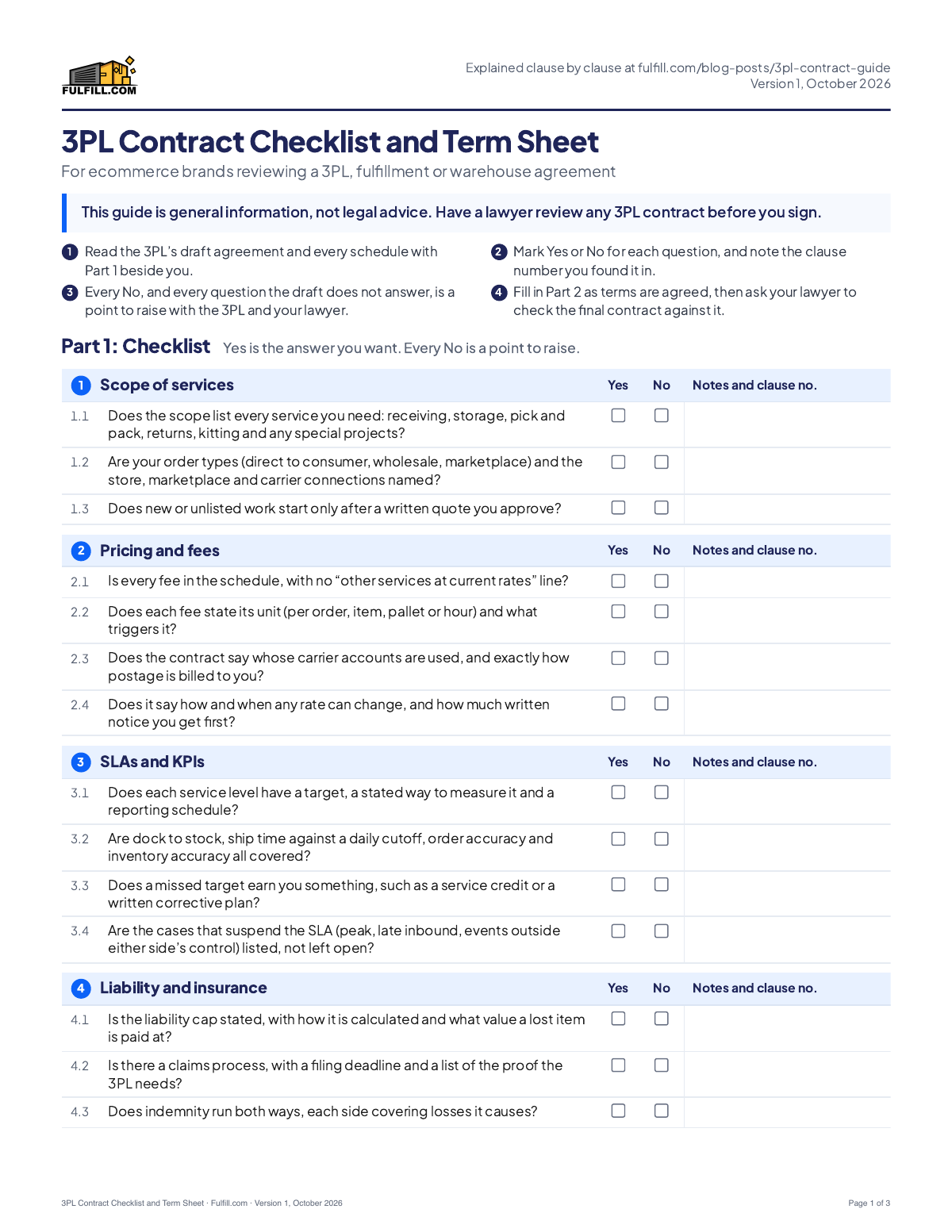
Download the 3PL contract template (checklist and term sheet)
One file, two parts. Part 1 is a checklist: 33 yes-or-no questions in nine sections that match
the clauses above, with room to note the clause number. Every No is a point to raise. Part 2 is a term
sheet: one page to record what you and the 3PL agree, from the parties and dates to the exit terms, so your
lawyer can check the final contract against it.
Page 1 of 3. The PDF prints on US Letter; the Word file is the same content to edit.
3PL contract FAQ
What is a 3PL agreement?
A 3PL agreement is the contract between a brand and a third-party logistics provider. It sets the services, the
fees, the service levels, who is liable for your inventory, the term, and how either side can end it. "3PL contract"
and "fulfillment agreement" usually mean the same thing.
What should a 3PL contract include?
Nine areas: scope of services, pricing and fees, SLAs and KPIs, liability and insurance, term and termination,
inventory and lien, data ownership and export, confidentiality, and disputes and governing law. Our checklist turns
each one into yes-or-no questions.
What is a 3PL service level agreement?
It is the part of a 3PL contract that sets measurable targets, such as ship time, order accuracy and dock to
stock, with how each is measured and what the 3PL owes you when it misses one.
Is there a 3PL contract template or example?
Yes: our free checklist and term
sheet, linked to the download section. It's a review aid, not a contract to sign. Have a lawyer draft or review
the final agreement.
Can a 3PL hold my inventory if I leave?
It may, if charges are unpaid. Under UCC § 7-209, a warehouse has a lien on goods it holds for unpaid storage,
transportation, labor and related charges on those goods. It can hold them for charges on your other goods only if
your agreement says so. Ask a lawyer.
What termination terms should it include?
Termination for cause with time to fix a breach, the right to leave after repeated SLA misses, a clear notice
date if the contract renews itself, and exit terms for your inventory and data. When you are ready to move, see
how to switch 3PLs.
Next step
Read the 3PL's draft with the checklist beside it, fill in the term sheet as you negotiate, and send both to your
lawyer with the draft. If you are still choosing a provider, find a 3PL that fits your
volume and channels first.
How we wrote this: the legal points follow the text of Article 7 of the Uniform Commercial Code (§§ 7-204,
7-209 and 7-210) as published by Cornell Law School's Legal Information Institute, read October 23, 2026. Each state
enacts the UCC as its own law, sometimes with changes, so ask your lawyer how the governing state's version applies
to your agreement.
Get 3PL Insights in Your Inbox
Insights on choosing a 3PL, evaluating fulfillment partners, and scaling your eCommerce operation, from the team behind Fulfill.com.
No spam, ever. You'll get our newsletter; unsubscribe anytime.
How Mercado Libre fulfillment works: Envíos Full, Flex and Global Selling by country, what each one costs, and where a 3PL fits for cross-border sellers.