The questions to ask a 3PL provider come down to seven: who they already serve, whether they have room for your volume and your peak, which systems you will use and who owns the data, what accuracy and speed they will commit to in writing, what you will actually pay, how they handle returns and things that go wrong, and how you review performance or leave. Ask each one openly, then ask for proof: a reference, a report, a sample invoice or a contract clause.
Below, each question comes with the follow-ups worth asking, what a strong answer sounds like, the red flags to listen for, and the point in the process where it belongs. Where a question has a measurable answer, you get an independent benchmark to hold it against, so you are not relying on the provider's own marketing.
The 7 Questions at a Glance
#
Question
Ask for this proof
1
Who do you serve today, and can I speak to two of them?
Client mix by product type and size, and two references with an order profile like yours
2
Do you have room for my volume and my peak?
Open capacity, minimums, and what last year's busiest week looked like
3
What systems will I use, and who owns my data?
A live demo of the client portal, the integration list and the data clause
4
What accuracy and speed will you commit to in writing?
Three months of measured KPIs and an SLA with credits for misses
5
What will I actually pay each month?
The full rate card and a sample invoice built from your real orders
6
How do you handle returns, damage, loss and disruption?
The returns workflow, shrinkage allowance, liability terms, insurance and continuity plan
7
Who is my contact, how do we review performance, and how do I leave?
A named account manager, the review cadence, and the term and termination clauses
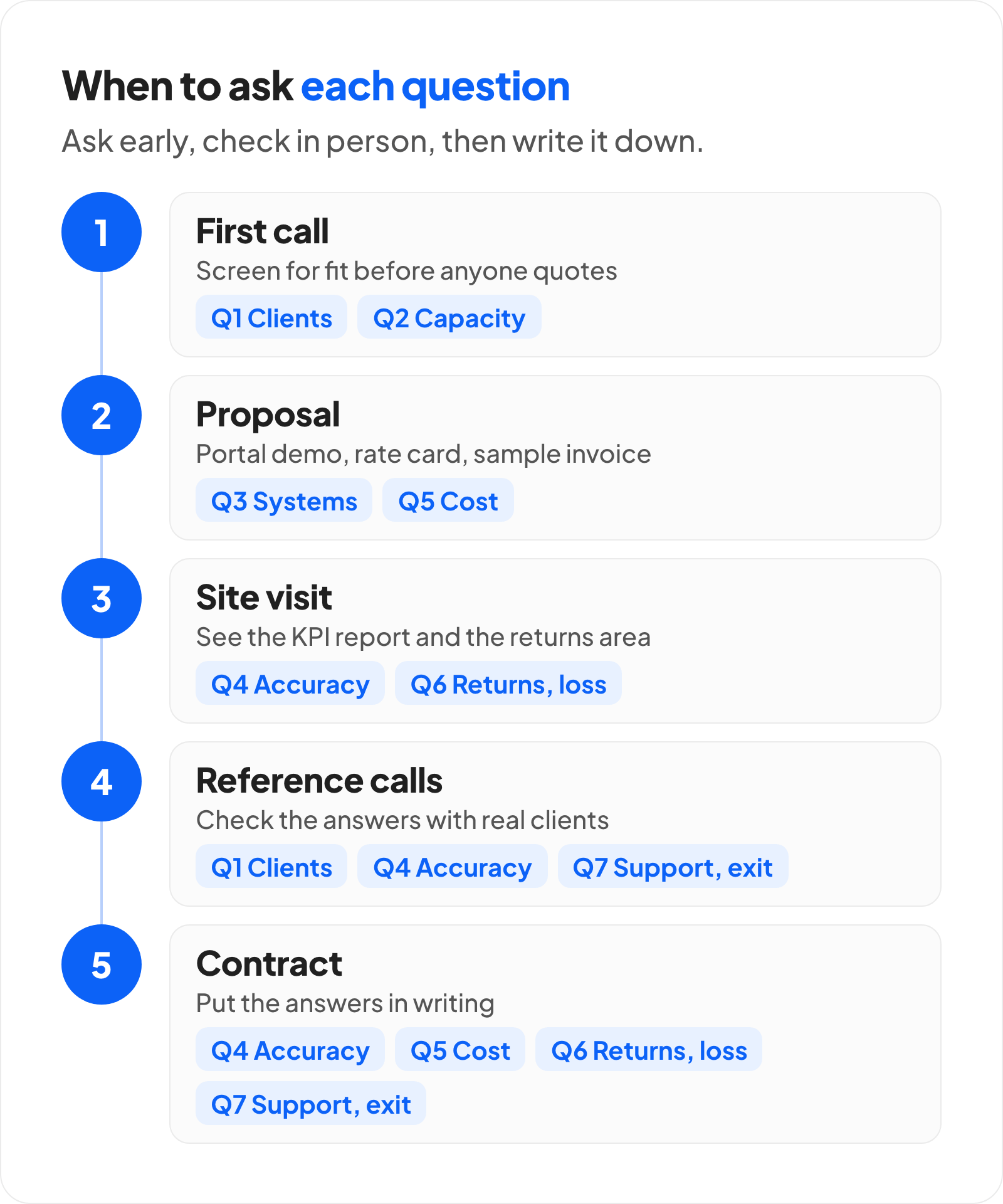
Not every question belongs in the first call. Some are best answered on a site visit, some by a reference, and some only in the contract.
Source: Fulfill.com editorial guidance for this article.
Before You Ask: What to Have Ready
A 3PL can only answer these questions well if it knows what it is quoting on. A 3PL contract is a long-term commitment and costly to unwind, so pull this together before the first call and send the same pack to every provider on your shortlist:
Order volume: orders per month, units per order, and your peak month compared with an average month.
Products: SKU count, dimensions and weights, and anything that needs special handling, such as temperature control, hazardous materials, lot or expiry tracking, fragile or oversized items.
Channels: your store platform and every marketplace you sell on, including any retail or wholesale (B2B) orders.
Customers: where your orders ship to, and the delivery speed you promise.
Extra services: value-added work such as kitting, inserts, custom labeling or re-palletizing.
Your targets: the metrics you want in the contract, such as order accuracy and same-day shipping.
If you are running a formal Request for Proposal (RFP), this pack becomes its data section.
1. Who Do You Serve Today, and Can I Speak to Two of Them?
Experience with products like yours matters more than size. A 3PL used to light apparel may not have the racking, equipment or trained staff for heavy, fragile, perishable or temperature-controlled goods, and a food or supplement brand may need a facility registered with the FDA. Ask about fit first, then ask for people who can confirm it.
Follow-up questions:
What share of your clients sell products like mine in size, weight, fragility or temperature needs?
How big is a typical client, in orders per month, and where would I sit in that range?
Is this a dedicated facility, or a public warehouse shared with many other clients?
Do you run this building with your own staff, or do you pass the work to another operator?
Which certifications or registrations do you hold for products like mine, and can I see the most recent audit?
Can I speak to two current clients with an order profile like mine, and to one that left in the past year?
A strong answer: names product categories and example clients like you, explains how they handled a specific problem for one of them, and offers references without being pushed.
Red flags: "we can handle anything", no references, or a client list made up entirely of brands far bigger than you (you may get little attention at peak) or far smaller (they may not have the systems you need).
2. Do You Have Room for My Volume and My Peak?
A 3PL should be able to grow with you, and to handle a Black Friday week without your orders slipping behind a bigger client's. It should also tell you what happens if your volume drops.
Follow-up questions:
How much open storage and pick space does this building have today?
What did your busiest week last year look like in orders shipped, and did every client's orders go out on time?
How do you staff peak: core team, temporary labor or both, and how are temporary workers trained?
When do you need my peak forecast, and what happens if I beat it?
Is there a monthly minimum fee or order minimum? Can I reduce my space in a slow season?
Can you split my inventory across more than one location as I grow? (This is called multi-node fulfillment.)
A strong answer: gives real figures from last peak, a written peak plan with forecast deadlines, and minimums stated up front.
Red flags: minimums that only appear in the contract, or no answer on how temporary staff are trained.
3. What Systems Will I Use, and Who Owns My Data?
You will run your business through the 3PL's software every day, so see it before you sign. The key checks are how your orders reach the warehouse, how quickly inventory counts update, and whether you can take your data with you.
Do you connect directly to my store platform and marketplaces, or through middleware or EDI? Who fixes a broken connection?
How often does the inventory in my portal update, and how often do you cycle count?
Can I pull orders, inventory and shipping data by API or scheduled report?
Does the contract say I own my data, and in what format do I get it if I leave?
A strong answer: a live demo on a real client account (with names hidden), a list of working integrations, and a clause that gives you your data on exit.
Red flags: integrations described as "on the roadmap", inventory that updates only once a day with no reason given, or no answer on data ownership.
4. What Accuracy and Speed Will You Commit to in Writing?
This is the question that separates providers. Ask for measured numbers from the WMS, not adjectives, and ask which of them the provider will put in a service-level agreement (SLA).
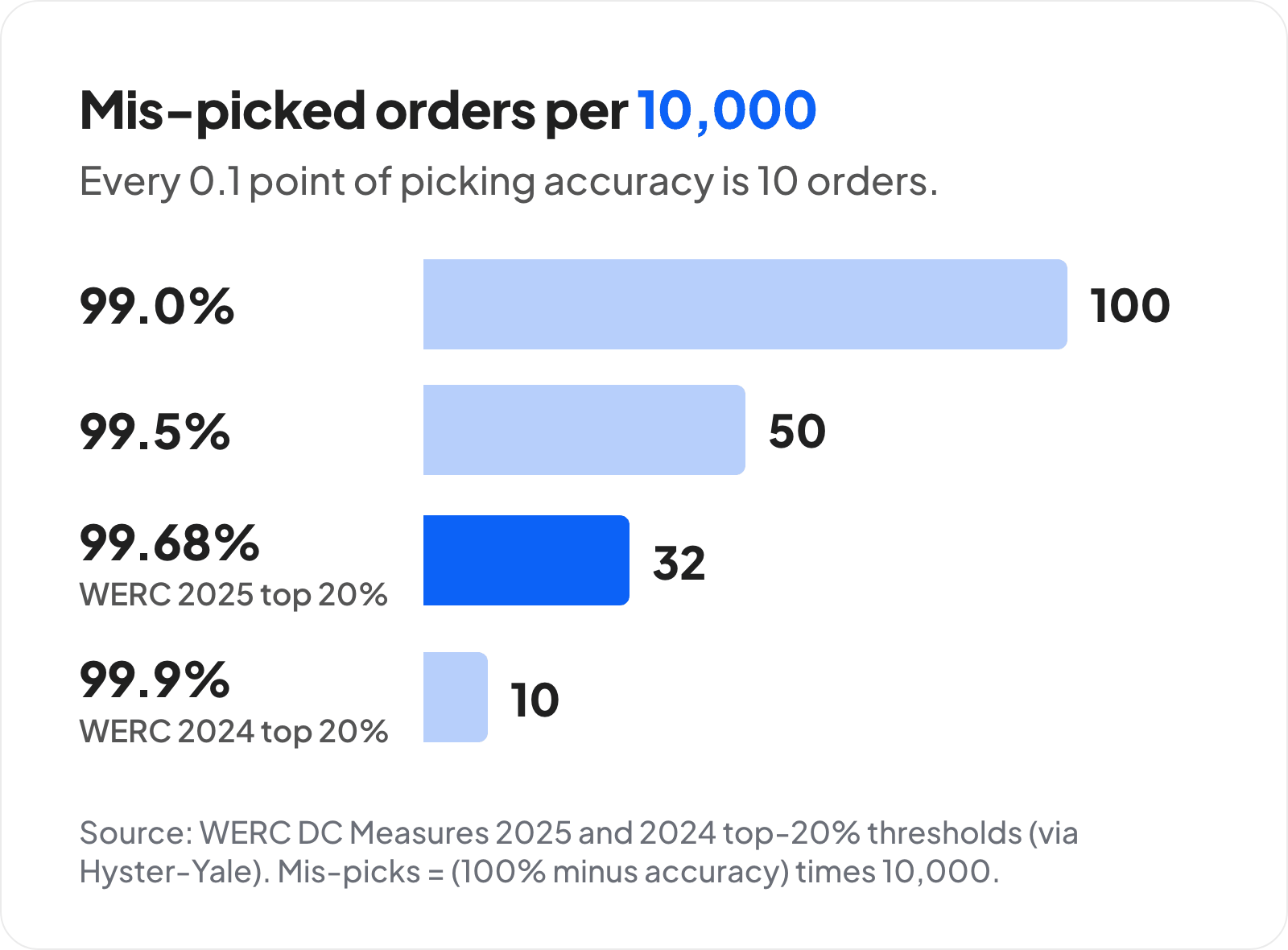
The Warehousing Education and Research Council (WERC) publishes yearly benchmarks from its DC Measures survey. In the 2025 report, these were the thresholds for the top 20% of respondents:
Order-picking accuracy: 99.68% or better
On-time shipments: 99.5% or better
Inventory count accuracy by location: 99.5% or better
Dock-to-stock cycle time (from arrival to put away and recorded in the system): under 3.5 hours
These cover warehouses of every kind, not only ecommerce 3PLs, so treat them as a yardstick for the conversation rather than a contract default. They are useful because they show how small the gaps look as percentages. At 10,000 orders, 99.0% picking accuracy means 100 mis-picked orders, and 99.68% means 32.
Source: WERC DC Measures Report 2025 and 2024 top-20% thresholds, as published by Hyster-Yale; mis-picked orders calculated as (100% minus accuracy) times 10,000.
Follow-up questions:
How do you define accuracy: per order or per line, and measured before shipment or from customer complaints?
What were your accuracy, on-time shipment and dock-to-stock numbers for the last three months, for clients like me?
What is your daily cutoff for same-day shipping, and does it change at peak?
Where are your warehouses, which carriers and service levels do you use, and how many days in transit by ground are most of my customers from your building?
Do you ship internationally, and who prepares the customs paperwork?
Which of these numbers will you write into the SLA, and what credit do I get when you miss one?
When an order ships wrong, who pays for the reshipment and the return?
If you sell on Amazon and want the Prime badge on orders you ship yourself, also ask whether the 3PL can meet Amazon's Seller Fulfilled Prime Standards and how it reports on them.
A strong answer: a per-client KPI report straight from the WMS, a clear definition of each metric, and targets in the SLA with credits attached.
Red flags: a round "99.9% accuracy" with no definition and no report behind it, or an SLA with targets but no remedy. Mistakes cost more than the reshipment; see the hidden costs of mis-shipments.
5. What Will I Actually Pay Each Month?
Headline pick and pack rates rarely match the final invoice. The way to compare providers fairly is to ask each one for the full rate card and a sample invoice built from the same month of your real orders.
Follow-up questions:
What are your fees for onboarding or setup, receiving (per pallet, carton or hour), storage (per pallet, bin or cubic foot) and long-term storage?
How is pick and pack charged: per order, per item, or both? What do packaging, inserts, kitting and returns processing cost?
Is there an account, technology or monthly minimum fee?
Do you pass carrier rates through at cost, or add a markup? How do you bill dimensional weight?
Which accessorial charges can appear, such as residential delivery, address correction or fuel surcharges?
How often can rates change, and with how much notice?
Once you sign, check each invoice line against the contract rate card, including the shipping charges. For typical fee ranges, see how much a 3PL costs, or model your own order profile with the fulfillment cost calculator.
A strong answer: an itemized rate card, a sample invoice without surprises, and every fee named in the contract.
Red flags: an "all-in" price the provider will not itemize, or fees that appear on the invoice but not in the contract.
6. How Do You Handle Returns, Damage, Loss and Disruption?
Returns are part of ecommerce, and inventory will sometimes go missing or get damaged. What matters is how fast returns are processed, who pays when stock is lost, and what happens when the building has a bad day.
Follow-up questions:
How are returns received, inspected, graded and restocked, and how quickly does restocked inventory show as available?
What is your shrinkage allowance, and how do you pay for inventory lost or damaged beyond it: at cost, at wholesale value or up to a cap?
What insurance do you carry, and will you share the certificate?
What security is in place: cameras, access control, background checks for staff?
What is your plan for a power outage, an internet failure, a weather event or a systems outage? Is there a second site?
If you import: can you receive goods held under bond or in a foreign trade zone?
A strong answer: a written returns workflow with target times, a shrinkage allowance and liability terms in the contract, and a continuity plan they can walk you through.
Red flags: liability capped at a small amount per unit regardless of product value, or no backup plan for power and internet.
7. Who Is My Contact, How Do We Review Performance, and How Do I Leave?
Good support resolves problems before customers notice them. Good contracts make the relationship easy to review and, if needed, to end. Ask about both before you sign, not after the first missed peak.
Follow-up questions:
Will I have a named account manager? What are support hours, and what is the escalation path for an urgent problem?
How will you tell me about a problem before I find it myself?
What reports will I get each month, and will we hold a quarterly business review?
How long have you been in business, and has the company changed ownership recently?
How long is the contract term, does it renew automatically, and what notice do I need to give?
Can I end the contract for repeated SLA misses? If I leave, how and how quickly is my inventory released, and at what cost?
A strong answer: a named contact with a backup, a regular review with KPIs you agreed in the SLA, and clear termination and inventory-release terms.
Red flags: support only through a ticket queue, automatic renewal with a long notice period, or exit fees that are not spelled out. If you are already planning a move, read how to switch 3PL providers.
How to Compare the Answers
Send the same questions to every provider on your shortlist, with the same data pack, so the answers are comparable. Fulfill.com's 3PL evaluation questions tool lets you filter a bank of questions by category and export them as a questionnaire.
Score each answer from 1 to 5 and weight the questions that matter most for your products, such as accuracy for fragile goods or storage cost for slow-moving stock.
Visit your finalists. Walk the floor, look at the returns area, and ask to see the KPI report on screen.
Call the references and ask them what went wrong and how it was fixed.
Negotiate the SLA and exit terms as hard as the price. They decide what happens when things go wrong.
Start with your data (volume, products, channels and where your customers are), shortlist providers that handle products like yours in the right locations, send them all the same questions, then compare measured performance, the full cost and the contract terms. Our guide on choosing a 3PL provider covers each step.
What should a 3PL contract include?
At minimum: the services in scope, the full rate card and how rates can change, an SLA with defined metrics and credits, liability and insurance terms for your inventory, data ownership, the term and renewal terms, termination rights, and how your inventory is released if you leave.
How do I measure a 3PL's performance after I sign?
Track the same metrics you wrote into the SLA every month: order accuracy, on-time shipments, dock-to-stock time and inventory accuracy, plus cost per order. Review them with your account manager each quarter. See how to evaluate your 3PL provider.
How much does a 3PL cost?
It depends on your order volume, product size and the services you use. Most 3PLs charge separately for receiving, storage, pick and pack, packaging and shipping, plus any minimums. See 3PL pricing for typical fee ranges.
When should a business start using a 3PL?
Common signs are running out of space, spending more time packing orders than growing the business, missing shipping deadlines, or needing to reach customers faster from more locations. Read more on when to engage a 3PL.
What is the difference between a 3PL questionnaire and an RFP?
A questionnaire is an early screen: a short set of questions to narrow a long list of providers. A Request for Proposal (RFP) comes later and is more formal: you share detailed order data and ask your shortlist for pricing, SLA commitments and contract terms you can compare line by line.
Find a 3PL That Fits
Asking the right questions is the difference between a 3PL that supports your growth and one you have to replace in a year. If you want help building the shortlist, use Fulfill.com's 3PL Finder to tell us what you ship and get connected with providers that match your products, volume and locations.
Get 3PL Insights in Your Inbox
Insights on choosing a 3PL, evaluating fulfillment partners, and scaling your eCommerce operation, from the team behind Fulfill.com.