3PL Contract Template & Guide: Key Clauses to Check
What a 3PL contract (or agreement) should cover, clause by clause, red flags to catch, plus a template to review with your lawyer.
Choosing a 3PLOctober 23, 202612 min read
 Fulfill Team·October 23, 2026·Add Fulfill as a preferred source on Google
Most importing brands need all three jobs done, but not always three companies. Some forwarders run warehouses, some 3PLs book ocean freight, and some forwarders are licensed customs brokers too. Know which job each company does for you, because the handoffs between them, at the port and the warehouse dock, are where delays turn into charges.
We checked how much import work the 3PLs on Fulfill.com take on themselves. Of the 2,701 3PLs with a profile on Fulfill.com, 771 list at least one port handoff service (port drayage, container devanning or transloading), and 411 list at least one of ocean freight, air freight or end-to-end import. Providers list their own services, so read these counts as floors.
| Freight forwarder | Customs broker | 3PL | |
|---|---|---|---|
| Main job | Books and manages international freight | Clears your goods through US Customs | Receives, stores and ships your inventory |
| Paperwork it owns | Booking, bill of lading or air waybill, arrival notice | Customs entry, entry summary, often the Importer Security Filing | Receiving report, inventory records, outbound tracking |
| What you pay it for | Freight, plus origin, documentation and destination charges | A fee per entry, plus the duties and fees it pays CBP for you | Unloading, receiving, storage, pick and pack, and order shipping |
| Credential to ask for | Its FMC license number, if it is a US company handling ocean freight | Its CBP customs broker license | Its insurance certificate, and any certification your goods need |
| You need one when | You buy from abroad and your supplier does not deliver to your door | You do not file your own customs entries | You would rather not store and ship orders yourself |
A freight forwarder sells you a route, not a vehicle. It usually owns no ships or planes. It books space with ocean and air carriers, combines smaller loads into shared containers, prepares the shipping documents and tracks the cargo until it lands. A typical forwarder handles:
A US company that acts as an ocean freight forwarder or a non-vessel-operating common carrier needs a license from the Federal Maritime Commission (46 CFR 515.3). An NVOCC is a carrier that does not operate the ships it uses (46 CFR 515.2). Ask any US forwarder that handles your ocean freight for its FMC license number.
Who hires the forwarder depends on the Incoterms in your purchase order, so ask your supplier which one applies before anyone books a container. If you import a few pallets at a time, ask for LCL (less than container load) quotes: the forwarder ships your cartons in a container shared with other importers.
A customs broker is licensed by US Customs and Border Protection (CBP) to transact customs business for other people (19 CFR 111.2). For an importing brand, that comes down to four jobs:
Ocean cargo has a deadline before the ship leaves: the Importer Security Filing must reach CBP no later than 24 hours before the goods are loaded aboard the vessel at the foreign port (19 CFR 149.2). The importer or its agent, often the broker or forwarder, files it, so they need your supplier's details early.
You do not have to use a broker: an importer can file its own entries without a license (19 CFR 111.2). Either way, the importer of record, usually your company, must use reasonable care in what the entry declares, whether it files itself or through an agent it authorizes in writing (19 U.S.C. 1484). Low-value shipments used to enter without duty under the de minimis exemption, Section 321. That exemption is suspended; our Section 321 guide covers what importers do now.
A 3PL (third-party logistics provider) takes over at its warehouse door: receiving, storage, picking, packing, shipping orders and returns. For an importer, the useful 3PLs also handle the awkward part of arrival, like unloading containers packed with loose cartons and booking the truck from the port. Here is how many 3PLs on Fulfill.com list each import service.
| Service | 3PLs | What it means |
|---|---|---|
| Cross-docking | 710 | Moving goods from inbound to outbound trucks with little or no storage |
| Container devanning | 439 | Unloading a shipping container at the warehouse |
| Port drayage | 395 | Trucking the container between the port and the warehouse |
| End-to-end import | 258 | Managing the import from origin to the warehouse |
| Freight consolidation | 250 | Combining smaller shipments into fuller loads |
| Air freight | 156 | Arranging air shipments |
| Ocean freight | 137 | Arranging ocean shipments |
| Transloading | 66 | Moving goods from an ocean container into a domestic trailer |
Two numbers stand out. Only 66 list transloading, the move that sends an ocean container back to the carrier fast. And only 87 list both port drayage and container devanning, so do not assume the company that pulls your container from the port also unloads it. Plan that handoff on purpose.
On certifications, 269 list a bonded warehouse, 85 list C-TPAT and 16 list a foreign-trade zone. Our guide to bonded warehouses and foreign-trade zones explains how the two differ.
This is where the three roles meet, and where delays start to cost money. Here is the order of events for an ocean container.
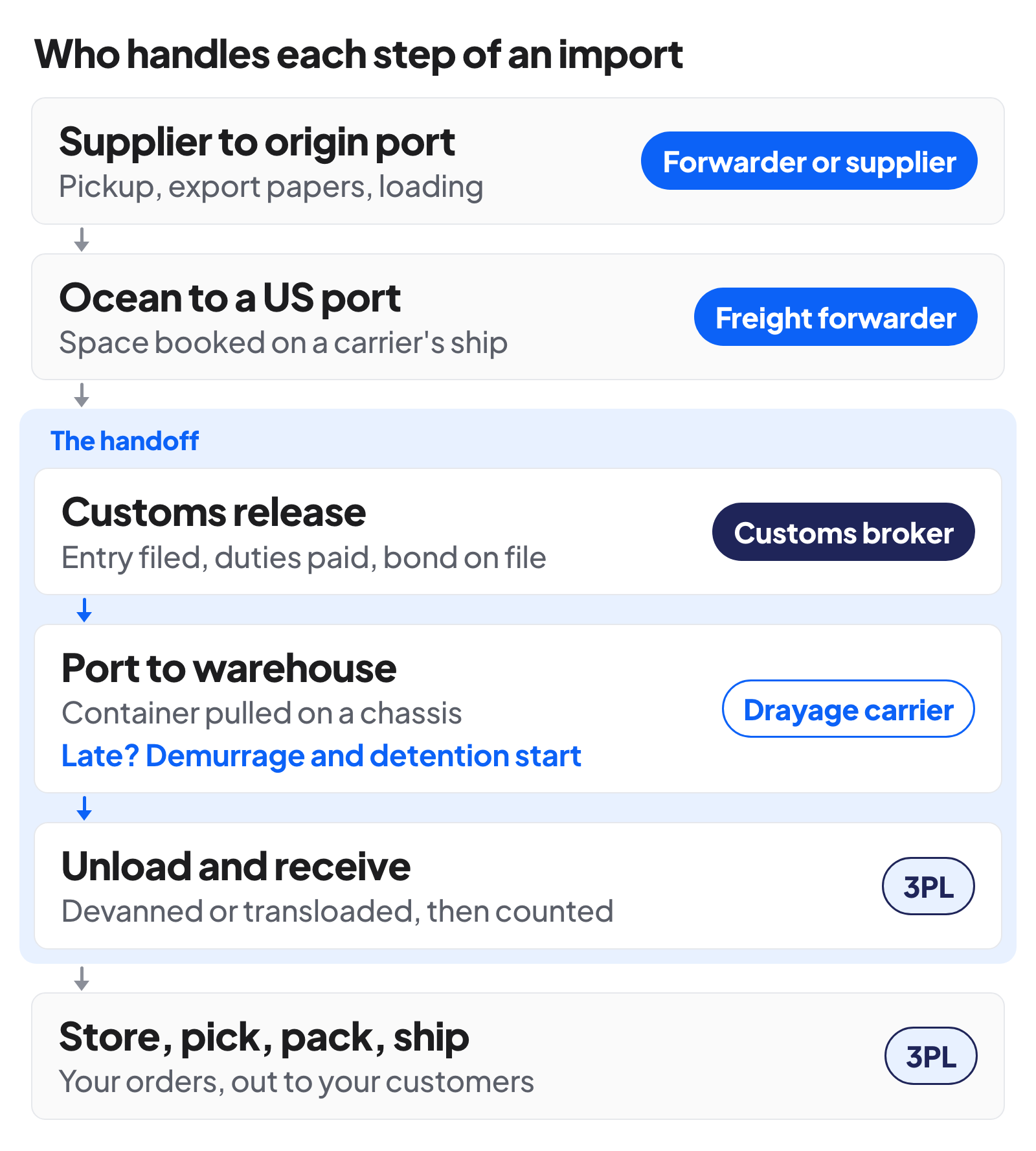
Near the big ports, many importers transload instead: the cartons move into a 53-foot domestic trailer near the port, the container goes straight back, and the trailer goes on to one warehouse or several.
Who books the truck? Either the forwarder quotes door delivery and books the drayage, the 3PL runs or contracts its own, or you hire a drayage carrier yourself. Whichever you pick, put one company's name next to "last free day" in writing.
Where your containers land shapes which 3PL makes sense. Here is how many of the 3PLs that list port drayage have a warehouse in eight of the major port states, plus Illinois for Chicago's rail ramps.
| State | 3PLs that list port drayage | Nearby port |
|---|---|---|
| California | 60 | Los Angeles and Long Beach |
| New Jersey | 38 | New York and New Jersey |
| Texas | 34 | Houston |
| Georgia | 25 | Savannah |
| Florida | 24 | Miami, Port Everglades, Jacksonville |
| Illinois | 23 | Chicago rail ramps (inland) |
| Washington | 10 | Seattle and Tacoma |
| South Carolina | 10 | Charleston |
| New York | 6 | New York and New Jersey |
A 3PL counts once per state where its profile lists a warehouse. Not every profile lists its warehouse addresses, so these are floors too.
Plenty of companies blur the line. Of the 2,701 3PLs on Fulfill.com, 258 list end-to-end import, and 207 list port drayage alongside ocean freight, air freight or end-to-end import. From the other side, large forwarders run their own warehouses. Combined providers come in three common shapes:
One provider means one contract, one invoice and no argument over whose fault a delay was. Separate specialists let you shop each leg and switch forwarders without moving inventory. If a company says it handles imports end to end, ask which parts it does itself, which it subcontracts, and under whose license the customs entry is filed.
Each role bills its own lines. We do not print rates, because they move with the lane, the season and the tariff on your goods; use this table to check that your quotes miss nothing.
| Cost | Who usually bills it | When it hits |
|---|---|---|
| Ocean or air freight | Forwarder | At booking, or before the cargo is released |
| Origin charges (pickup, export paperwork, loading) | Forwarder, unless your trade terms put them on the supplier | Before departure |
| Destination terminal and handling charges | Forwarder or carrier | On arrival |
| Customs entry and Importer Security Filing | Customs broker | Per shipment |
| Duties, taxes and CBP fees | Customs broker, passed through from CBP | With the entry |
| Customs bond | Customs broker or a surety | Per entry, or yearly for a continuous bond |
| Drayage and chassis | Drayage carrier, or whoever booked it | On delivery |
| Demurrage and detention | Terminal or carrier, often passed on by the forwarder or trucker | Once the free time runs out |
| Unloading and receiving | 3PL | When the container arrives |
| Storage, pick and pack, order shipping | 3PL | Monthly and per order |
Two habits prevent surprises: ask every quote to list what it excludes, and add duties, drayage and receiving to your landed cost before you set prices.
When you get to signing, our 3PL contract guide walks through the clauses that matter.
Broadly, yes: it is a third party running part of your logistics. In ecommerce, though, "3PL" usually means a fulfillment warehouse, and most forwarders do not store and ship your orders. A company that coordinates several providers for you is closer to a 4PL.
Only through a licensed customs broker. Some forwarders hold a CBP broker license themselves; others hand your entry to a broker they work with. Either way, ask whose license the entry is filed under.
You need someone licensed to file your entry, unless you file it yourself as the importer. If your forwarder's quote includes customs clearance, its broker files for you. Check, because clearance is often a separate line.
No. A port-side 3PL can handle drayage, unloading and storage, but someone still has to book the international freight and file the customs entry. Some 3PLs also arrange the freight: 137 on Fulfill.com list ocean freight.
The terminal or ocean carrier bills them, usually to the importer or to the forwarder that booked the move, which passes them on. Your contracts decide who absorbs them, so name in writing who owns the pickup and the empty return.
A freight forwarder manages international shipments, including the documents and often customs. A freight broker matches your load with a trucking company, usually within one country, and handles no customs or storage.
Start with where your containers land. Browse 3PLs that list port drayage or end-to-end import, or international fulfillment if you also ship orders across borders. Importing through Mexico? Our IMMEX program guide covers that route. Or tell us what you import and where it lands, and we will match you with 3PLs that fit.
How we counted. Counts cover 3PLs with an active profile on Fulfill.com on October 24, 2026, from the services, certifications and warehouse addresses each lists on its profile. Each count is a floor, and our specialty directory pages count by directory tag, so their totals can differ. Rules cited were read from the eCFR and the US Code the same day.
Insights on choosing a 3PL, evaluating fulfillment partners, and scaling your eCommerce operation, from the team behind Fulfill.com.
No spam, ever. You'll get our newsletter; unsubscribe anytime.
What a 3PL contract (or agreement) should cover, clause by clause, red flags to catch, plus a template to review with your lawyer.
Choosing a 3PLOctober 23, 202612 min read
How Mercado Libre fulfillment works: Envíos Full, Flex and Global Selling by country, what each one costs, and where a 3PL fits for cross-border sellers.
Choosing a 3PLAugust 26, 202512 min read
Why picking a nearby 3PL can cost you more: when proximity helps, when it doesn't, and how widening your search can save thousands a year.
Choosing a 3PLAugust 15, 20257 min read