How to Evaluate Your 3PL Provider
Learn how to evaluate a 3PL provider with actionable steps to boost efficiency, ensure reliability, and improve your logistics performance.
Choosing a 3PLFebruary 4, 20257 min read
 Fulfill Team·Updated September 23, 2026·Add Fulfill as a preferred source on Google
The difference between 3PL and 4PL is that a 3PL (third-party logistics provider) handles logistics tasks like warehousing, fulfillment and shipping, while a 4PL (fourth-party logistics provider) manages the entire supply chain by coordinating multiple 3PLs, carriers and other partners. Think of 3PL as doing the work and 4PL as the boss overseeing and optimizing the whole process.
This guide explains how each model works, where 1PL, 2PL and 5PL fit, how each one charges and which companies operate as each, so you can decide which model fits your business.
| Factor | 3PL (third-party logistics) | 4PL (fourth-party logistics) |
|---|---|---|
| What it does | Runs warehousing, order fulfillment, transportation and returns | Designs and manages the supply chain, and coordinates the 3PLs, carriers and systems that run it |
| Assets | Often owns or operates the warehouses and equipment | Most often non-asset: works through other providers' warehouses and fleets |
| Who manages the providers | You manage each 3PL and carrier relationship yourself | The 4PL manages them; you manage the 4PL |
| Point of contact | One of several in your supply chain | A single point of contact for the whole supply chain |
| Focus | Day-to-day execution: accurate orders out the door on time | Network design, provider performance, cost and visibility across every node |
| Control | You keep the strategic decisions; the 3PL executes them | You hand strategy to the 4PL in exchange for less day-to-day management |
| How it charges | Transactional: per order, per pallet, per unit stored | A management fee, often with cost-plus or gain-share terms, on top of the provider costs it manages |
| Typical client | Ecommerce brands and B2B shippers running one or a few warehouses | Mid-market and enterprise shippers with many warehouses, carriers and regions |
| Examples | ShipBob, ShipMonk, Amazon FBA | Kuehne+Nagel Integrated Logistics, Transport Works, Penske Logistics' lead logistics service |
Third-party logistics (3PL) providers offer outsourced logistics services that handle key supply chain functions (see our 3PL glossary entry for the full definition). These services focus on the operational aspects of logistics, including:
A 3PL provider's primary role is to meet customer demands and maintain smooth day-to-day operations. They manage logistics tasks such as order fulfillment, on-time deliveries, and inventory accuracy to help businesses focus on their core activities.
Partnering with a 3PL provider offers several advantages:
Partnering with a 3PL allows businesses to upgrade their logistics capabilities, improve customer satisfaction, and scale their operations.
3PL pricing is transactional: you pay for what moves and what sits on the shelf. In 2026 most ecommerce brands pay roughly $2 to $3 per B2C order picked and packed and $18 to $25 per pallet per month for storage, before shipping, according to our 3PL pricing benchmarks, which draw on a survey of more than 600 warehouses.
Fourth-party logistics (4PL), also known as a Lead Logistics Provider (LLP), goes beyond the services offered by 3PLs. A 4PL acts as a strategic partner that oversees and manages the entire supply chain. The idea was first defined by Andersen Consulting (now Accenture) as an integrator that assembles the resources, planning capabilities and technology of its own organization and other organizations to design, build and run supply chain solutions (Wikipedia, Logistics). Our 4PL glossary entry covers the term in more depth. A 4PL provides a comprehensive solution that includes:
A 4PL provider offers services focused on higher-level logistics management, including:
Partnering with a 4PL offers significant advantages:
A 4PL provider is ideal for businesses seeking a holistic, tech-driven approach to managing their supply chain while focusing on their core operations.
4PL pricing is typically a management fee plus either a cost-plus or gain-share structure, according to a 2026 buyer's guide from Navata SCS, an Indian supply chain company. In a gain-share deal the 4PL keeps a percentage of the savings it produces. One 2026 guide from eFulfillment Service puts the management fee at 5% to 12% of total logistics spend, with a one-time implementation fee of $50,000 to $500,000. Treat those as one company's published estimate, not a benchmark: the carrier and warehouse costs the 4PL manages still sit underneath its fee.
It's important to understand the distinctions between 3PL and 4PL providers when selecting the right solution for your business. Here's how they differ:
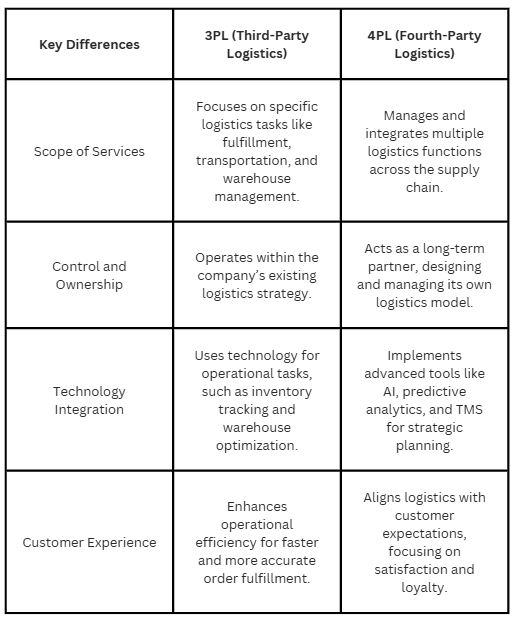
The quickest test is where your inventory sits. If the provider runs the warehouse that ships your orders, it is acting as a 3PL. If it coordinates warehouses and carriers it does not run, it is acting as a 4PL. Many large logistics companies sell both roles under separate service lines, which is why the same name can show up on both lists.
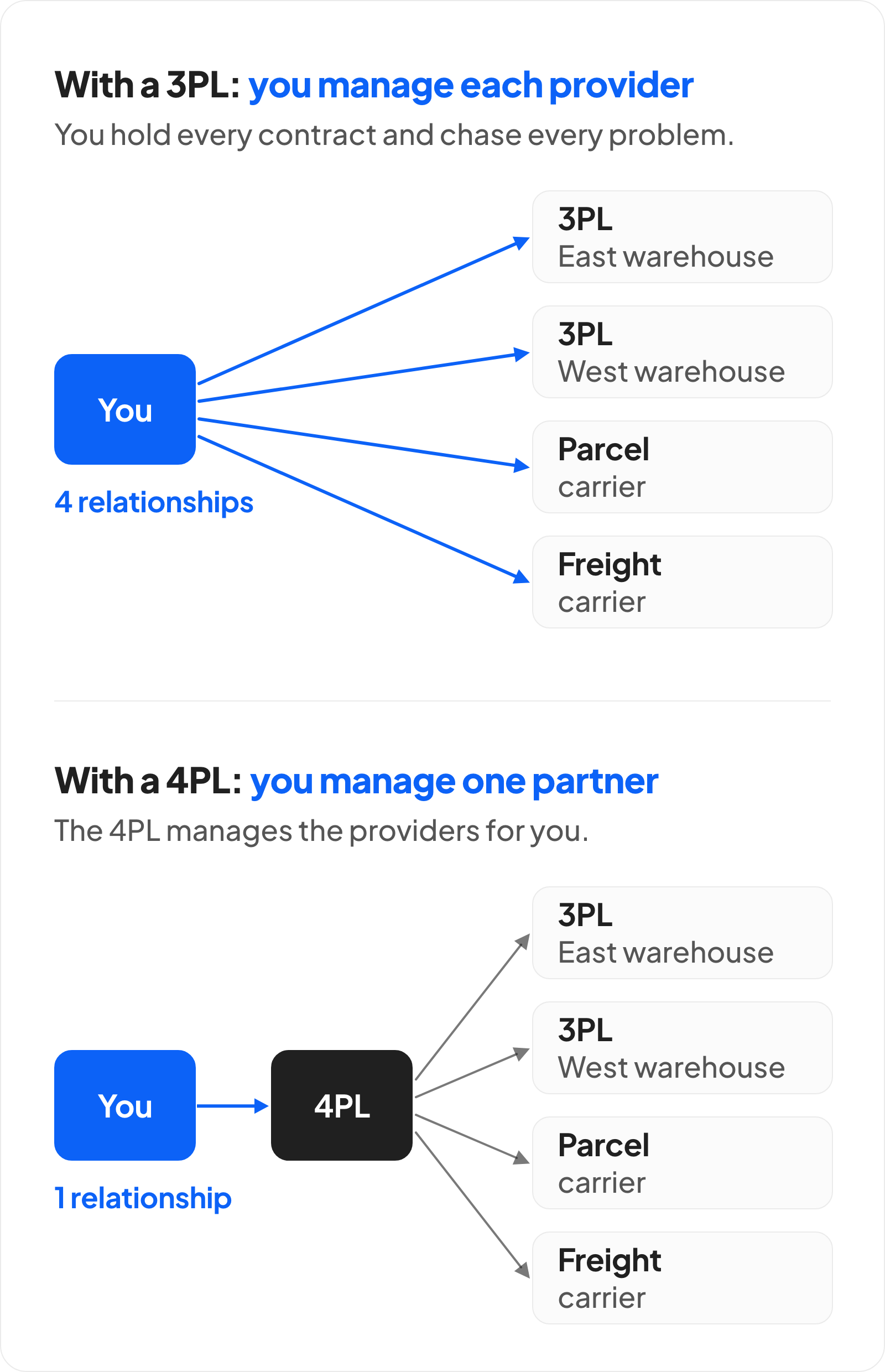
Businesses can determine which solution best suits their needs by comparing 3PL and 4PL providers. The right logistics partner should align with their specific goals, whether focusing on operational efficiency or taking a more strategic approach to supply chain management.
Each number adds a layer of outsourcing. Here is where 3PL and 4PL sit on the full ladder:
For most ecommerce brands the live decision is 3PL or 4PL. 1PL and 2PL describe how you ship today, and 5PL offers are aimed at companies running several supply chains at once.
Named companies make the line clearer. The 4PL descriptions below come from each company's own site.
You can also browse providers that offer 4PL services in our directory.
Choosing between 3PL and 4PL depends on your business size, logistics complexity, budget, and long-term goals. Aligning these factors with the right solution facilitates better performance and growth.
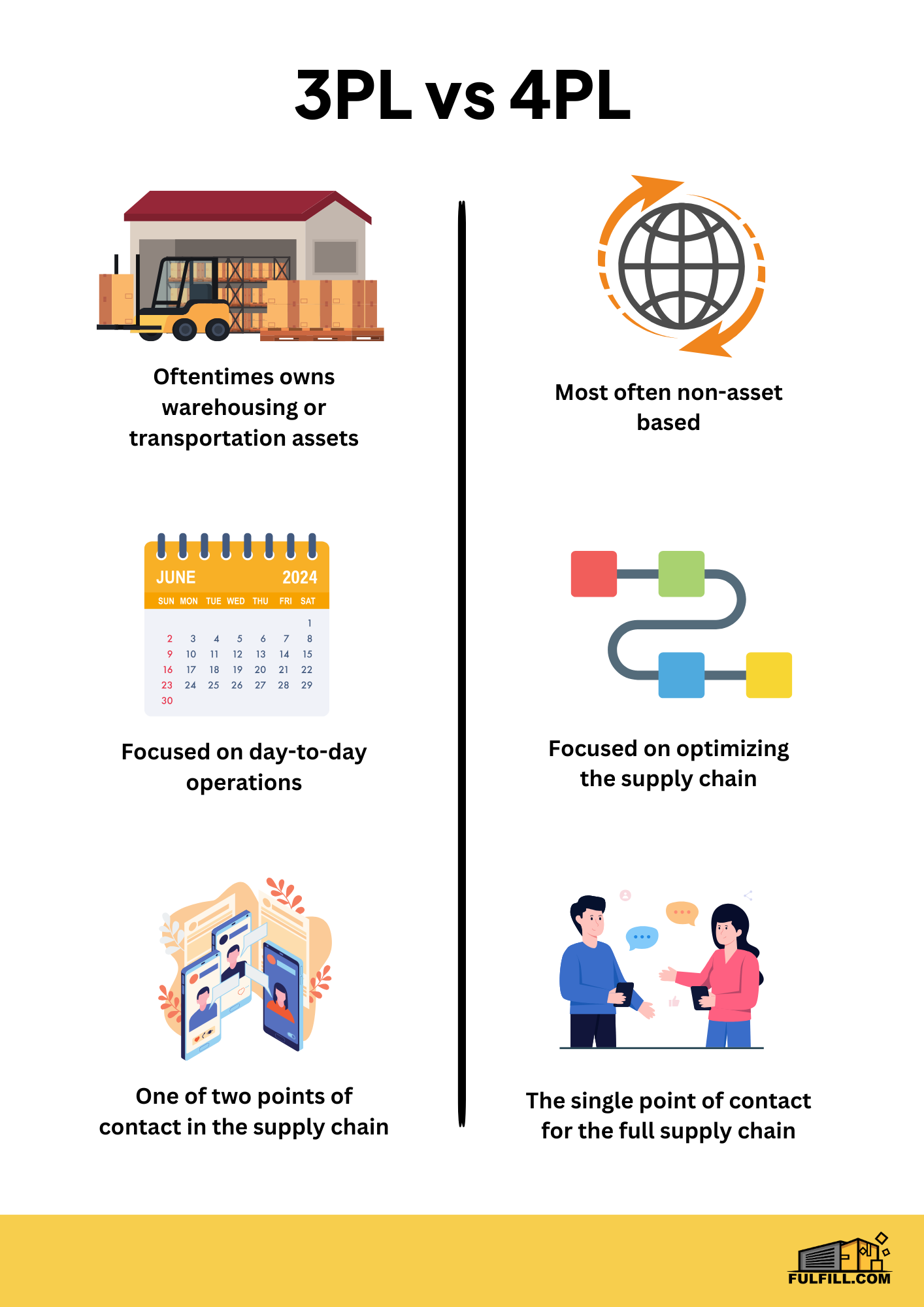
If you run one warehouse and ship through one or two carriers, a 4PL adds a fee without much to coordinate. A well-chosen 3PL covers it.
Choosing between a 3PL or 4PL provider requires understanding their unique benefits and limitations. While 3PL focuses on operational efficiency and cost savings, 4PL provides a comprehensive, strategic approach to supply chain management. Below is a breakdown of the key advantages and challenges for both models:
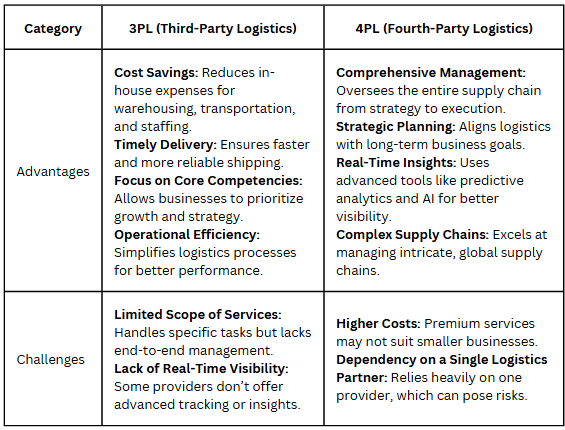
Businesses should weigh the advantages and challenges of each option. This will help them determine whether a 3PL or 4PL solution aligns better with their needs and logistics objectives.
Choosing between 3PL and 4PL depends on your business's unique logistics requirements. Start by evaluating your needs, such as operational efficiency, shipping costs, and overall logistics strategy. Consider KPIs like delivery times, order accuracy, and customer satisfaction to determine which option aligns better with your goals.
Assess the complexity of your supply chain. Businesses with straightforward logistics may benefit from a 3PL. Meanwhile, those with intricate, multi-layered supply chains might require the strategic oversight of a 4PL. Most importantly, make sure you align with a third or fourth-party logistics provider that matches your specific needs and can adapt to your growth. If a 3PL is the right fit, our guide on how to choose a 3PL provider covers what to check before you sign.
Amazon works as a 3PL for sellers. Through Fulfillment by Amazon it stores inventory in its fulfillment centers, picks, packs and ships orders, and handles customer service and returns. Amazon Supply Chain Services also sells end-to-end supply chain management, covering inbound transportation, storage, distribution and fulfillment, which reaches into 4PL territory. The difference is that Amazon sells its own transportation, storage and fulfillment services, while a classic 4PL coordinates providers it does not own on your behalf.
UPS plays more than one role. Its parcel network, with its own aircraft and trucks, is a carrier, which is the 2PL role. Its Supply Chain Solutions unit runs forwarding and contract logistics, which is 3PL work, and also sells supply chain design and management, which overlaps with what a 4PL does (Wikipedia, United Parcel Service).
Expect a management fee on top of the carrier and warehouse costs the 4PL manages, often with cost-plus or gain-share terms. One 2026 guide from eFulfillment Service puts the fee at 5% to 12% of total logistics spend, or a fixed monthly retainer. A 3PL, by contrast, bills per order, per pallet and per unit stored. See How 4PLs Charge above for the detail.
For practical purposes, yes. Lead logistics provider (LLP) is another name for a 4PL, and it stresses that one partner leads and answers for the whole program. Penske Logistics, for example, sells the service as "4PL/Lead Logistics Provider".
Yes. Kuehne+Nagel and Penske Logistics both run warehouses and sell 4PL management as a separate service. Ask which role your contract covers: a 4PL that sends all of your volume to its own warehouses is managing itself, not managing providers for you.
Rarely. With one or two warehouses and a handful of carriers there is little for a 4PL to coordinate, and its fee comes on top of what you already pay. Most growing brands are better served by the right 3PL and someone in-house who owns the relationship.
3PL and 4PL offer distinct solutions, with 3PL focusing on specific logistics tasks and 4PL providing comprehensive supply chain management. Knowing the main differences and your unique logistics requirements is key to making an informed decision.
Upgrade your logistics today! Try Fulfill's 3PL Finder to connect with the right provider and take your supply chain to the next level.
Need help finding the right 3PL partner for your business? Fulfill helps you find your perfect match in less than a week.
Insights on choosing a 3PL, evaluating fulfillment partners, and scaling your eCommerce operation, from the team behind Fulfill.com.
No spam, ever. Unsubscribe anytime.
Learn how to evaluate a 3PL provider with actionable steps to boost efficiency, ensure reliability, and improve your logistics performance.
Choosing a 3PLFebruary 4, 20257 min read
Compare 12 ShipBob competitors, from ShipMonk, Stord and Flexport to Red Stag: where each one ships from, who it fits, and how to switch 3PLs cleanly.
Choosing a 3PLJanuary 23, 202515 min read
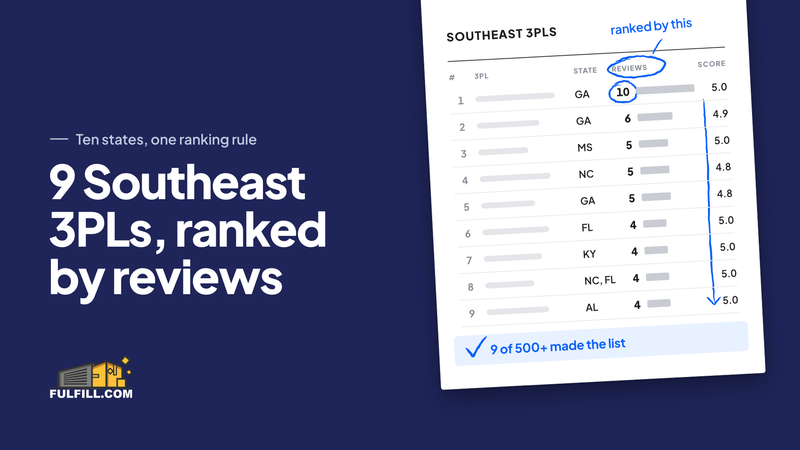
9 Southeast 3PL companies with warehouses in Georgia, Florida, North Carolina, Alabama, Kentucky and Mississippi, ranked by their reviews on Fulfill.com.
Choosing a 3PLSeptember 26, 20247 min read