If your company wants to manufacture in Mexico and export the finished goods, the IMMEX program might be the best option. IMMEX allows companies to bring in raw materials, parts and components from other countries without paying import duty up front, as long as those goods are used to make products that will be exported later. Machinery and equipment can also come in temporarily and stay for the life of the program, but Article 110 of the Customs Law makes import duty payable on them when they enter. With a separate certification from Mexico's tax authority (SAT), the VAT on those imports is covered by a tax credit too.
In this guide, we'll explain what the IMMEX program is, how it works, what the requirements are, how to get approved, how the VAT and IEPS certification and Annex 24 inventory control fit in, and what changed in 2025 and 2026. We'll also cover the question most people search next: how IMMEX differs from a maquiladora.
In this article (19 sections)
What Does IMMEX Mean?
IMMEX stands for Industria Manufacturera, Maquiladora y de Servicios de Exportación. That's a long name, but the idea is simple: it's a program that helps companies temporarily import goods to be used in production. These goods enter Mexico without paying import duty up front, as long as they're used to produce goods that will be exported.
This means companies can save money on duties and taxes, run their business operations more smoothly, and stay competitive in global trade.
How Does the IMMEX Program Work?
Let's say you're a company based in the U.S., and you want to set up a factory near the Mexico border. You bring in raw materials, machines, and parts from another country. You then use those materials to make a product, like a car part or a medical device. Once the product is finished, you send it to a customer in another country.
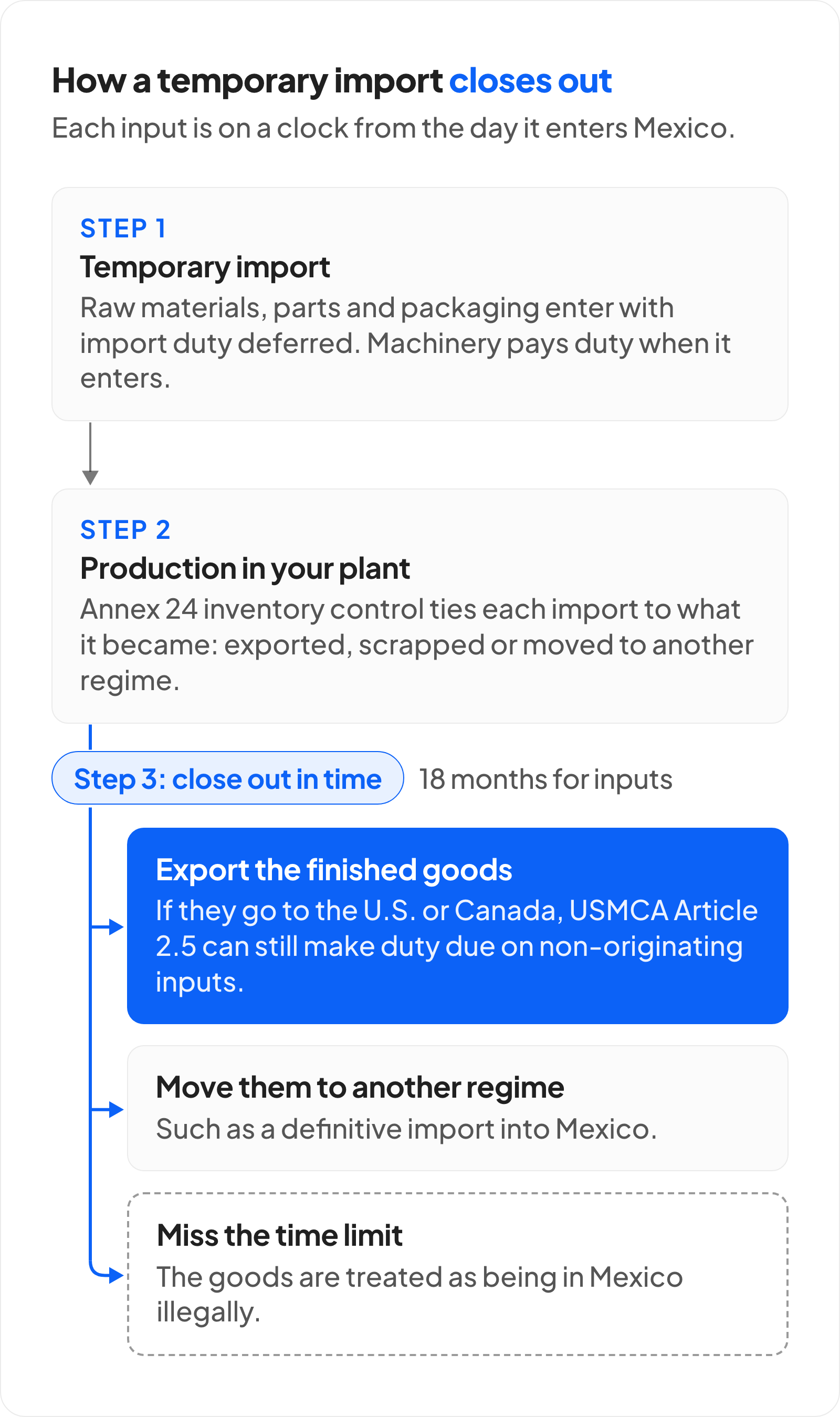
With IMMEX, you don't pay import duty on the raw materials when they enter Mexico. This is because they are temporarily imported, and the finished product will not stay in Mexico. You close out each temporary import by exporting the finished goods, or by moving the goods to another customs regime, within the time limit for that type of good.
Raw materials, parts and components that go into the export product
Up to 18 months
Lubricants and other materials consumed in production
Up to 18 months
Packaging, labels and leaflets
Up to 18 months
Containers and trailer boxes
Up to 2 years
Machinery, tools, molds, spare parts, test and lab equipment, IT and office equipment
For as long as the IMMEX program is in force
Goods that are not returned abroad or moved to another regime in time are treated as being in the country illegally, so the export clock matters as much as the tax savings.
This helps you:
Reduce costs
Speed up production
Avoid paying unnecessary import fees
IMMEX vs Maquiladora
This is the most common point of confusion, and the short answer is that the Maquiladora program no longer exists on its own: it was folded into IMMEX in 2006. Before 2006, Mexico ran two export programs side by side: the Maquiladora program and PITEX (temporary imports to produce export goods). The 2006 IMMEX Decree merged both into one program, which the December 2024 amending decree recounts in its preamble. The SE's current rules also state that existing PITEX and Maquila authorizations became part of each company's IMMEX program.
So today:
IMMEX is the legal program: the authorization the Secretaría de Economía grants to a Mexican company.
Maquiladora (or maquila) is the everyday word for a plant that assembles or processes imported materials for export. Most maquiladoras operate under an IMMEX program.
When someone asks whether they should use IMMEX or a maquiladora, the real question is usually whether to get their own IMMEX program or run under a shelter company's program. We cover that choice next.
What Are the Different Types of IMMEX?
Article 3 of the IMMEX Decree sets out five modalities, depending on how the company operates:
Holding company (controladora): a certified parent and one or more subsidiaries run their manufacturing under one program.
Industrial: for companies that make or transform products for export.
Services: for companies that provide services to export goods, or export services, limited to activities the SE lists.
Shelter (albergue): one or more foreign companies supply the technology and production materials, but do not operate the program themselves. The shelter company holds it.
Outsourcing (terciarización): a certified company without its own production facilities has registered third parties do the manufacturing.
If you're new to Mexico, many firms start with a shelter model, which makes setup and compliance easier.
Shelter vs Your Own Program
For a foreign company, the practical choice is whether to hold its own IMMEX program or to operate under a shelter provider's program.
Shelter (albergue)
Your own IMMEX program
Who holds the program
The shelter company
Your Mexican subsidiary
Who is the importer of record and handles customs, Annex 24 and reports
The shelter company
You
What you supply
Technology and production materials
Everything: entity, plant, staff, systems
Time to start
Shorter, because the program and systems already exist
Longer: company formation, plant, fe de hechos, application
Control
Shared with the provider
Full
A common path is to start under a shelter to prove out production, then move to your own program once volumes justify the in-house compliance team.
Who Uses the IMMEX Program?
The IMMEX program is popular with companies in many industries, especially those with high export volumes. Here are a few examples:
Automotive industries: companies that make parts for cars or trucks
Medical device manufacturers, such as surgical tools or implants
Electronics, like computers, phones, and electrical components
Aerospace: companies building aircraft parts or systems
Textiles and clothing, although finished apparel can no longer be imported temporarily (see the 2024 change below)
If your company wants to operate in Mexico and export most of its products, IMMEX is likely a great fit.
What Can You Import Under IMMEX?
You can temporarily import:
Raw materials (steel, plastic, wires, etc.)
Machinery and tools
Packaging materials
Components (circuit boards, screws, motors)
Containers or trailers to move goods
As long as these items are used in the manufacturing process, and the finished goods are exported, they can enter Mexico temporarily under IMMEX. Raw materials, components and packaging enter without paying duty up front. Machinery and tools pay import duty when they enter (Article 110 of the Customs Law), but they can stay for as long as the program is in force.
There are exceptions. Annex I of the IMMEX Decree lists goods that cannot be imported temporarily under the program at all. It includes items such as sugar, ethyl alcohol and used tires, and since the December 2024 amendment it also covers finished apparel and textile articles in chapters 61, 62 and 63 of Mexico's tariff schedule. Other goods classed as sensitive carry extra requirements. Check your parts' tariff classification against the annexes before you plan a supply chain around them.
IMMEX Program Requirements
To use IMMEX, your company must meet certain conditions set by the Mexican government. The core ones come from Article 11 of the IMMEX Decree and the application rules in the SE's general foreign trade rules (rule 3.2.20).
Here's what you need:
A Mexican company. The program is granted to a company resident in Mexico that pays corporate income tax there. A foreign company can own it, or can work through a shelter provider instead.
An export commitment. Annual export sales of at least USD 500,000, or exports of at least 10% of total sales.
Good tax standing. A current positive tax compliance opinion from SAT (the "opinión positiva" under Article 32-D of the Federal Tax Code) and an advanced electronic signature (e.firma).
A registered plant. Proof of legal possession of the premises, registered with SAT. A lease must have a minimum term of one year with at least eleven months left when you apply.
A real export project. Maquila contracts, purchase orders or firm orders, plus a description of each production step, the machinery, the staff and the installed capacity.
Your workforce on the books. Proof of IMSS social security payments for all employees.
A certified site record. A "fe de hechos" issued by a public broker (corredor público) authorized by the SE, no more than three months old, documenting the premises and the machinery. You can ask the SE for an inspection visit instead (rule 3.1.1).
Inventory control. An automated inventory control system (see Annex 24 below).
After approval, the obligations continue. You file an annual report on total sales and exports with the SE by the last business day of May (Article 25 of the decree and rule 3.2.16). If it is late, your right to import under the program is suspended until you file, and if it is still missing by the last business day of August, the program is cancelled from September 1. You also report statistics to INEGI, Mexico's statistics agency (rule 3.2.17), and each March the SE checks that program holders still meet the SAT registration requirements and publishes the program numbers that do not (rule 3.2.8).
How to Get IMMEX Certification
People say "IMMEX certification" for two different things: the IMMEX program authorization from the Secretaría de Economía, and the VAT and IEPS certification from SAT that most IMMEX companies get afterwards. This section covers the first. The next section covers the second.
Here's a simple step-by-step guide:
Set up your business
Register a legal entity in Mexico, get its tax ID (RFC) and e.firma, and register in the importers' registry. You can do this on your own or work with a shelter company.
Secure the plant and document it
Sign the lease or buy the site, then have a public broker issue the fe de hechos covering the premises and machinery. Registered plant addresses have to be active with SAT.
Create a business plan
Describe your production process, the types of products you'll make, the tariff codes you'll import and export, your installed capacity and how much you expect to export.
Apply for IMMEX
File the application through the Ventanilla Digital, Mexico's online foreign trade window, and choose the modality (industrial, services, shelter, outsourcing or holding company). The SE may visit the plant before it decides (rule 3.2.23).
Start operations
Once approved, you can begin importing materials under the program and manufacture in Mexico without paying duty on those inputs up front. If the site visit finds you only have the building so far, the SE approves a preoperative period of three months, extendable once, in which you can bring in machinery and equipment only. Raw materials follow once the SE confirms the plant is equipped.
How long does IMMEX approval take? The IMMEX Decree (Article 11) gives the SE 15 working days to decide a new application, and the SE's older English program page quotes 20. In practice it can take far longer: at its April 2025 working session with the SE, AmCham Mexico reported resolutions that in some cases took more than 200 days. Missing documents, a plant visit or a preoperative period all add time.
VAT and IEPS Certification
Temporary imports under IMMEX are subject to Mexico's 16% VAT (and IEPS excise tax, where it applies). Article 28-A of the VAT Law, added in December 2013, and the matching Article 15-A of the IEPS Law give companies two ways to avoid carrying that cost:
Get certified by SAT. A certified company applies a tax credit equal to 100% of the VAT due on the temporary import, so no cash leaves the business. Article 28-A sets a one-year term, renewable in the 30 days before it expires as long as the company still meets the requirements; SAT's foreign trade rules set the terms for each certification level.
Post a bond. A company that chooses not to certify can guarantee the VAT with a bond from an authorized surety instead of paying it.
Without either one, you pay the VAT at the border and credit it later, which ties up working capital on every inbound shipment. SAT sets the requirements for the certification in its general foreign trade rules (RGCE), and the law requires it to be an adequate control of your temporary import operations. The certification also opens other doors: the SE's January 2025 exception for the apparel change, for example, was open only to companies registered in SAT's company certification scheme.
Annex 24 Inventory Control
Every company importing under IMMEX has to keep an automated, permanent inventory control system that shows the status of its foreign trade goods at any moment and is available to customs. That obligation is in Article 59, section I of the Customs Law and Article 24 of the IMMEX Decree. SAT's general foreign trade rules spell out the system in their Annex 24, which is why people call it "Annex 24" (Anexo 24).
In practice, the system has to tie every temporary import declaration (pedimento) to what was consumed, exported, scrapped or moved to another regime, so you can prove each input left within its time limit. Article 109 of the Customs Law separately requires IMMEX companies to declare to customs what share of their temporary imports was returned, what was lost as waste and what went to the Mexican market. The stakes are high: under Article 59, if you fail to keep it, goods you own or hold that are the same as those you imported are presumed to be of foreign origin.
Annex 24 is also becoming the authority's window into your operation. The SE's Oficio 400.2025.001 required companies seeking its apparel exception to give the authority online access to their Annex 24 system. If you run a warehouse or 3PL flow inside an IMMEX operation, your warehouse management system data has to reconcile with Annex 24, not just with your own stock counts.
What Are the Benefits of IMMEX?
IMMEX helps companies cut costs, grow faster, and expand into new markets. Here are the biggest advantages:
1. Tax Savings
You avoid paying import duty up front on raw materials and components as long as the finished product is exported, and with SAT certification the VAT is covered by a 100% credit. Machinery and equipment still pay duty when they enter. Note the duty exception for goods exported to the U.S. or Canada, covered below.
2. Lower Manufacturing Costs
Labor and overhead costs in Mexico are often lower than in the U.S. or Europe. IMMEX adds tax relief to those savings.
3. Faster Market Access
Factories near the Mexico border offer quick shipping routes to the U.S. This is great for just-in-time supply chains.
4. Flexible Operations
You can adjust production levels without paying import duty up front on every shipment of raw materials.
5. Support for Growth
IMMEX works for small startups and large global firms, as long as they meet the export test. It scales with your business as it grows.
IMMEX vs Traditional Importing
Let's compare the IMMEX model with traditional importing.
Feature
IMMEX program
Traditional import
Import duty
Deferred on raw materials, parts, components and packaging while they are in the program. Machinery and equipment pay duty when they enter (Customs Law Article 110). Deferred duty can come due on non-originating inputs in goods exported to the U.S. or Canada (USMCA Article 2.5)
Paid at entry
VAT
Covered by a 100% credit with SAT certification, or guaranteed with a bond
Paid at entry and credited later
Export requirement
USD 500,000 a year or 10% of sales
None
Time limits
18 months for inputs, life of the program for machinery
None
Best for
Manufacturing for export
Selling in Mexico
IMMEX is ideal if you're building a production process that ends with exporting goods. If you're selling only inside Mexico, IMMEX might not be the best choice.
2025 and 2026 Rule Changes
IMMEX has tightened since late 2024. The changes that matter most:
December 2024: finished apparel removed. A decree published December 19, 2024 moved clothing and made-up textile articles in tariff chapters 61, 62 and 63 into Annex I, so they can no longer be imported temporarily under IMMEX. It took effect the next day and also set temporary tariffs of 15% on 17 textile lines and 35% on 138 apparel lines until April 23, 2026.
January 2025: a narrow exception. The SE's Oficio 400.2025.001 let companies registered in SAT's certification scheme keep importing those goods for programmed returns if they gave online Annex 24 access and imported only tariff codes they had used in the previous calendar year. The criteria were valid for six months.
2025: enforcement. Under "Operación Limpieza," the SE cancelled IMMEX programs of companies it said were simulating manufacturing. A joint SE and customs release of April 1, 2025 reported five cancellations of companies accused of simulating footwear manufacturing, whose imports totalled 9 billion pesos, after earlier cancellations tied to 15 billion pesos of finished textile imports.
November 2025: Customs Law reform. The reform published November 19, 2025 gives a company whose program is cancelled no more than 60 calendar days to return its temporary imports or import them definitively. The amended Article 108 also lets further goods be barred from the regime by rule, on top of petroleum products, which have been barred since 2018.
January 2026: higher tariffs for non-FTA inputs. A decree effective January 1, 2026 raised tariffs on 1,463 tariff lines for countries without a trade agreement with Mexico, across autos, textiles, steel, plastics, appliances and more. IMMEX defers duty, but it does not erase it in every case (see trade agreements below), so inputs from countries without a trade agreement with Mexico can cost more when that duty comes due.
What is IMMEX 4.0?
IMMEX 4.0 is the name the Secretaría de Economía and industry groups have used since 2025 for a planned redesign of the program under Plan México. At an April 2025 working session with AmCham Mexico, the SE described its goals as raising domestic content in exports, integrating local suppliers, creating 1.5 million jobs and simplifying procedures through a single digital file. Treat it as a direction, not a rule: until a change is published in the DOF, the 2006 decree and its amendments govern your program.
Does IMMEX Work With Trade Agreements?
Yes, with one important limit. Article 2.5 of the USMCA (United States-Mexico-Canada Agreement) restricts duty deferral programs like IMMEX. When a good made under IMMEX is exported to the U.S. or Canada, Mexico assesses duty on the non-originating inputs as if they had been imported for domestic use, and can waive it only up to the lesser of the Mexican duty and the duty paid in the destination country. Article 63-A of Mexico's Customs Law makes those duties payable. The same Article 2.5 limits duty drawback, so the logic will be familiar if you have claimed drawback in the U.S.
In practice: if your finished good enters the U.S. at a zero duty rate under USMCA, there is little or nothing to offset, and Mexican duty on inputs from outside North America can come due. Article 2.5 does not apply to originating inputs, to goods returned in the same condition they were imported, or to exports outside North America. Work through this with your customs broker before you set your sourcing.
This makes Mexico a popular choice for cost-effective manufacturing and export, as long as the sourcing is planned with USMCA in mind.
Is IMMEX Right for Your Business?
Ask yourself:
Are you producing goods that will be exported?
Will you export at least USD 500,000 a year, or at least 10% of your sales?
Do you plan to scale operations in Mexico?
Can you (or a shelter provider) run Annex 24 inventory control and meet the reporting deadlines?
If you said yes to most of these, then the IMMEX program could help your company operate in Mexico more efficiently and profitably. If you mainly need to hold imported inventory before it ships on, look at bonded warehouses and foreign trade zones instead.
IMMEX FAQ
What is IMMEX?
IMMEX is a Mexican government program that lets an approved company in Mexico import raw materials, parts and components temporarily, without paying import duty up front, to make or service goods for export. It can also bring in machinery and equipment temporarily for the life of the program, though duty is paid on those when they enter. The Secretaría de Economía grants it under the 2006 IMMEX Decree.
What does IMMEX stand for?
Industria Manufacturera, Maquiladora y de Servicios de Exportación: the manufacturing, maquiladora and export services industry.
Do I need a Mexican corporation for IMMEX?
Yes, the program holder must be a company resident in Mexico. A foreign company that does not want to form one can operate under a shelter provider's IMMEX program.
How long can temporary imports stay in Mexico?
Up to 18 months for raw materials, components and packaging, up to two years for containers and trailer boxes, and for the life of the program for machinery and equipment.
Is IMMEX certification the same as VAT certification?
No. The IMMEX program is authorized by the Secretaría de Economía. The VAT and IEPS certification is a separate SAT registration that turns the VAT on temporary imports into a 100% tax credit.
Is IMMEX only for U.S. companies?
No. Any foreign company can own a Mexican subsidiary with an IMMEX program, or work through a shelter. The export test counts sales abroad, not sales to the U.S. alone.
Final Thoughts
The IMMEX program is a smart way for manufacturers to lower costs, defer import duty on inputs, and run export operations smoothly in Mexico. Whether you're in the automotive, medical device, or electronics industry, IMMEX gives you tools to work faster, leaner, and more competitively, as long as your sourcing is planned around the USMCA rules above. The price of those benefits is compliance: the export test, the time limits, Annex 24 and the annual report.
But navigating regulations, choosing the right location, or finding the right partner in Mexico can feel overwhelming, especially if it's your first time.
Find a Logistics Partner in Mexico
There's no one-size-fits-all answer. But with Fulfill.com, you don't have to figure it out alone.
Whether you're exploring IMMEX, bonded warehousing, or looking to set up near the Mexico border, we'll connect you with logistics partners that fit your operation. Start by browsing warehouse and fulfillment providers in Mexico or bonded warehouse providers, and ask each one directly about its experience with temporary imports, export tracking and Annex 24 reconciliation.
Fulfill.com isn't just a directory; we're your partner in making smart, efficient fulfillment decisions. Tell us what your operation needs, and when you talk to the providers we match you with, ask whether they can:
Store imported goods in bonded warehouses
Handle cross-border freight (air, road, or ocean)
Manage compliance and documentation
Work with U.S. and Mexican customs authorities
Let us connect you with fulfillment partners who are ready to help, whether you need warehousing, freight forwarding, or complete 3PL solutions.
Get 3PL Insights in Your Inbox
Insights on choosing a 3PL, evaluating fulfillment partners, and scaling your eCommerce operation, from the team behind Fulfill.com.
FTZ vs bonded warehouse: how a foreign trade zone warehouse differs on duty rates, time limits, manufacturing and exports, with the CBP rules side by side.
18 ecommerce newsletters for DTC and retail brands, from DTC Newsletter and Shopifreaks to Retail Dive, with how often each one sends and who it is for.


.png?width=1600&resize=contain&quality=75)