3PL vs Freight Forwarder vs Customs Broker: Who Does What
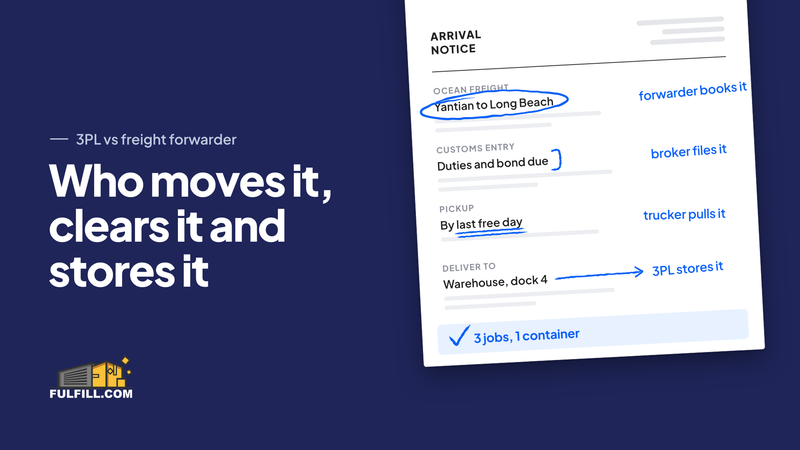
A freight forwarder books the move to a US port, a customs broker clears it, and a 3PL stores and ships it. The handoff, the costs, and network data.
Choosing a 3PLOctober 23, 202611 min read
 Fulfill Team·October 23, 2026·Add Fulfill as a preferred source on Google
Below: rent in 17 markets, every other line of the bill, one warehouse worked through to a cost per order, and when your own lease is the better deal. For what 3PLs charge, see our 3PL pricing guide.
Cushman & Wakefield's U.S. Industrial MarketBeat for the third quarter of 2026 puts the national average asking rent at $10.40 per square foot a year for all industrial space. That is up 4.0% from $10.00 a year earlier. For warehouse and distribution buildings alone, the figure is $10.06.
These are triple net asking rents: the tenant pays the building's taxes, insurance and maintenance on top. The average is weighted by the space on the market, so large vacancies count most. Rent is usually quoted per square foot per year; for a monthly figure, multiply by your square footage and divide by 12.
| Market | Asking rent per sq ft per year | 10,000 sq ft, rent per month |
|---|---|---|
| New York City outer boroughs | $28.04 | $23,367 |
| Orange County, CA | $17.50 | $14,583 |
| Northern New Jersey | $17.43 | $14,525 |
| Los Angeles | $16.05 | $13,375 |
| Central New Jersey | $15.73 | $13,108 |
| Miami | $14.90 | $12,417 |
| Philadelphia | $12.97 | $10,808 |
| Las Vegas | $12.39 | $10,325 |
| Inland Empire, CA | $12.15 | $10,125 |
| U.S. average | $10.06 | $8,383 |
| Reno | $9.93 | $8,275 |
| Dallas-Fort Worth | $9.55 | $7,958 |
| Orlando | $9.25 | $7,708 |
| Pennsylvania I-81/I-78 corridor | $9.07 | $7,558 |
| Atlanta | $7.51 | $6,258 |
| Chicago | $7.20 | $6,000 |
| Savannah | $6.80 | $5,667 |
| Memphis | $4.12 | $3,433 |
Source: Cushman & Wakefield, U.S. Industrial MarketBeat Q3 2026, warehouse and distribution average asking rents (NNN, preliminary). The monthly column is our arithmetic and covers base rent only.
The spread is close to sevenfold, and it is moving. Overall industrial asking rent in Dallas-Fort Worth rose 20% in a year, the fastest of the 83 markets, while rents softened in some coastal markets in California, New Jersey and Miami.
Base rent is the number on the listing. The monthly bill has more lines.
| Cost | What to expect | Source |
|---|---|---|
| NNN charges (property taxes, building insurance, common area maintenance) | $1.50 to $3.00+ per sq ft a year | Link Logistics, 2026 |
| Utilities | Billed separately, on usage | Link Logistics, 2026 |
| Annual rent increases | 2% to 5% a year, or tied to the Consumer Price Index | Link Logistics, 2026 |
| Security deposit | 1 to 3 months' rent | Link Logistics, 2026 |
| Lease term | 59.7 months on average for leases under 200,000 sq ft | CompStak, Q1 2026 |
| Rent abatement (months with no base rent) | 4.5% of the lease term on non-bulk leases | CompStak, Q1 2026 |
| Warehouse staff | $17.95 an hour median wage, plus benefits | BLS, May 2025 and June 2026 |
| Racking, packing stations, lift equipment | Quoted per project | Your vendors |
| WMS and shipping software | Quoted per month | Your vendors |
| Your own insurance (inventory, liability) | Quoted per policy | Your insurance broker |
Under a triple net lease, the landlord estimates your share of the building's taxes, insurance and common area maintenance. You pay that estimate monthly, then settle the difference once a year. At $1.50 to $3.00 per square foot, NNN adds $1,250 to $2,500 a month to a 10,000 square foot lease.
About five years is the average for a lease under 200,000 square feet. At the U.S. average rent, with 3% annual increases, a five-year lease on 10,000 square feet commits you to about $534,000 in base rent, before NNN. The rent itself reaches $11.32 per square foot by year five.
The deposit, one to three months' rent, holds another $8,383 to $25,150 until you move out. Ask for rent abatement as well. At 4.5% of a 59.7-month term, the CompStak average works out to about 2.7 months with no base rent.
The Bureau of Labor Statistics put the national median wage for stockers and order fillers at $17.95 an hour in May 2025. In private industry, benefits make up 31.4% of what employers spend on pay and benefits for transportation and material moving jobs (June 2026). So each wage dollar costs about $1.46. That is $26.17 an hour, or about $54,426 a year, for one full-time person.
Wages vary far less by market than rent does. In the eight states we checked (California, New Jersey, Pennsylvania, Illinois, Florida, Nevada, Texas and Georgia), the state median for the same job ran from $17.13 in Georgia to $20.61 in California. That gap is about 20%; the rent spread is sevenfold. A cheaper market saves you far more on rent than on payroll.
We found no current public price benchmark for pallet racking, packing stations or lift equipment in a small warehouse, so get at least two quotes for your layout. The same goes for a warehouse management system (WMS) and shipping software.
When you size the space, Link Logistics suggests a 15 to 20% buffer for growth; every unused foot still costs rent and NNN. A 3PL already owns its racking, equipment and WMS, and builds their cost into its rates, plus any account or technology fee (see our 3PL pricing guide).
One warehouse at the U.S. average rent, with two full-time staff at the national median wage plus benefits (2,080 hours a year each). NNN is shown at both ends of its range.
| Monthly cost | NNN at $1.50 | NNN at $3.00 |
|---|---|---|
| Base rent (10,000 sq ft × $10.06, divided by 12) | $8,383 | $8,383 |
| NNN charges | $1,250 | $2,500 |
| Two full-time staff ($17.95 an hour, benefits at 31.4% of pay and benefits) | $9,071 | $9,071 |
| Monthly total, before utilities, software, insurance and fit-out | $18,704 | $19,954 |
In this example, that total stays the same whether you ship 1,000 orders or 5,000, so the cost per order falls as volume grows:
| Orders a month | Fixed cost per order, NNN at $1.50 | Fixed cost per order, NNN at $3.00 |
|---|---|---|
| 1,000 | $18.70 | $19.95 |
| 2,000 | $9.35 | $9.98 |
| 3,000 | $6.23 | $6.65 |
| 5,000 | $3.74 | $3.99 |
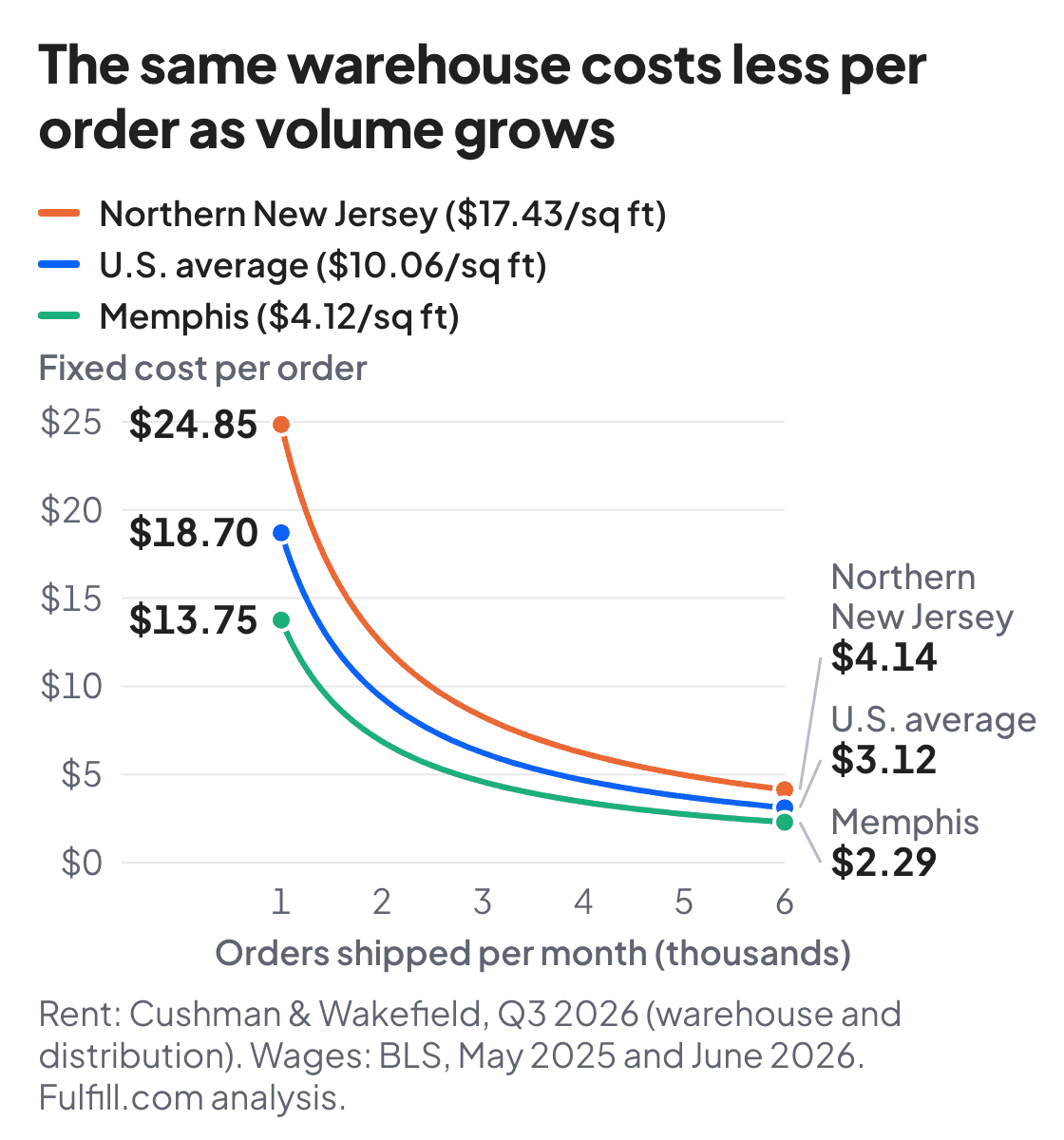
These are floors. Utilities, software, insurance and the fit-out (spread over the lease) come on top, then packaging and postage, which you pay with a 3PL too. The market moves the total most: the same warehouse starts at $24,846 a month in northern New Jersey, and it starts at $13,754 in Memphis. Two people is an input, not a rule; set it to what your volume needs.
Now set your number next to a 3PL's. Our 3PL cost per order guide does the same division for 3PL fees at several volumes, and the fulfillment cost calculator runs it with your own numbers.
Leasing costs less when your warehouse's cost per order, supplies included, stays below what a 3PL would charge at the same volume. That has to hold for the whole lease, not just your best months.
Leasing tends to win when:
A 3PL tends to win when:
You can also do both. Keep a small space for wholesale, kitting or returns, and let a 3PL ship your direct-to-consumer orders. For the signs that it is time to hand off fulfillment, see how to know when you need to outsource fulfillment.
High rent does not have to keep you out of a market. The six states below hold 12 of the 17 markets in the rent table, from Chicago at $7.20 to Orange County at $17.50. In them, 3PLs with a profile on Fulfill.com list these operational facilities (our network data, October 24, 2026). The counts are floors: each 3PL lists the facilities it chooses to.
| State | Operational facilities listed by network 3PLs |
|---|---|
| California | 198 |
| New Jersey | 86 |
| Illinois | 75 |
| Florida | 68 |
| Pennsylvania | 68 |
| Nevada | 39 |
California and New Jersey hold four of the five costliest markets in the rent table, and they also carry the most network facilities of these six states. Network 3PLs list 1,143 operational U.S. facilities in all. Of the 979 with a size on file, half are 80,000 square feet or larger, eight times the warehouse in our example.
A 3PL runs space at that scale and bills storage by the pallet, bin or cubic foot. That lets a brand stock inventory near Los Angeles or northern New Jersey without signing a five-year lease. Our 3PL storage fee benchmarks show what that space costs. If you ship a few hundred orders a month, start with 3PLs that work with small businesses, and check monthly minimums first.
At the U.S. average asking rent of $10.06 per square foot a year, about $8,383 a month in base rent, plus $1,250 to $2,500 in NNN charges. The market moves it most: $3,433 a month in Memphis, $14,525 in northern New Jersey.
About $2,515 a month in base rent at the U.S. average, plus $375 to $750 in NNN charges. A small space can rent above or below its market's average, which is weighted toward the large vacancies.
About $83,833 a month, or $1,006,000 a year, in base rent at the U.S. average of $10.06 per square foot. NNN charges add $12,500 to $25,000 a month.
It is when your volume keeps the space and the staff busy for the whole lease. Divide the monthly total by the orders you ship, and compare that with a 3PL quote at the same volume.
Triple net. On top of base rent, the tenant pays its share of the building's property taxes, insurance and common area maintenance. Link Logistics puts those charges at $1.50 to $3.00 or more per square foot a year.
Leases under 200,000 square feet averaged 59.7 months in the first quarter of 2026, about five years, according to CompStak. Leases of 200,000 square feet and up averaged 80.2 months.
Price your warehouse with the worked example above, then get 3PL quotes at the same volume. Tell Fulfill.com what you ship and where, and compare the 3PLs that fit.
Insights on choosing a 3PL, evaluating fulfillment partners, and scaling your eCommerce operation, from the team behind Fulfill.com.
No spam, ever. You'll get our newsletter; unsubscribe anytime.
A freight forwarder books the move to a US port, a customs broker clears it, and a 3PL stores and ships it. The handoff, the costs, and network data.
Choosing a 3PLOctober 23, 202611 min read
What a 3PL contract (or agreement) should cover, clause by clause, red flags to catch, plus a template to review with your lawyer.
Choosing a 3PLOctober 23, 202612 min read
How Mercado Libre fulfillment works: Envíos Full, Flex and Global Selling by country, what each one costs, and where a 3PL fits for cross-border sellers.
Choosing a 3PLAugust 26, 202512 min read