
How FRAYT's Last-Mile Delivery Transforms 3PL Operations
Last-mile delivery is a crucial part of a successful supply chain operation. FRAYT is a shipping technology company that offers last mile solutions.
For 3PLsMay 30, 20233 min read



 Carissa Spisak·Updated September 29, 2026·Add Fulfill as a preferred source on Google
Logistics real estate companies come in two kinds. Owners and developers, such as Prologis and Link Logistics, own warehouses and lease them to tenants like 3PLs. Brokerages, such as CBRE, JLL, Cushman & Wakefield, Colliers and Cresa, advise you on which building to lease and negotiate the terms. If you run a 3PL and need more space, hire a tenant representation broker with an industrial practice before you tour buildings, because the landlord's agent works for the landlord.
This guide to 3PL real estate explains how each type works, what the brokerages with industrial practices say they do, what the 2026 warehouse market means for your next lease, and how to hire a broker and lease a building step by step.
Logistics real estate is the warehouses, distribution centers, fulfillment centers and truck terminals that goods move through. A logistics real estate company is any firm whose business is that property. For a 3PL looking for space, three kinds matter, and they sit on different sides of the table.
| Type | What it does | Who it works for | Examples |
|---|---|---|---|
| Owner or developer | Builds, buys and owns warehouses, then leases them out | Itself and its investors | Prologis, Link Logistics |
| Landlord (listing) broker | Markets a building and finds tenants for the owner | The landlord | The agency leasing teams of most national brokerages |
| Tenant representation broker | Finds space, runs the search and negotiates the lease for the occupier | You, the tenant | Tenant-side teams at CBRE, JLL, Cushman & Wakefield and Colliers; tenant-only firms such as Cresa |
A logistics property company develops or acquires industrial buildings, leases them to occupiers such as 3PLs, retailers and manufacturers, and manages them over the lease term. Its leasing team, or the listing broker it hires, wants the highest rent and the longest term the market will bear. That is why a 3PL signing a multi-year commitment should have its own representation.
Beyond the national owners, every market has local and regional landlords. A broker's market survey is how you see all of them at once.
The firms below are national and regional brokerages with industrial and logistics practices. They are listed in no particular order and described only from their own websites, read in September 2026.
CBRE's industrial and logistics page describes site selection that "weighs factors like labor costs and availability, supply chain logistics, and state and local incentives," along with transaction services, supply chain strategy and project management. It speaks to 3PLs directly: "We help 3PL providers gain a competitive edge." CBRE serves both occupiers and investors, so ask which side your team works for. Visit the website for its full list of industrial services.
JLL's tenant leasing service says it guides occupiers "from sourcing the right location to negotiating favorable lease terms." JLL runs a separate leasing service for owners, and it lists a President of Americas Industrial Brokerage, so ask to meet the industrial tenant team rather than a general office team. See JLL's services on its website.
Cushman & Wakefield's logistics and industrial page lists site selection strategy, lease negotiations and renewals, labor analysis, occupancy cost analysis, location incentives, build-to-suit construction management and "3PL advisory services." It says it has "more than 1,250 dedicated logistics and industrial professionals across 400 offices around the world." It also represents landlords and developers.
Colliers' industrial services page lists workforce and labor analytics, site selection, incentives procurement, project management and supply chain consulting. Its Logistics and Transportation group says it focuses on "the 95% of supply chain costs that are not rent-related," a useful frame for a 3PL, where labor and freight costs sit outside the lease.
Cresa describes itself as an "occupier-centric commercial real estate firm" and tells clients to "partner without conflict," meaning it works for tenants, not landlords. Its transportation and logistics practice lists workforce and transportation analysis, site selection, facility planning and advanced modeling for distribution centers, fulfillment centers and last-mile space. Read more about Cresa's services here.
Lee & Associates says its supply chain consultants "will benchmark your operation" and lists site selection, build-to-suit, sale/leaseback and project management. NAI Global says it advises "industrial property owners and occupiers" and negotiates on the tenant's behalf. Regional firms like these can bring a different local network than a national team, so interview at least one alongside a national firm.
"Big four" is an informal label, not an official list. In commercial real estate it is often used for CBRE, JLL, Cushman & Wakefield and Colliers, the global brokerages that also publish national market research; three of them are quoted below. Their reported 2025 revenue, with Newmark shown for comparison:
| Firm | 2025 revenue | Reported |
|---|---|---|
| CBRE | $40.6 billion | Feb. 12, 2026 |
| JLL | $26.1 billion | Feb. 18, 2026 |
| Cushman & Wakefield | $10.3 billion | Feb. 19, 2026 |
| Colliers | $5.6 billion | Feb. 13, 2026 |
| Newmark | $3.3 billion | Feb. 25, 2026 |
Size tells you reach and research depth, not who will work hardest on a 60,000 square foot lease. The individual broker and their industrial deal history matter more than the logo.
The national industrial vacancy rate was 6.9% in the second quarter of 2026, down 10 basis points from the prior quarter, according to Cushman & Wakefield's U.S. Industrial MarketBeat for Q2 2026. JLL's Q2 2026 report put it at 6.8%. Cushman & Wakefield says vacancy has likely passed its cyclical peak, and JLL says landlords in the tightest markets began regaining pricing leverage.
3PLs are a big part of that demand. Cushman & Wakefield says 3PLs and manufacturers made up more than 55% of US industrial leasing activity in the first half of 2026, and CBRE's 2026 midyear outlook cites 19% year-over-year growth in 3PL leasing.
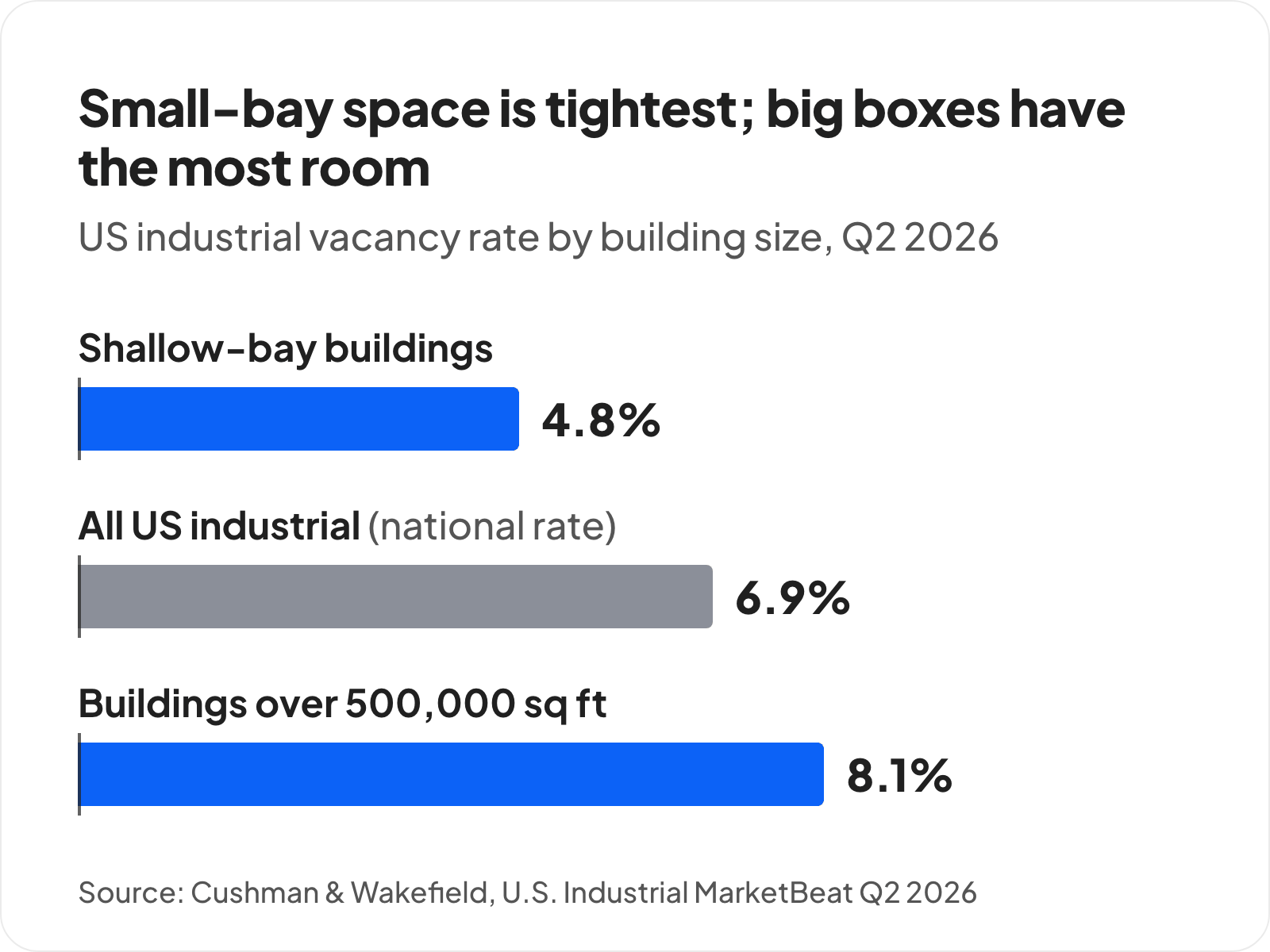
Vacancy is not even across building sizes, and that shapes how much room you have to negotiate:
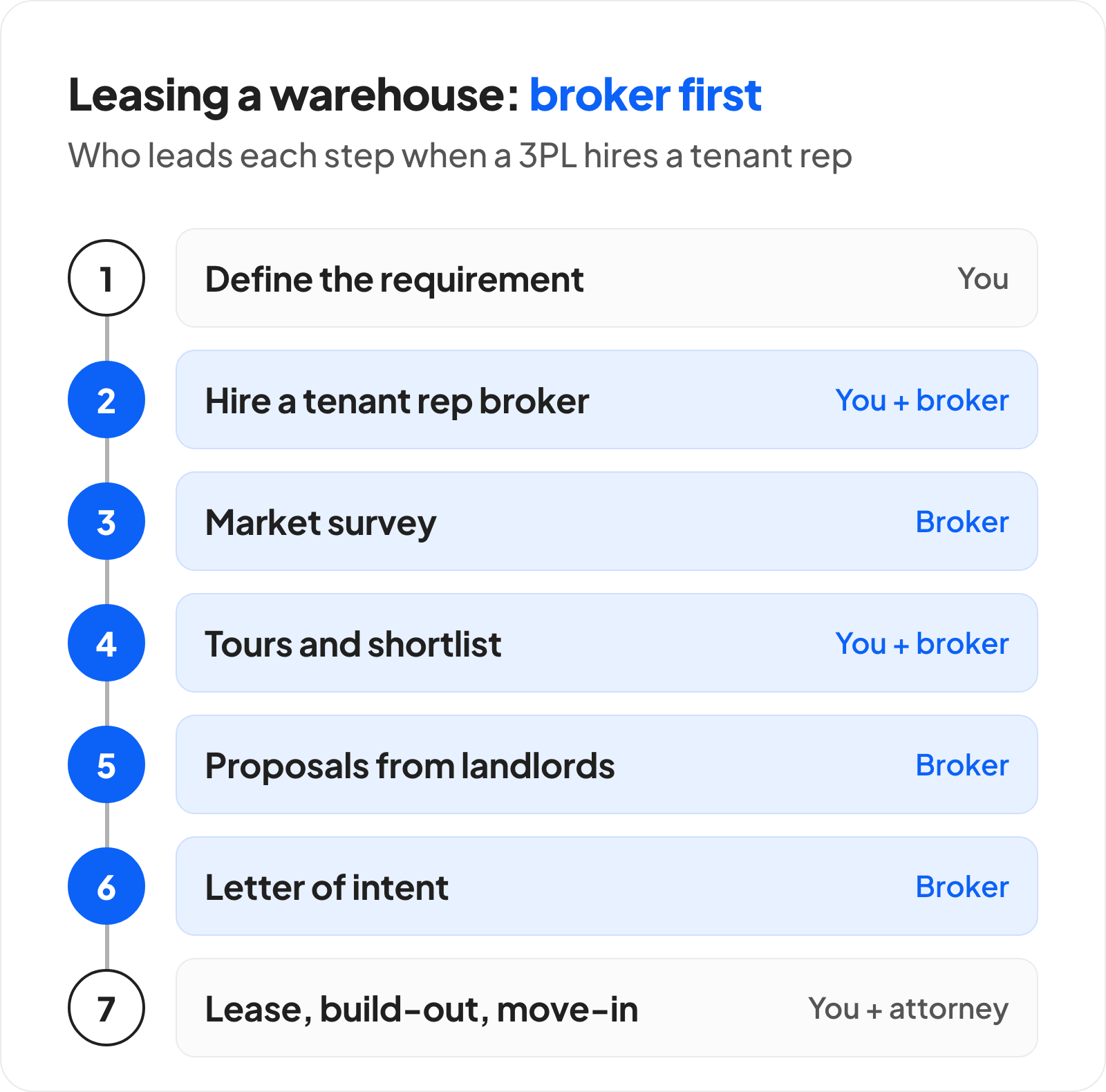
Hire the broker first, before you call listing signs or tour buildings, so every landlord knows from the first conversation that you are represented.
Siting a new distribution center is a bigger job than filling a building in a market you already serve. Ask for a broker whose firm has a supply chain or site selection group, not only a leasing team. CBRE, Cushman & Wakefield, Colliers, Cresa and Lee & Associates all list site selection, labor analysis or supply chain consulting on their own sites.
A good site selection study for a 3PL compares candidate markets on:
Rent depends heavily on the market and the building. As a national benchmark, JLL reported an average asking rent of $10.45 per square foot in Q2 2026, and Cushman & Wakefield reported asking rents up 2.9% year over year. Your local figure can be far above or below that, which is why the market survey matters.
When you compare warehouse spaces, ask every landlord to quote on the same basis:
Then price the lease into what you charge clients. Our guide to 3PL pricing shows how storage, pick and pack and receiving fees are usually structured.
Usually the landlord. Hughes Marino, a tenant-only brokerage, says "the landlord or seller typically pays our real estate commission," and that landlords pay commissions on renewals too. Confirm the arrangement in writing before you sign a representation agreement.
The landlord's broker is paid to get the most favorable deal for the landlord. A tenant representation broker shows you buildings from many owners and negotiates for you, typically without a separate fee from you.
Start well before your current space is full. Leasing activity in the first half of 2026 reached a four-year high, and small-bay vacancy was just 4.8% (Cushman & Wakefield), so good buildings in tight markets can go quickly.
New space only pays off when it is full. If you are opening a building and want to meet brands looking for fulfillment, list your 3PL on Fulfill.com. If you are new to running a warehouse business, read 7 lessons you should know when starting a 3PL.
Insights on choosing a 3PL, evaluating fulfillment partners, and scaling your eCommerce operation, from the team behind Fulfill.com.
No spam, ever. You'll get our newsletter; unsubscribe anytime.
Last-mile delivery is a crucial part of a successful supply chain operation. FRAYT is a shipping technology company that offers last mile solutions.
For 3PLsMay 30, 20233 min read
How to start a 3PL business: 7 lessons from a founder who grew a fulfillment company out of a vacant morgue, on clients, niche, carrier rates and more.
For 3PLsOctober 24, 20225 min read
How 3PL billing software turns warehouse activity into client invoices, where billing revenue leaks, WMS billing modules vs standalone tools, and what to ask.
For 3PLsNovember 1, 20269 min read