Fulfillment Center vs Distribution Center vs Warehouse
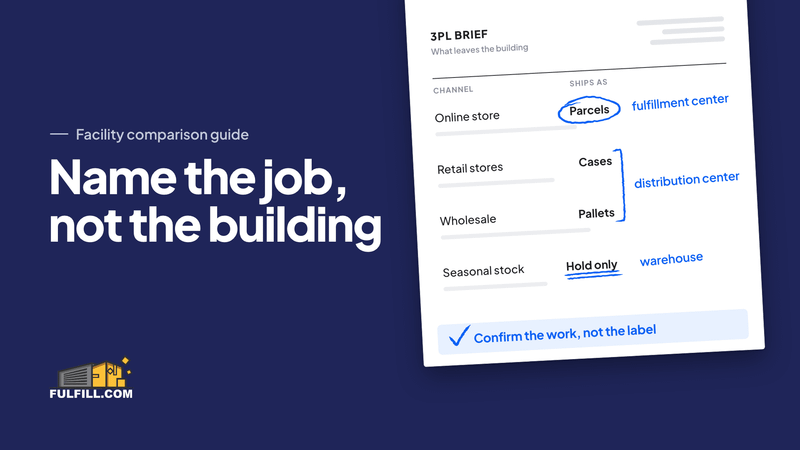
Compare fulfillment center vs distribution center and warehouse roles. Choose the right facility for ecommerce orders, retail shipments or both.
Choosing a 3PLOctober 29, 20267 min read
 Fulfill Team·October 29, 2026·Add Fulfill as a preferred source on Google
That leaves three questions for any brand that stores stock with a 3PL: what the 3PL owes, what its insurance actually covers, and which policy of your own fills the gap. This guide walks through each one, stage by stage, with the rule or carrier term behind every limit.
We also checked how many 3PLs on Fulfill.com mention insurance. Of the 2,701 3PLs on Fulfill.com, 262 list insurance among the services on their Fulfill.com profile (read October 29, 2026). Not every profile lists every service a 3PL offers, so read that as a floor. A listing does not say which policy a 3PL means or whose goods it covers, so ask, using the questions further down.
Your inventory changes hands at least three times on its way to a customer: inbound freight to the 3PL, storage in its warehouse, and the outbound parcel. Each stage has its own default rule, and each rule has a limit.

| Stage | Who is liable by default | Default limit | Where the rule comes from |
|---|---|---|---|
| Inbound ocean freight | The ocean carrier | $500 per package, unless the shipper declares a higher value on the bill of lading | Carriage of Goods by Sea Act, section 4(5) |
| Inbound truck freight | The motor carrier | The actual loss, unless a lower value is agreed in writing or declared by the shipper | 49 U.S.C. 14706 |
| Storage at the 3PL | The 3PL, when it failed to take reasonable care | The cap in the warehouse receipt or storage agreement | UCC § 7-204 |
| Outbound UPS or FedEx parcel | The carrier | $100 per package, unless a higher value is declared and paid for | UPS Tariff, section 56; FedEx Service Guide |
| Outbound USPS parcel | USPS | Up to $100 of insurance included with Priority Mail Express, Priority Mail and USPS Ground Advantage, subject to the manual's conditions | USPS Domestic Mail Manual 503 |
Two things follow. A limit is a ceiling, not a payout: the 3PL or carrier pays only when it is liable, and only up to the limit. And the gaps sit at every stage, so a brand that insures only its warehouse stock, or only its freight, still carries the rest.
Under UCC § 7-204, a warehouse is liable for loss or damage caused by its failure to take reasonable care of your goods, and, unless the agreement says otherwise, it is not liable for loss that reasonable care could not have avoided. States adopt the UCC with their own changes, and the version enacted by the state whose law governs your agreement is the one that controls.
So the cause of a loss decides whether the 3PL owes anything. Careless handling is the kind of loss the rule covers. An event the 3PL could not have avoided with reasonable care is the kind it leaves out, unless your agreement holds the 3PL to more.
Then the cap decides how much. The same section lets the warehouse receipt or storage agreement limit the amount, and a cap can be written per item, per pound or per incident. Amwins's guide to warehouse legal liability uses a storage contract that limits losses to $0.50 a pound as its example. At that rate, a 2-pound carton of earbuds worth $400 would be capped at $1. High-value, light goods show the gap most, which is why the way a 3PL writes its cap matters to brands comparing 3PLs for electronics or 3PLs for collectibles and fine art.
Section 7-204 also lets you ask in writing, when you sign, for a higher limit on some or all of your goods, and lets the warehouse charge more for it. The request can also come within a reasonable time after you receive the warehouse receipt. A cap does not limit the warehouse's liability if it converts your goods to its own use. And the agreement can set reasonable rules for when and how you present a claim, so the claim window matters as much as the cap.
Warehouse legal liability insurance, also called warehouseman's legal liability, is the policy a 3PL can carry for its legal liability for customers' goods in its care, custody or control. The Hartford, which offers it, sets it apart from commercial property insurance, which typically covers property the business owns.
The key word is liability. Amwins puts it plainly: the policy "responds to what an insured is liable for, and the contract determines what the insured is liable for." So a loss the 3PL is not liable for, such as one reasonable care could not have avoided, is outside it, and so is any amount above the cap in your agreement. Amwins's own example runs the same fire through two warehouses with identical policies: the one whose contract caps losses at $0.50 a pound answers for less than the one whose contract makes it responsible for every loss.
What the policy does not do is insure your inventory for its value. It protects the 3PL, with its own limits and terms. That is why the follow-up questions below matter more than whether a 3PL lists insurance at all.
Four options address the gaps above, and one of them is not insurance. An insurance professional can tell you which fits your stock.
A property policy can cover stock you own, but not always where it sits. Munich Re notes that general property insurance often excludes or limits goods in transit, goods stored at third-party locations and goods awaiting shipment at ports. Ask whether your policy names stock held at a 3PL's address, and at which limit.
Marsh describes a stock throughput policy as a marine cargo policy for companies that import, distribute or export goods, covering them in transit and in storage at owned or third-party premises. Munich Re describes the cover as end to end, from the moment goods are produced or purchased to their final destination. One policy across every stage leaves fewer seams between policies.
Cargo insurance covers the goods themselves while they travel, separate from what the carrier is liable for. Some forwarders offer it at booking: Kuehne+Nagel, for one, describes cargo insurance applied each time you book a shipment, arranged with its insurance broker subsidiary.
Declaring a higher value raises a carrier's liability limit on a package, for a fee. It is not insurance. UPS's terms say a shipper who declares a higher value "does not receive any form of insurance," and FedEx's say FedEx does not provide insurance coverage of any kind. Insurance is bought separately, from an insurer.
Ask these before you sign, and get the answers in writing:
Then put the answers in the agreement. Our 3PL contract guide's liability and insurance clause covers what to write down. For a second read of the commercial terms, Freight & Fulfillment Optimization Advisors describes analyzing existing 3PL and carrier agreements and negotiating their terms.
A loss can run on more than one deadline: the carrier's or the 3PL's, and your own insurer's.
For a domestic package, UPS must receive notice of the claim within 60 days after delivery, and the claim must be filed within nine months (UPS Tariff, section 55.3). FedEx asks for notice of concealed damage as promptly as possible and no later than 60 days after delivery, and for the written claim within 90 calendar days of delivery, with documents that prove the value. It also asks that the original cartons, packing and contents stay available for its inspection until the claim is resolved (FedEx Service Guide, Claims). USPS sets its claim rules in Domestic Mail Manual section 609. For inbound freight, a freight claim goes to the carrier, under the terms of the bill of lading.
When the 3PL ships on its own carrier account, who files carrier claims for your orders is a term to settle in the agreement. Claims services take on this work too: Intelligent Audit, for one, lists lost and damaged claims management among its services.
The storage agreement can set the claim window and the proof the 3PL needs. Keep the records that show what arrived, what the 3PL confirmed it received, and what is now missing or damaged: receiving reports, inventory counts and order records.
Your own policy sets its own notice terms, separate from the 3PL's and the carrier's, so a loss can need a notice to your insurer as well as a claim against the 3PL or carrier.
Not by default. A 3PL's warehouse legal liability policy responds only to what the 3PL is liable for, such as losses from its failure to take reasonable care up to your agreement's cap, and within the policy's own terms. If a 3PL offers more cover, ask what it covers.
It covers a 3PL's legal liability for customers' goods in its care, custody or control, within its own limits and exclusions. It leaves out losses the 3PL is not liable for and amounts above the contract's cap, and may not follow a contract that widens the 3PL's liability.
No. Commercial property insurance typically covers property the business owns. Warehouse legal liability covers the 3PL's legal liability for goods it holds for customers, which it does not own.
No. Declaring a higher value raises the carrier's liability limit for a fee. UPS's and FedEx's terms both say it is not insurance. Insurance is bought separately, from an insurer.
Yes. UCC § 7-204 lets you ask in writing, when you sign or within a reasonable time after you receive the warehouse receipt, for a higher limit on some or all of your goods, and lets the warehouse charge more for it. Your governing state's version controls.
Usually the carrier, if the claim is filed in time, and only up to its limit: $100 a package by default at UPS and FedEx unless a higher value was declared. Who files the claim, and how a recovery reaches you, is a term to settle with your 3PL.
Insurance is one line to compare when you choose a 3PL, next to storage, service and price. Tell us what you sell and where it ships, and we will match you with 3PLs that fit.
How we counted. The count covers 3PLs with an active profile on Fulfill.com on October 29, 2026, from the services shown on each profile, so it is a floor. The rules and carrier terms below were also read on October 29, 2026:
Insights on choosing a 3PL, evaluating fulfillment partners, and scaling your eCommerce operation, from the team behind Fulfill.com.
No spam, ever. You'll get our newsletter; unsubscribe anytime.
Compare fulfillment center vs distribution center and warehouse roles. Choose the right facility for ecommerce orders, retail shipments or both.
Choosing a 3PLOctober 29, 20267 min read
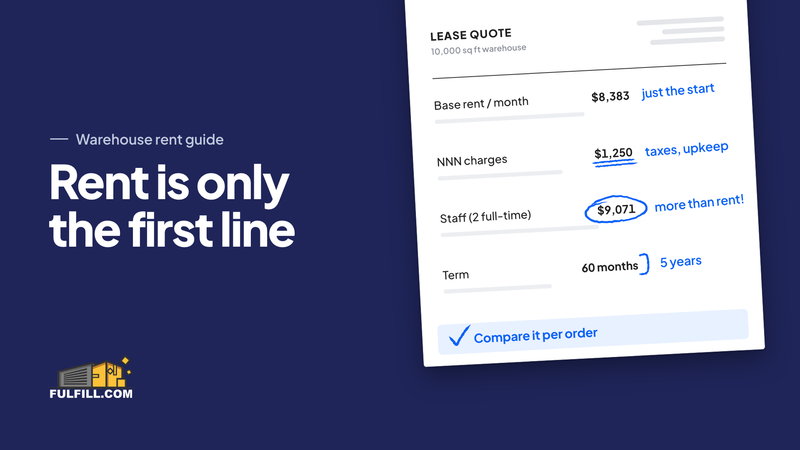
Average U.S. warehouse asking rent was $10.06 per sq ft a year in Q3 2026, plus NNN. Rent by market, the full monthly cost, and when a 3PL costs less.
Choosing a 3PLOctober 23, 202611 min read
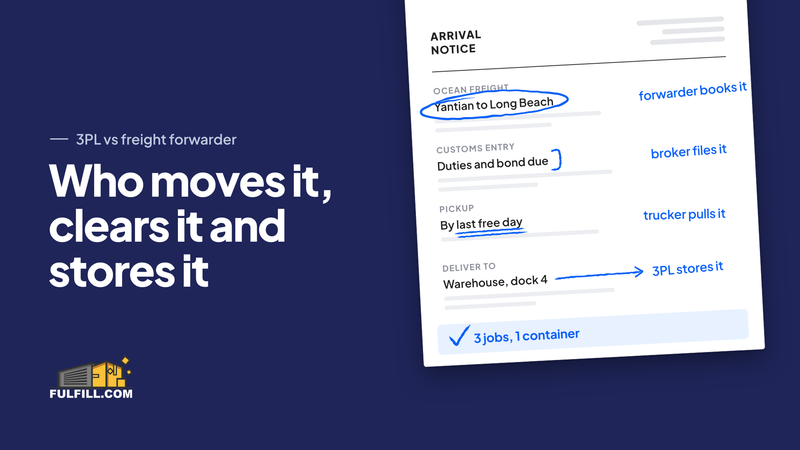
A freight forwarder books the move to a US port, a customs broker clears it, and a 3PL stores and ships it. The handoff, the costs, and network data.
Choosing a 3PLOctober 23, 202611 min read