Fulfill or Fulfil? Fulfillment vs Fulfilment Explained
Fulfill (US) and fulfil (UK) are both correct. Learn when to use fulfillment vs fulfilment, with examples from the eCommerce logistics industry.
Shipping and operationsJuly 18, 20236 min read
 Carissa Spisak·Updated September 23, 2026·Add Fulfill as a preferred source on Google
A straight truck is a truck whose cab and cargo body are mounted on one chassis frame, with every axle attached to that frame. Nothing hitches or pivots between the driver and the freight, which is what separates it from a tractor-trailer. The Federal Highway Administration counts these vehicles as "single-unit trucks," meaning all vehicles on a single frame, and the federal CDL rules call the heavier ones a "Heavy Straight Vehicle".
The name comes from the truck's structure: the cargo body is attached directly to the truck's frame instead of riding on a separate trailer. This design allows for easier maneuverability, making straight trucks an ideal choice for deliveries in urban areas or locations with tight spaces. For shippers, they are the workhorse of local and regional freight: pallet deliveries to stores, LTL pickups from a warehouse dock, and bulky home deliveries that need a lift gate at the curb.
Straight trucks are often called box trucks or cube trucks, and in everyday use the names overlap, but they are not the same thing. "Straight truck" describes how the vehicle is built: one frame, no trailer. "Box truck" describes the body on that frame: an enclosed, box-shaped cargo area. Every box truck is a straight truck. Not every straight truck is a box truck, because a flatbed, a stake bed, a dump truck or a tank truck built on a single frame is a straight truck too.
The useful comparison for most shippers is between a straight truck and a tractor-trailer, since that decides how much freight fits on one load and who is allowed to drive it.
| Feature | Straight truck | Box truck | Tractor-trailer |
|---|---|---|---|
| Build | Cab and body on one frame | A straight truck with an enclosed box body | Tractor pulling one or more separate trailers |
| Bodies | Box, refrigerated, flatbed, stake bed, dump, tank | Enclosed box, sometimes refrigerated | Swaps trailers, so any trailer type |
| Articulation | None | None | Pivots at the hitch |
| CDL group at 26,001 lb or more | Group B (Heavy Straight Vehicle) | Group B (Heavy Straight Vehicle) | Group A (Combination vehicle), when the trailer is rated over 10,000 lb |
| Typical work | Local and regional delivery, construction, utilities | Local delivery, moving, LTL pickup and delivery | Long-haul and full truckload freight |
CDL groups are from 49 CFR 383.91. Below 26,001 lb, a CDL is needed only for placarded hazardous materials or 16 or more passengers (Group C), as covered in the CDL section below.
There are several types of straight trucks, each designed to meet specific transportation needs. They are grouped two ways: by the body behind the cab, and by the cab itself.
The standard straight truck has a regular two-door cab. The extended cab straight truck features a larger cab for additional passenger space, and the crew cab straight truck has an even larger cab that can accommodate a full crew of workers. Many urban straight trucks use a cab-over-engine design, which places the driver's cab over the engine, resulting in a shorter overall vehicle length. Conventional-cab straight trucks, with the engine ahead of the driver, are also widely used.
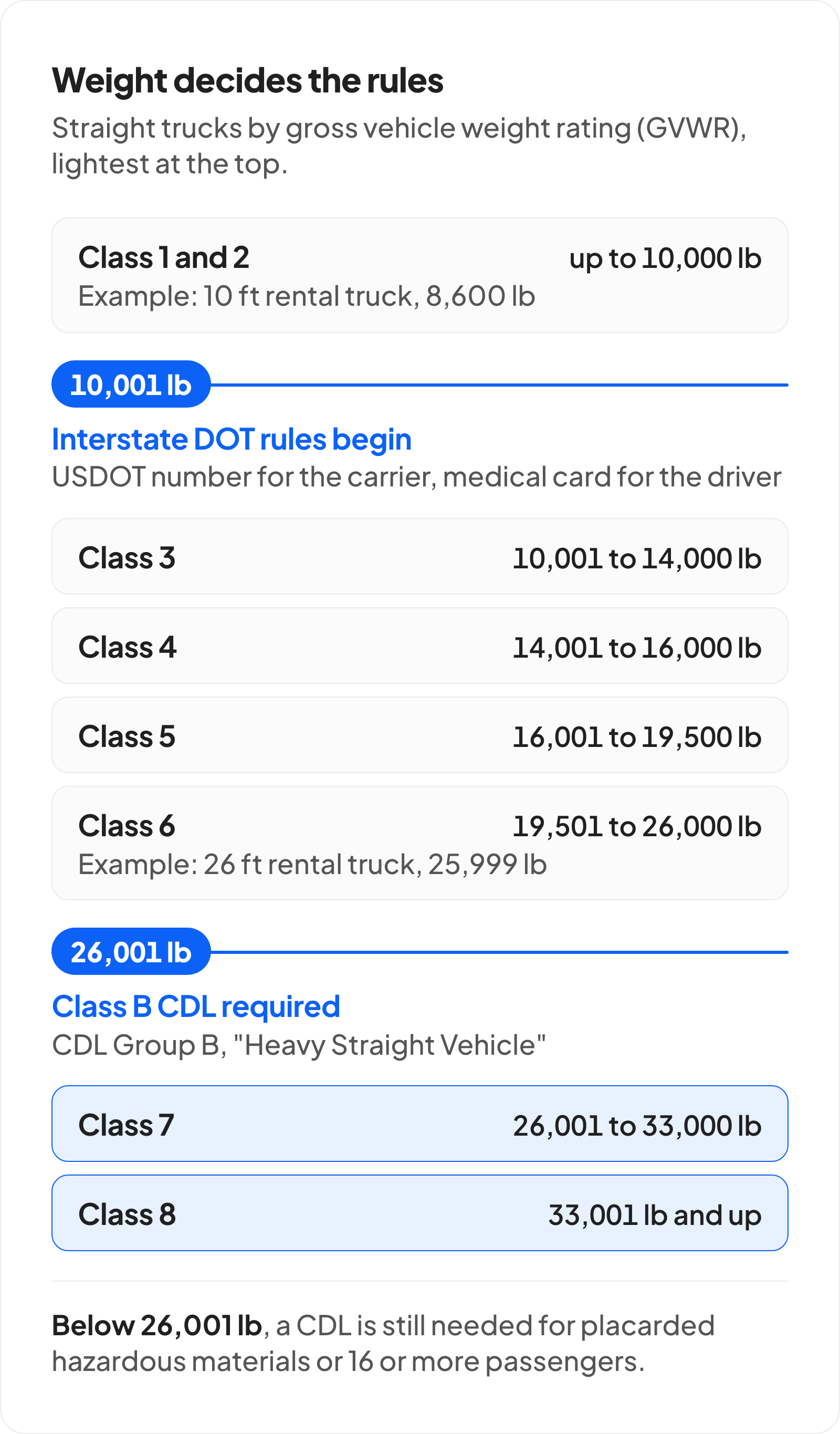
Straight trucks are sold and regulated by gross vehicle weight rating (GVWR): the maximum the loaded truck may weigh, set by the manufacturer. The Federal Highway Administration's weight classes, as published by the U.S. Department of Energy's Alternative Fuels Data Center, are the scale the industry uses. Most straight trucks fall in Classes 3 through 8.
| FHWA class | GVWR (lb) | Duty category |
|---|---|---|
| Class 3 | 10,001 to 14,000 | Medium duty |
| Class 4 | 14,001 to 16,000 | Medium duty |
| Class 5 | 16,001 to 19,500 | Medium duty |
| Class 6 | 19,501 to 26,000 | Medium duty |
| Class 7 | 26,001 to 33,000 | Heavy duty |
| Class 8 | 33,001 and up | Heavy duty |
Source: AFDC, Vehicle Weight Classes and Categories. The line between Class 6 and Class 7 matters most, because 26,001 pounds is also where a CDL becomes required.
Box length is how straight trucks are usually described, from small 10 foot trucks to the 26 foot trucks common in rental and delivery fleets. Two published rental specs show the range:
Payload is GVWR minus the truck's empty weight, which is why the 26 foot truck above carries about 12,900 pounds even though it is rated just under 26,000. On public roads, federal rules cap vehicle width at 102 inches on the National Network and set no federal height limit; states set heights between 13.6 and 14.6 feet. The federal length standards cover semitrailers and trailers, so a straight truck's overall length limit comes from state law (FHWA size and weight overview).
If your freight is arriving at a warehouse by straight truck, confirm with the receiving team whether the deck height lines up with their dock doors or whether the load needs a ground-level door or a lift gate.
Whether you need a commercial driver's license to drive a straight truck depends on its GVWR, not its length:
"DOT" rules start lower than the CDL line. For interstate work, FMCSA treats a truck with a GVWR, or actual weight, of 10,001 pounds or more as a commercial motor vehicle (49 CFR 390.5). That brings in USDOT registration for the carrier (49 CFR 390.201) and a medical examiner's certificate for the driver (49 CFR 391.41), even when no CDL is needed. States add their own licensing and intrastate rules, so check your state's DMV and DOT before putting a truck in service.
In the context of warehousing and fulfillment, straight trucks serve as a vital link between the warehouse and the customer. They carry inbound pallets from a supplier or port to the warehouse, outbound LTL freight from the warehouse to a carrier terminal, and retail replenishment and bulky orders to their final stop, the last mile.
Most ecommerce orders leave a warehouse by parcel carrier. The ones that go by straight truck are pallets, retail replenishment and large items: the warehouse picks and stages the order at the dock, it is loaded onto the truck, and the carrier delivers it to a store, a terminal or the customer's door. If you sell furniture, appliances or other large items, look at 3PLs that handle big and bulky freight, since those orders often ship by straight truck rather than parcel.
One of the main benefits is their size and maneuverability, which allows them to navigate through residential areas and tight spaces with ease. This makes them particularly suited for last mile delivery, where goods need to be delivered to the customer's doorstep. The enclosed cargo area of a box truck protects goods during transit, reducing the risk of damage or loss, and trucks rated at 26,000 pounds or less can be driven without a CDL, which widens the pool of drivers.
One of the main challenges is the limited capacity of straight trucks. They are not as large as tractor-trailers, which can transport larger quantities of goods in a single trip, so large volumes moving long distances usually go by tractor-trailer instead. Another challenge is the cost of operating and maintaining straight trucks: fuel, insurance, maintenance and the purchase price add up, especially for small businesses or startups with limited capital. Brands that do not want to own trucks can leave local freight to their 3PL and its carriers, and weigh those costs alongside the rest of their 3PL pricing.
Because the truck runs straight from the front bumper to the back of the body on one frame, with no hitch or pivot point. A tractor-trailer bends at the hitch; a straight truck does not.
Yes. A box truck is a straight truck with an enclosed box body. The reverse is not always true: a flatbed, dump or tank truck on a single frame is also a straight truck.
Only if its GVWR is 26,001 pounds or more (Class B), or if it carries hazardous materials as defined in the CDL rules or is designed for 16 or more passengers. A truck rated at 26,000 pounds or less needs no CDL on weight alone (49 CFR 383.91).
The federal rules use "Heavy Straight Vehicle" for CDL Group B, a single vehicle of 26,001 pounds GVWR or more. Separately, any truck with a GVWR, or actual weight, of 10,001 pounds or more used in interstate commerce is a commercial motor vehicle under FMCSA rules, which brings USDOT registration and driver medical certification (49 CFR 390.5).
Its payload: GVWR minus empty weight. A U-Haul 26 foot truck, for example, is listed at a 25,999 lb GVWR and a 12,859 lb maximum load (U-Haul). Heavier Class 7 and 8 straight trucks carry more and need a Class B CDL.
Time logged driving a straight truck, usually a box truck. When a delivery or carrier job posting asks for it, the employer wants a driver who has already handled a single-frame truck of that size on real routes.
A straight truck is any truck with its cab and cargo body on one frame. Box trucks are the most familiar type, but flatbeds, dump trucks and tank trucks count too. Weight decides the rules: 10,001 pounds GVWR is where interstate DOT requirements begin, and 26,001 pounds is where a Class B CDL is required. For brands, straight trucks are what bring inbound pallets to your warehouse and bulky orders to your customers, so understanding the role and function of straight trucks is useful for anyone involved in the ecommerce logistics chain.
Insights on choosing a 3PL, evaluating fulfillment partners, and scaling your eCommerce operation, from the team behind Fulfill.com.
No spam, ever. Unsubscribe anytime.
Fulfill (US) and fulfil (UK) are both correct. Learn when to use fulfillment vs fulfilment, with examples from the eCommerce logistics industry.
Shipping and operationsJuly 18, 20236 min read
Pick, pack and ship explained: piece, batch, zone and wave picking, packing and dimensional weight, typical 3PL fees and picking accuracy benchmarks.
Shipping and operationsMay 31, 20239 min read
What is a liftgate? A powered platform that lowers freight off a truck where there is no dock. When liftgate delivery is required and what carriers charge.
Shipping and operationsMay 30, 20237 min read