Pick, pack and ship is the part of ecommerce order fulfillment that turns an online order into a parcel on a truck. Picking means pulling the ordered items from their storage locations, packing means checking them, boxing them and labeling the box, and shipping means handing the sealed parcel to a carrier and sending the customer tracking. It is often shortened to pick and pack, and it is the labor you pay for, per order, when a warehouse or 3PL fulfills for you.
This guide covers each step, the four common picking methods, how box size changes your shipping bill through dimensional weight, what 3PLs charge for pick and pack, and what picking accuracy good warehouses reach.
The Pick, Pack and Ship Process at a Glance
Step
What happens
What goes wrong
Pick
A picker follows a pick list from the warehouse system to each item's bin and scans it
Wrong item, wrong size or color, wrong quantity
Pack
A packer scans the items again, chooses a box, adds protection, the packing slip and any inserts, then seals, weighs and labels it
Oversized boxes, damage in transit, missing inserts
Ship
The label is bought at the chosen carrier and service, the parcel is scanned onto the carrier's manifest and picked up, and tracking goes to the customer
Missed carrier pickup, wrong service level, no tracking
Where Pick, Pack and Ship Fits in Order Fulfillment
A common way to describe order fulfillment is in seven steps. Pick, pack and ship is the middle of it:
Receiving: inbound inventory is counted, checked and logged.
Storage: each SKU is put away in a known bin, shelf or pallet location.
Order processing: the order arrives from your store or marketplace and is released to the warehouse.
Picking
Packing
Shipping
Returns: returned items are inspected, then restocked or disposed of.
Picking only runs smoothly when receiving and storage were done right. If a SKU was put away in the wrong bin, the picker finds the wrong item, and no amount of care at the packing station fixes a count that was off from the start.
Step 1: Picking
Picking starts when the warehouse management system (WMS) turns released orders into pick lists. A pick list tells the picker which bin to visit, which SKU to take and how many units. In most modern warehouses the picker scans the bin and each item with a handheld scanner, so the system flags a wrong item before it leaves the shelf.
Walking between bins takes up much of a picker's time, so warehouses choose a picking method that cuts travel for their order mix.
Piece picking
Also called discrete or single-order picking: one picker takes one order at a time and walks the aisles until it is complete. It is the simplest method and the easiest to get right, but every order means a full trip. It suits low volume, a small warehouse or large, bulky items.
Batch picking
In batch picking, one picker collects items for several orders in a single trip, often into a cart with a tote per order (sometimes called cluster picking). If twenty orders all include the same best seller, the picker visits that bin once. Items are sorted back into orders at the cart or at the packing station.
Zone picking
The warehouse is split into zones and each picker stays in one. An order passes from zone to zone, often in a tote on a conveyor, and each picker adds the items stored in their area. It keeps pickers in aisles they know well and works for large warehouses with many SKUs.
Wave picking
Wave picking releases orders in scheduled groups, or waves, planned around things like carrier pickup times or shipping service. Within a wave the warehouse can still pick by piece, batch or zone. The point is to have the right orders packed before the right truck arrives.
Method
How it works
Typical fit
Piece
One picker, one order, one trip
Low volume, few SKUs, bulky items
Batch
One picker, many orders, one trip
Many small orders that share SKUs
Zone
Each picker owns an area; orders move between zones
Large warehouses, large SKU counts
Wave
Orders released in timed groups
High volume with several carrier pickups a day
Warehouses also layer technology on top of the method: RF scanners, pick-to-light displays on the shelving, and voice picking headsets. Slotting, which places fast-moving SKUs closest to packing, cuts walking whatever method is used.
Step 2: Packing
At the packing station a packer:
Verifies the order by scanning each item against the order, the second check after picking.
Chooses packaging: a box, mailer or poly bag sized to the items.
Protects the contents with void fill such as paper or air pillows so nothing shifts in transit.
Adds paperwork and inserts: the packing slip, plus any marketing inserts, samples or gift notes you have asked for.
Seals, weighs and measures the parcel, then prints and applies the shipping label.
Branded boxes, tissue paper and multi-item bundles take more time per order. If you sell sets or subscription boxes, ask whether the warehouse builds them ahead of time as kitting, which is usually billed separately from pick and pack.
Why box size matters: dimensional weight
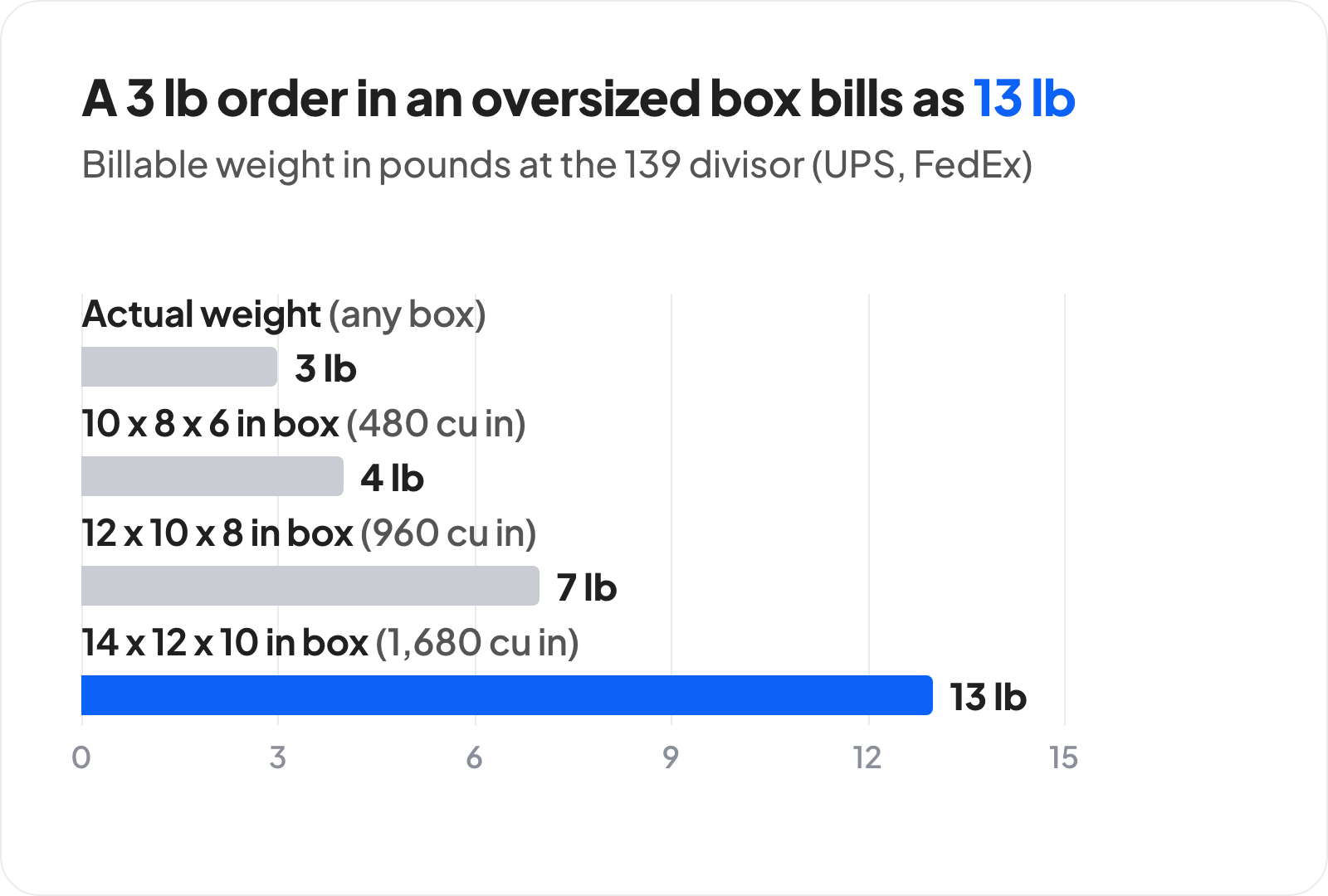
Carriers price a parcel on whichever is greater: its actual weight or its dimensional weight, a weight worked out from the box's size. The formula is length times width times height in inches, divided by a number called the DIM divisor. The result is rounded up to the next whole pound. For the three large U.S. parcel carriers the divisor is 139:
Carrier
DIM divisor
When it applies
Source
UPS
139
May apply to all UPS domestic and international package services; fractions of an inch round up
UPS Rate and Service Guide, Daily Rates, 2026 (updated September 7, 2026)
FedEx
139
All shipments in customer packaging; fractions of an inch round up
FedEx Service Guide, effective January 5, 2026 (updated September 11, 2026)
USPS
139
Commercial Priority Mail and USPS Ground Advantage rectangular parcels over 1 cubic foot (1,728 cubic inches)
USPS Domestic Mail Manual 223 and 283, revised July 12, 2026
In practice this means a light product in a box that is too big is billed as a heavy one:
Source: Fulfill.com calculation using the 139 divisor published by UPS (Daily Rates guide, 2026) and FedEx (Service Guide, January 2026). USPS applies dimensional weight only above 1 cubic foot.
This is why good packing stations stock several box sizes and why some warehouses use automated box-sizing machines. Ask any warehouse you are considering how it chooses box sizes for your products, and whether you can supply your own.
Step 3: Shipping
Shipping starts before the box is sealed. The warehouse's shipping software buys the label, often by rate shopping across carriers and services for the cheapest option that meets the delivery promise you show at checkout. Price depends on billable weight and on the shipping zone, which is set by the distance between the warehouse and the customer.
Labeled parcels are sorted by carrier, scanned onto each carrier's manifest and loaded at the scheduled pickup. The tracking number then flows back to your store, which sends it to the customer. Warehouses usually set a daily order cutoff time: orders released before it are expected to leave that day, and orders after it go out on the next working day. Ask each warehouse for its cutoff and for its record of shipping on time against it.
What 3PLs Charge for Pick, Pack and Ship
Many third-party logistics (3PL) providers charge a fee for the first item in an order and a smaller fee for each extra item. Packaging and postage are usually billed on top. Typical ranges from The Fulfillment Advisor's 2025 study of more than 600 warehouses:
Fee
Typical range
First item picked (per order)
$2.00 to $3.00
Each additional item
$0.30 to $0.75
Packaging materials
$0.25 to $1.00, depending on size
Postage
Carrier rate, passed through or marked up
The same source reports that 74% of fulfillment providers charge for boxes separately. That is why a low headline pick fee can still produce a high invoice: compare quotes on the total cost of a typical order, box and postage included, not on the pick fee alone. Our 3PL pricing guide breaks down storage, receiving, returns and the other fees that sit around pick and pack.
How Accurate Should Picking Be?
Order accuracy is the measure your customers feel directly. The Warehousing Education and Research Council (WERC) benchmarks it every year in its DC Measures report. For 2025, the top tier of distribution centers reached these levels:
Metric
What it measures
WERC 2025 top tier
Order-picking accuracy
Orders picked correctly out of all orders picked
99.68% or higher
On-time ready to ship
Orders packed, documented and ready for pickup at the planned time
99.5% or higher
On-time shipments
Orders off the dock at the planned time
99.5% or higher
Lines picked and shipped per hour
Order lines per person per hour
70 or more
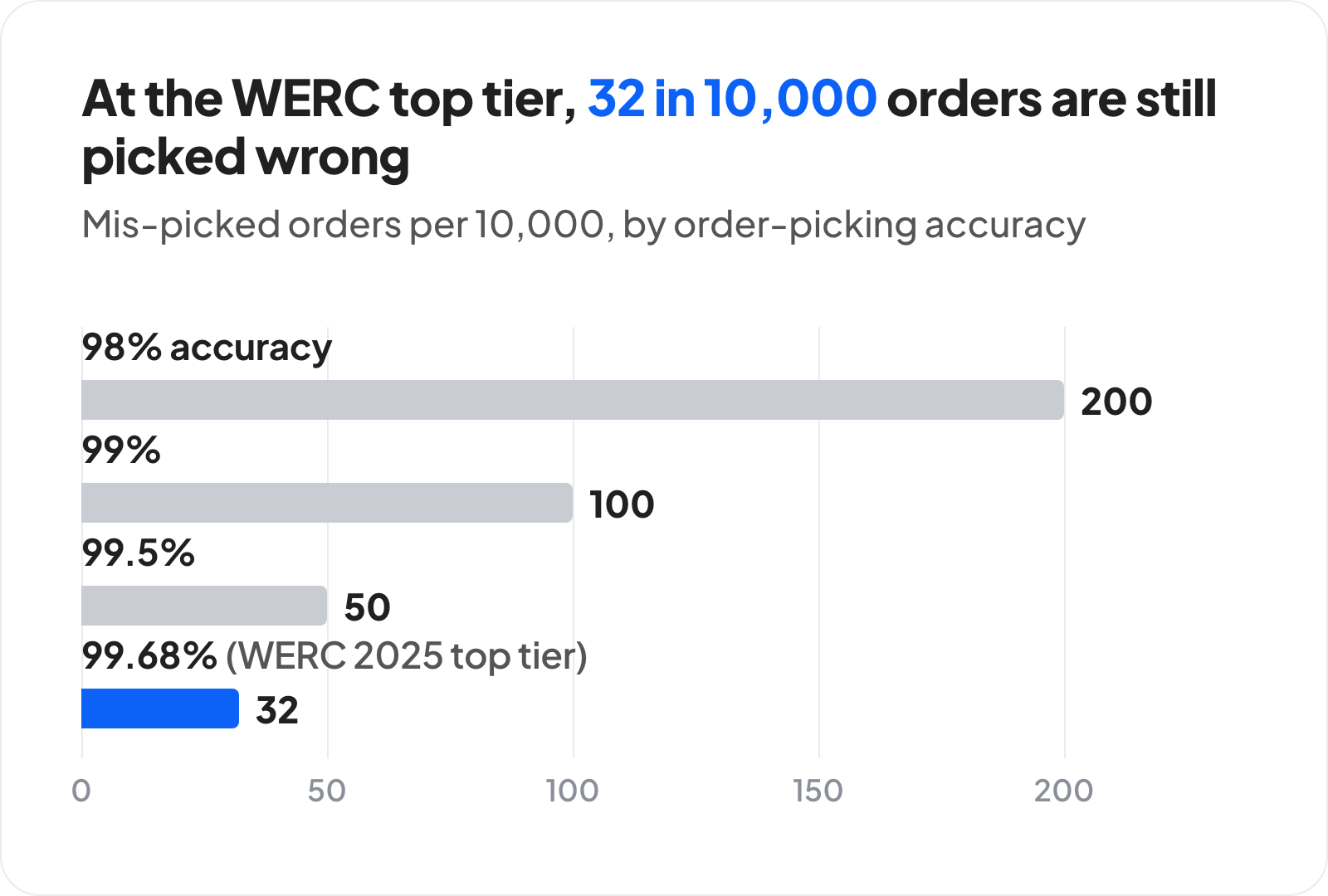
A fraction of a percentage point sounds small, but it adds up across thousands of orders:
Source: WERC 2025 DC Measures top-tier order-picking accuracy (99.68%), as published by Yale Materials Handling; error counts are Fulfill.com arithmetic.
Each mis-pick that gets through costs a reshipment, a return and sometimes a customer. When you compare warehouses, ask how each one measures accuracy (per order, per line or per unit give different numbers), what it reported for the last few months, and what happens to your invoice when it ships a wrong item.
In-House or Outsourced?
Plenty of brands pick, pack and ship from a garage or a small warehouse at first. Handing the work to a 3PL starts to make sense when order volume outgrows your space or your team:
Focus: your time goes into product and marketing, not packing tables.
Fewer errors: a warehouse that scans items at both picking and packing catches wrong items before they ship.
No fixed overhead: you pay per order instead of for warehouse space, staff and equipment.
Room to scale: seasonal peaks are absorbed by the 3PL's labor pool, not by hiring your own.
Shipping rates: 3PLs ship at volume and often negotiate discounted rates with carriers.
Frequently Asked Questions
What does pick pack and ship mean?
It is the three-step process of pulling ordered items from warehouse storage (pick), boxing and labeling them (pack), and handing the parcel to a carrier with tracking (ship). It is the core labor of ecommerce order fulfillment.
What does "pickpack" mean?
Pickpack, or pick and pack, is shorthand for the same work, and usually the name of the per-order fee a 3PL charges for it. Shipping costs are billed separately.
Who is the cheapest company to ship with?
No single carrier is cheapest for every parcel. The price depends on billable weight, box size and the distance zone, so the cheapest option changes from one package to the next. That is why warehouses rate shop each label across UPS, FedEx, USPS and regional carriers.
Is pick and pack the same as order fulfillment?
No. Pick and pack is part of fulfillment. Full order fulfillment also covers receiving and storing inventory, processing orders, shipping and handling returns.
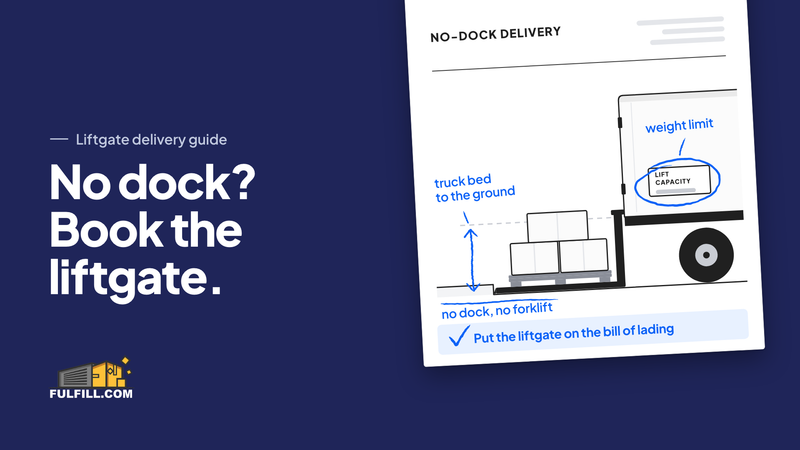
What is a liftgate? A powered platform that lowers freight off a truck where there is no dock. When liftgate delivery is required and what carriers charge.