
The Hidden Costs of Mis-Shipments and How to Avoid Them
Mis-shipments are a common occurrence in the world of order fulfillment. This article explores the financial implications of a mis shipment.
Shipping and operationsMay 24, 20237 min read
 Carissa Spisak·Updated September 23, 2026·Add Fulfill as a preferred source on Google
If you've ever had to move heavy objects or had a large delivery, you may have wondered, "What is a liftgate?" In logistics, a liftgate (also written lift gate) is the powered platform on the back of a truck that raises freight from the ground to the trailer floor and lowers it back down. For a shipper, it is also a line on the freight bill: a carrier charge that applies whenever a delivery or pickup needs that platform because there is no loading dock.
The short answer
The hardware is hydraulic or electric equipment mounted at the rear of a truck or trailer. Its platform travels between the ground and the height of the truck bed, and the driver runs it from a switch box with a simple "up" and "down" function.
In LTL (less-than-truckload) shipping, the word usually means the service rather than the hardware. "Liftgate delivery" or "liftgate service" means the carrier sends a truck equipped with a liftgate and uses it to set your pallets on the ground. It is an accessorial charge, one of the fees carriers add for anything beyond a standard dock-to-dock move. Estes, for example, describes liftgate use as an accessorial that carries an additional charge (Estes LTL FAQ).
A liftgate is required any time a location can't lift freight to the height of a trailer, or down from the trailer to the ground. Estes puts the test simply: when the receiving location has no raised loading dock, forklift or pallet jack, a liftgate may be needed to move freight safely from the trailer to the ground (Estes). In practice that means:
When an order, a booking form or a carrier's delivery notes say "liftgate required," it means the address cannot unload the freight without one, so the carrier must send a liftgate truck. Estes advises the shipper to specify the liftgate when requesting the pickup or on the bill of lading, so the arriving vehicle is equipped with one (Estes). Leaving it off does not avoid the charge. XPO's tariff applies its liftgate charge whenever the carrier is "required or requested" to use its lifting equipment, including when a dock problem forces it (XPO CNWY 199-AK.3, Item 218). And carriers are not obliged to perform the service when no liftgate truck is available (Saia 170-D, Item 575), so an unflagged delivery can turn into a second attempt.
Each LTL carrier publishes its accessorial charges in a rules tariff. In the two tariffs below, liftgate is priced per 100 pounds (per hundredweight), with a minimum and a maximum per shipment:
| Carrier tariff (effective date) | Per 100 lb | Minimum | Maximum |
|---|---|---|---|
| XPO CNWY 199-AK.3, Item 218 (Aug 17, 2026) | $14.20 | $274.00 | $682.00 |
| Saia 170-D, Item 575 (Oct 1, 2025) | $11.54 | $156.50 | $364.00 |
Sources: XPO rules tariff CNWY 199-AK.3; Saia rules tariff 170-D.
Worked example: a 1,000 lb shipment is 10 hundredweight. At XPO's rate that is $142, below the minimum, so you pay $274. At Saia's, $115.40 becomes the $156.50 minimum. A 3,000 lb shipment comes to $426 at XPO and $346.20 at Saia. Any shipment under about 1,930 lb at XPO, or about 1,360 lb at Saia, pays the minimum.
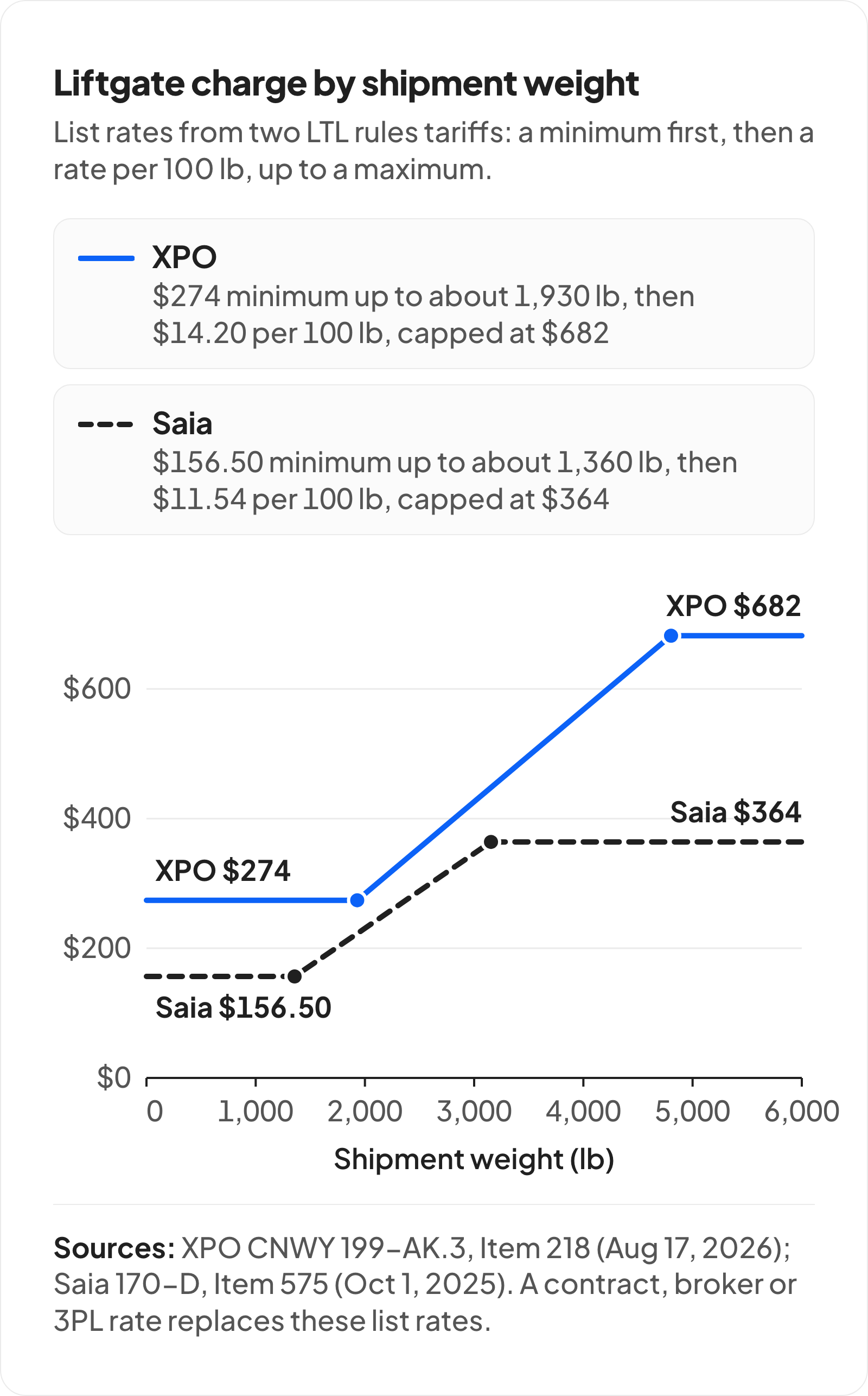
These are published list rates. If you ship on your own carrier contract or through a broker or 3PL account, the liftgate charge is whatever that agreement sets, so check it before you quote a customer.
A home delivery can carry two accessorials, not one, and at Saia it always does. XPO charges residential delivery at $16.90 per 100 lb, minimum $191, maximum $932 (Item 224). Saia charges $11.54 per 100 lb, minimum $166, maximum $694.50, and its residential item says liftgate service applies as well (Item 753). On a 1,000 lb residential shipment at those minimums, that is $465 at XPO and $322.50 at Saia before the freight charge itself. Schools, places of worship, hospitals and self-storage sites fall under a separate limited-access charge in both tariffs.
That arithmetic is why brands selling big and bulky products direct to consumers price delivery carefully.
A liftgate platform has a rated capacity and a fixed footprint, so not every pallet fits. FedEx Freight states that its liftgate can accommodate shipments up to 78.75" x 30" and up to 4,000 lbs, and that a bigger or heavier shipment may be rejected (FedEx freight packing guide). Estes says its service centers carry both standard and oversized 8-foot liftgates (Estes). Limits differ by carrier and by truck, so book with the size and weight of each handling unit, not just the shipment total.
Liftgate service ends at the back of the truck. Saia's tariff says the carrier transfers the freight to the top of the lift gate or off the trailer, at which point delivery is complete, and the consignee unloads it from there (Saia 170-D, Item 575). Its residential service is curbside only (Item 753). Moving the freight into a garage, up stairs or into a room is inside delivery, a separate charge (XPO bills it at $18.50 per 100 lb, minimum $190, in Item 216), or white glove service if you also need unpacking or assembly.
Manufacturers build liftgates in several styles. MAXON's range, for example, includes (MAXON Lift):
If you are moving your own goods rather than shipping through a carrier, rental trucks with lift gates suit a one-off move of heavy items, such as furniture, equipment or a small inventory transfer. For recurring freight, booking liftgate service with an LTL carrier is usually the simpler path, because the carrier supplies the truck and the driver.
Because the trailer floor sits well above the ground and the receiving address has no dock, forklift or pallet jack to bridge the gap. Without a liftgate, a pallet of heavy freight has no safe way off the truck.
Liftgate delivery puts the freight on the ground at the back of the truck. Inside delivery moves it past the doorway, and carriers bill it as a separate accessorial.
No. In freight, a liftgate is a powered platform that raises and lowers a load; a tailgate is a hinged panel that only opens. On cars and SUVs, "liftgate" also names the rear hatch that swings up, which is a different thing from the freight equipment this article covers.
Lift gates are an essential tool in freight and logistics, simplifying the loading and unloading of heavy items at addresses without a dock. For a shipper, the practical questions are when liftgate delivery is required, what your carrier's tariff or contract charges for it, and whether each charge on the invoice was actually needed. Get those three right and the liftgate stops being a surprise line on the freight bill.
Insights on choosing a 3PL, evaluating fulfillment partners, and scaling your eCommerce operation, from the team behind Fulfill.com.
No spam, ever. Unsubscribe anytime.
Mis-shipments are a common occurrence in the world of order fulfillment. This article explores the financial implications of a mis shipment.
Shipping and operationsMay 24, 20237 min read
Supply chain and logistical processes have always struggled due to unpredictability and human error. That's why AI and Machine Learning can help.
Shipping and operationsOctober 22, 20226 min read
Are you debating whether or not you need custom packaging for your ecommerce brand? Here are 5 reasons you should get custom packaging.
Shipping and operationsSeptember 22, 20223 min read