With one sales channel and one warehouse, your store's admin is your order
management system. Orders come in, your 3PL's integration pulls them, and
tracking goes back to the customer. Nothing needs deciding.
That changes when you add Amazon, TikTok Shop or a wholesale account, or a
second 3PL. Now every order needs a decision: which location ships it,
whether to split or hold it, and how tracking and stock counts get back to
every channel. An order management system (OMS) makes those decisions and moves
the data.
This guide to ecommerce order management software is for brands doing
roughly $5M to $100M that ship through a 3PL and are adding a channel or a
warehouse. It covers what an OMS does to each order, the signs you need one
and the signs you don't, exactly what passes between an OMS and your 3PL,
what it costs, and ten questions that tell a good vendor answer from a weak
one. The featured example is Pipe17, a Fulfill.com vendor partner that pays
us when readers click through to its site.
The short answer
An OMS decides where each order ships from, then moves orders, tracking
and stock counts between your sales channels and your warehouses.
With one channel and one warehouse, you probably do not need one. With
two or more of each, score yourself on the checklist below.
Published prices run from about $20 to about $1,200 a month; enterprise
and connectivity-led OMSs, Pipe17 included, sell by quote.
Before you buy, confirm the OMS has a live connection to your 3PL, by
name, and get the cost of every change after go-live in writing.
In this article (13 sections)
What is ecommerce order management?
Ecommerce order management is everything that happens to an order between
checkout and delivery, across every channel you sell on and every location
you ship from. An ecommerce order management system is the software that
runs it. The deciding and coordinating part is also called
order orchestration.
Our order management system glossary entry
has the general definition; this guide covers the ecommerce version, where
the fulfillment side is usually a 3PL.
What an OMS does with each order
Capture. It pulls orders from every storefront, marketplace,
wholesale portal and EDI retail partner into one queue, in one format.
Check and hold. It flags likely fraud and bad addresses, and can
hold new orders briefly so customers can cancel or edit them.
Route. It chooses the location that ships each order: the warehouse
or 3PL that has the stock, is closest, costs least, or can meet the
delivery date. This is automated order routing,
and it is what makes multi-node fulfillment
work across several warehouses.
Split or combine. It decides whether an order no single location can
fill should split or wait, and whether
separate orders to one address should ship together.
Hand off. It sends the order to the warehouse's system in the format
that system expects, with kits and bundles broken
into the components the picker needs.
Sync back. It returns tracking to the channel and the customer, and
pushes updated stock counts to every channel so you do not oversell.
Handle what breaks. It retries failed handoffs and sends the rest
to a person.
Returns run the same path in reverse.
One order's journey
An illustrative example: a brand sells on Shopify and Amazon and stocks two
3PL warehouses, in New Jersey and Reno.
10:02. A customer in Ohio orders two items on Shopify. The OMS pulls
the order in and holds it for 30 minutes, the brand's cancel window.
10:32. The hold ends. Item A is in stock in both warehouses, including New Jersey,
the closer one, but item B is only in Reno. The brand's rule is not to split
an order that one location can ship complete, so the OMS routes both items
to Reno and reserves them.
10:33. The Reno 3PL connects by EDI, so the order goes out as a 940.
That afternoon. The 3PL ships and sends back a 945 with tracking,
which the OMS posts to Shopify. Amazon's count for each item is already
one lower, because the OMS reserved the stock when it routed the order.
One box, no oversell, and nobody touched it.
Types of ecommerce order management software
Built into your store platform. Shopify's order routing assigns
each Shopify order to one of your locations by rules such as minimizing
split fulfillments, once you have two or more active locations.
Your 3PL's order portal. Some 3PLs give clients software that pulls
in orders from connected channels, but it ships only from that 3PL's
warehouses.
Standalone order and inventory tools. Software that pulls orders from
several channels, keeps stock counts in step and sends orders to your
warehouses and 3PLs.
Connectivity-led and enterprise OMS. Platforms for many channels,
several 3PLs and an ERP, where maintained connectors and configurable
routing are the product. Pipe17 sits here.
OMS vs ERP vs WMS vs iPaaS
Each of these touches orders. The difference is what each one decides.
System
What it owns
What it decides about an order
Store or marketplace admin
One channel's orders and listings
Nothing beyond that channel
OMS (order management system)
Every order, across every channel and location
Where it ships from, whether it splits or holds, and what happens when something fails
ERP (enterprise resource planning)
Finance, purchasing and the inventory ledger
Sometimes handles orders; often records the fulfillment result
How the order is picked, packed and shipped once it arrives
iPaaS (integration platform as a service)
Connections between apps
Usually no fulfillment rules of its own; routing logic is built as integration flows
An OMS does not replace your ERP; the two often run side by side. If you
use a 3PL, the 3PL runs the WMS.
Do you need an OMS yet?
Probably not if you sell on one channel and ship from one location. Your
platform and your 3PL's built-in integration cover that.
Score yourself. Count how many of these are true:
You sell on two or more channels and ship from two or more locations.
That is multichannel order
management, and a store admin was not built for it.
You oversell, or pull listings early, because stock counts lag between
channels.
Customers receive half an order and contact you to ask where the rest is.
Someone moves orders between systems by spreadsheet or CSV every day.
Adding a channel or a 3PL takes months and a developer.
Your 3PL keeps mis-picking kits and bundles.
Retail partners send orders by EDI, and someone keys them in by hand.
0 or 1 true: wait. 2 or 3: evaluate the cheaper rungs below and an OMS
side by side. 4 or more: buy, and take the ten questions below into
every demo.
Try the cheaper rungs first. If you sell mainly on Shopify, its order
routing already chooses between two or more locations by rules. If
one 3PL ships everything, its order portal may already pull in your other
channels. Both run out of road when orders come from channels the tool
cannot see, or your stock sits with more than one company.
How an OMS connects your store to your 3PL
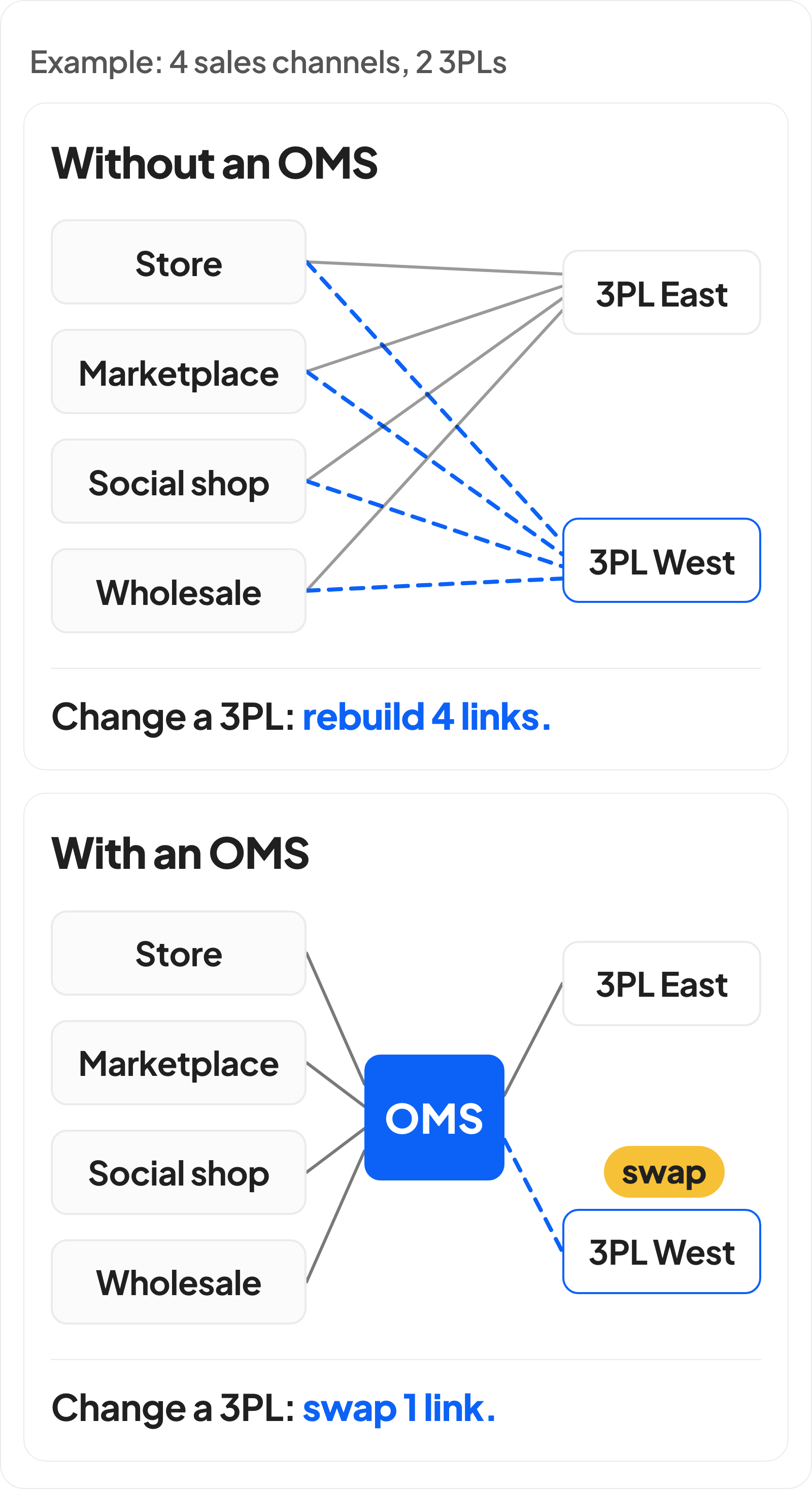
Without an OMS, each channel connects to your 3PL on its own. With an
OMS, your channels connect once, to the OMS, and the OMS connects to each
3PL. Four kinds of data cross that link:
Orders out. The OMS sends each order to the 3PL's warehouse system,
by API or by EDI. In EDI
terms this is the 940: the order a brand sends a warehouse asking it to
ship.
Shipment confirmations back. The 3PL confirms what shipped, with
tracking. In EDI this is the 945.
Inventory back. The 3PL reports what is on hand, so the OMS can
update every channel. In EDI, stock levels can travel as an 846, and
changes to the warehouse's counts as a 947.
Receipts and returns. Inbound stock and returned items, so the counts
stay true. You tell the warehouse what is coming with an
advance shipping notice (ASN),
and in EDI the warehouse confirms what it received with a 944.
EDI matters most if you sell wholesale to retailers that trade by it (see
our B2B retail 3PL directory). Do not assume a
3PL handles it: of the 2,851 active 3PL listings in
the Fulfill.com directory, 281, about 1 in 10, mention EDI anywhere in their
profile description or FAQ answers (September 2026). A listing that
does not mention EDI may still offer it, so ask. For your own side of the
connection, see the EDI providers in our partner directory.
With an OMS, adding or swapping a 3PL changes one connection instead of one per channel.
The payoff shows up the day you add or change a 3PL. Say you sell on
Shopify, Amazon and two wholesale accounts, and you go from one 3PL to two.
Without an OMS, that is four connections to rebuild and test at the new
warehouse, plus a rule about which orders go where that someone enforces by
hand. With an OMS, it is one new connection and one routing rule, such as
"East Coast addresses ship from the New Jersey warehouse when it has stock."
Your channels never notice the change.
Many OMS vendors quote rather than publish prices, but enough publish them
to sketch the tiers, read from vendors' own pricing pages in September 2026.
Tier
What you get
Published price
Who it fits
Built into your store platform
Location routing for that platform's own orders, such as Shopify's order routing
Part of the platform; no separate price listed
One main storefront, two or more locations
Entry-level order and inventory tools
Orders and stock counts synced across a few channels
About $20 to $100 a month on entry plans; some list a $0 plan for a few dozen orders a month
Smaller sellers adding a second or third channel
Mid-market OMS
Rules-based routing across several warehouses and 3PLs
About $350 to $1,200 a month on published plans
Multichannel brands with two or more fulfillment locations
Connectivity-led and enterprise OMS
Maintained connectors, EDI, ERP integration and configurable routing, with setup services
Not published; sold by quote (Pipe17 is in this tier)
Brands with several channels, several 3PLs and an ERP
Price the changes, not just the launch. "With our previous OMS, every small
change meant submitting a ticket and paying for a $50,000+ statement of
work," says Kara Strasser, Senior Director of Supply Chain at Made In, in a
case study Pipe17 published in 2025. For the warehouse side of the
budget, see our 3PL pricing guide.
Implementation: timeline and what to measure
Most projects run in four stages:
Decide before you sign. Name the source of truth for orders,
inventory and financials (the system whose numbers win when two
disagree), and write down your routing rules.
Pilot one channel and one 3PL with real orders.
Expand to the other channels, locations and the ERP.
Cut over, switching off old connections once counts match.
Before you start, record a baseline for each of these:
oversold or canceled orders per month;
share of orders shipped in more than one box;
"where is my order?" contacts per 100 orders;
time from checkout to the 3PL receiving the order;
lag between your 3PL's stock counts and your channels';
staff hours spent fixing orders by hand each week.
How to choose ecommerce order management software: 10 questions
Question
A good answer
A red flag
1. Do you have maintained connectors for my channels and my 3PL?
A live connector for each, your 3PL named, and the vendor fixes it when an API changes
"We can build that"
2. How does routing work?
Rules you set (stock, location, cost, delivery promise), with a record of why each order went where
One fixed location order, and no record
3. How do you handle splits, holds and kits?
A demo of a bundle reaching the 3PL as components, and splits only by your rules
Kits mapped by hand in a spreadsheet
4. What happens when a handoff fails?
Automatic retries, alerts, and a queue of stuck orders someone owns
A failed-sync log you have to check yourself
5. Which system is the source of truth?
An owner for orders, inventory and financials, agreed before setup
"We'll work that out during setup"
6. Can my operations team change rules without a developer?
A live demo of adding a rule
Every change is a ticket or a statement of work
7. How long does adding a channel or a 3PL take?
A recent customer you can call
An estimate with no reference
8. How is it priced, and what does change cost?
Subscription, connections, implementation and change costs in writing
A quote that covers launch only
9. How often does inventory sync with my 3PL and channels?
A stated interval per connection, and what happens when two counts disagree
"It depends," with no interval
10. What happens if we leave?
A full export of orders, rules and mappings, and a term you can live with
No export path, or a long auto-renewing term
Featured provider: Pipe17
Pipe17 is a Seattle company that sells what it calls an
Order Operations Platform: connectivity and order management in one product. Pipe17 pitches this as an alternative to running a separate
integration tool and OMS. Pipe17 says it runs more than 300 pre-built
connectors and maintains them as the APIs behind them change. It also
offers a unified API that standardizes data across every connected
system, and EDI connector pages for about 60 trading
partners, such as Walmart, Target and Nordstrom (as of September 2026).
Routing in three passes. Your priority rules first, then only the
locations with stock, then a ranking by cost, proximity or promised
delivery date.
Beside your ERP or instead of it. Pipe17 can be the system of record,
or sit beside an ERP such as NetSuite that keeps that role.
e.l.f. Beauty uses it to connect Shopify, its Salesforce OMS and SAP
S/4HANA, and Pipe17 reports it automated a settlement reconciliation that
had taken 20 to 80 hours per reporting cycle.
Who it fits. Brands selling on two or more channels through two or more locations, and
larger brands keeping their ERP. It is not a
WMS, a rate shopper or a freight broker; it connects to those. It
also sells to 3PLs: in a Pipe17 case study, Radial says pairing Pipe17 with
Logiwa's WMS cut client onboarding for its Fast Track offer from 18 weeks to
as little as one.
Where it may not fit. No published prices, a one-time configuration
charge, and a product built for multi-channel, multi-location operations.
Before the second 3PL ships an order, pull inventory from both warehouses into one place and write down your routing rules. Once every channel sees the same stock and every order has a clear home, the second 3PL is one more connection, not a rebuild.
Mo Afshar Co-Founder and CEO, Pipe17
MaryRuth Organics uses Pipe17's routing to cut split shipments and the
"where is my order?" calls (WISMO) they caused:
Sometimes customers would call asking, 'Where's my second product? I only got one thing in the box.' With Pipe17, we can automatically route orders between warehouses, avoid fulfillment errors, and decrease WISMO questions.
Victoria Scott Senior Business Analyst, MaryRuth's, in a case study Pipe17 published in 2024
Results are as reported by Pipe17 and its customers; yours will vary.
Brands often shop for an OMS and a 3PL in the same quarter, because adding a
3PL is what exposes the gap. Before you sign either, ask each 3PL four
things. Which OMSs does it have a live connection to, by name, with a client
using it today? Does it connect by API or EDI? How often does it send
inventory counts back? And who fixes the connection when it breaks? A 3PL
that already runs your OMS's connector skips a build; one that has to build
it adds that build to your go-live date.
Partly: its order routing picks which of your locations fulfills each
Shopify order. Routing Amazon, wholesale and other channels' orders alongside Shopify's takes a separate OMS.
Can my 3PL's software be my OMS?
Often, if one 3PL ships everything. Not once you add a second 3PL or your
own warehouse.
How long does implementation take?
It depends on how many channels, locations and systems you connect.
Pipe17's published cases run from under an hour for one brand's
fulfillment partners to under 90 days for a whole operation.
Is API replacing EDI?
Not for retail yet: retail trading partners and many warehouses still
exchange EDI documents. An OMS that serves wholesale usually needs both.
Is an OMS a CRM?
No. An OMS manages orders; a CRM manages customer contacts, sales and
service history.
What is the difference between multichannel and omnichannel order management?
Multichannel pulls orders from several channels into one system.
Omnichannel adds retail stores to the same inventory, for ship-from-store
and in-store pickup.
What are EDI 940 and 945?
The 940 is a brand's order asking its warehouse to ship; the 945 is the
warehouse's confirmation that it shipped.
How much does Pipe17 cost?
Pipe17 does not publish prices. It prices on order volume, connections,
flows (the order processes it automates) and sub-accounts, plus a one-time
configuration charge.
Next step
An OMS is half the decision; the 3PL that ships your orders is the other.
Tell Fulfill.com what you sell and where,
compare 3PLs that fit, and take the four 3PL questions above into every
call.
Disclosure: Pipe17 is a Fulfill.com vendor partner. Fulfill.com is paid when readers click through to its website.
Get 3PL Insights in Your Inbox
Insights on choosing a 3PL, evaluating fulfillment partners, and scaling your eCommerce operation, from the team behind Fulfill.com.