

Micro Fulfillment: Hype or Must Have?
Learn how micro fulfillment centers enable 2-hour delivery for eCommerce. Explore the technology, costs, and strategies for ultra-fast urban shipping.
Shipping and operationsOctober 1, 202518 min read

 Joe Spisak·September 23, 2026·Add Fulfill as a preferred source on Google
Every carrier invoice is a claim about what you owe. Many brands pay it without checking. A parcel audit is the check: a line-by-line comparison of each UPS, FedEx, USPS or DHL invoice against what you shipped, what the carrier promised, and the rates in your contract. Anything that does not match gets disputed, and the credit comes back to you.
For a brand shipping a few hundred packages a month, one person with a spreadsheet can check this. Past about 1,000 a month, nobody has the hours, and refund windows are short. Audit vendors say billing errors run 1% to 9% of invoice value; they publish no method for that figure, so treat it as a ceiling. On $1M a year in parcel spend, even 1% is $10,000 paid for nothing. Below: what gets checked, what a brand your size can expect back, what it costs, and how to pick a provider. We feature Intelligent Audit (IA), a Fulfill.com vendor partner that pays us when readers click through to its site.
The short answer
A parcel audit reviews small-package carrier invoices for billing errors and service failures, then files the disputes and refund claims that recover the money. "Small parcel" describes the shipment, not the business: boxes that move through a carrier's package network rather than as freight, which covers nearly every ecommerce order.
It is the parcel counterpart of a freight audit. Our glossary entry on parcel invoice audit has the one-paragraph definition; this guide covers what an audit finds and how to buy one.
One detail catches brands that outsource fulfillment. Many 3PLs ship on their own carrier accounts and bill you a shipping rate. If so, the carrier invoice is the 3PL's, not yours, and a parcel audit on your side has nothing to read. Ask your 3PL whether it audits its carrier invoices, and whether refunds for late or lost packages reach your bill.
If your 3PL bills you a marked-up shipping rate, check that line against your 3PL contract instead; a parcel audit cannot see it. If you ship on your own carrier accounts through the 3PL, you can audit directly, and the rest of this guide applies.
Carrier invoices are long, and most of the lines are correct. The value sits in a handful of charge types that go wrong often enough to be worth checking on every shipment.
| What gets billed | How it goes wrong | What the audit does |
|---|---|---|
| Guaranteed delivery times | The package arrives after the time the service guaranteed | Files a service-failure refund, if the guarantee is active for that service and your contract has not waived it |
| Lost and damaged packages | Nobody files a claim unless a customer complains | Monitors every shipment and files the claim |
| Labels billed but never scanned | A label is printed and voided in your system, but the carrier still bills it | Matches billed tracking numbers against carrier scans and disputes packages never handed to the carrier |
| Duplicate charges | The same tracking number is billed twice, on one invoice or across two | Flags repeated tracking numbers and disputes the extra charge |
| Address corrections | A correction fee lands on an address that was not wrong | Checks each correction against the address you sent |
| Package dimensions | The carrier re-measures the box and bills a dimensional weight correction | Compares billed dimensions to the ones you sent and flags patterns by box size |
| Zones | A package is billed at a farther zone than its origin and destination justify | Recalculates the zone from the two ZIP codes |
| Fuel surcharge | The wrong week's percentage is applied, or a contract discount on it is missed | Checks the rate against the carrier's published table and your contract |
| Peak or demand surcharges | A seasonal surcharge is billed outside the carrier's published dates, or on a service your contract exempts | Checks each surcharge against the carrier's dates and your contract |
| Service level | Volume drifts to a costlier service than the one your team meant to use | Flags the shift so operations can correct it |
| Contract rates and discounts | An agreed discount or surcharge cap is not applied | Recalculates each charge at your contract rate |
| Accessorial charges | Residential, delivery-area and handling surcharges on packages that do not qualify | Validates each surcharge against the shipment's facts |
Not every provider checks every row, and some check the contract-rate rows only on higher plans, so ask for the list in writing.
An audit pays in two ways, and the second is easy to miss.
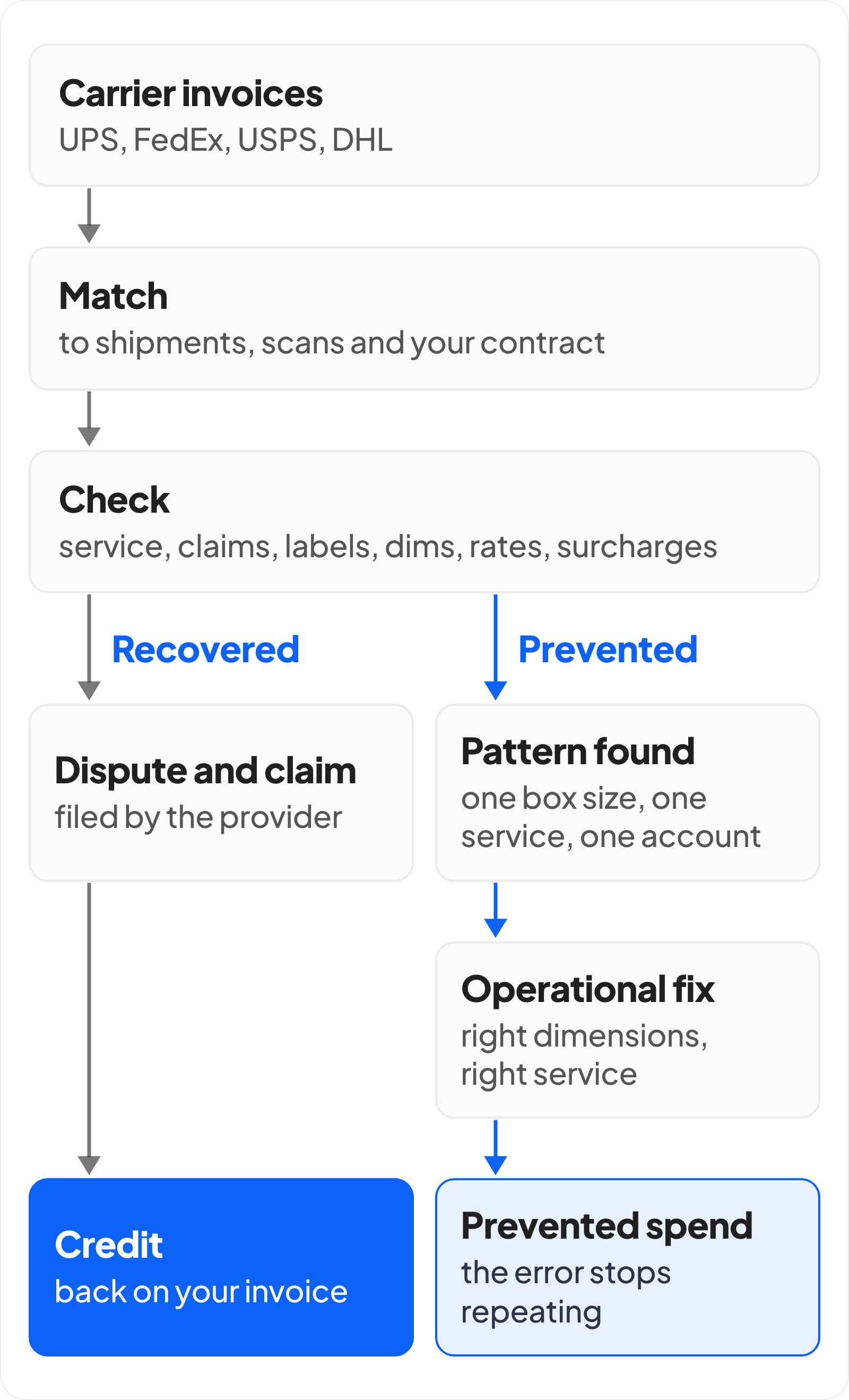
Recovered money is the refund or credit on a specific invoice line: a late package, a duplicate charge, a claim for a lost order. It shows up as a credit, and it is easy to count.
Prevented spend is the error that stops happening because someone found its cause. A refund fixes one invoice. Finding the reason the invoice was wrong fixes the next ten thousand.
Three of IA's published case studies show the difference.
Results are as reported by Intelligent Audit in its published case studies; we did not verify them, and your results will differ.
In the second and third cases the value came from the fix, not a refund: pick the right service, and send the right dimensions. That is why the reporting behind the audit matters as much as the disputes. Our piece on the hidden costs of mis-shipments covers the same idea from the warehouse side.
"Can I get a refund if my delivery is late?" is one of the questions people ask most about carrier billing. The answer depends on the service, the carrier's current policy and your contract.
Carrier on-time delivery guarantees change. FedEx currently applies its Money-Back Guarantee to a listed set of express services for U.S. payors, including First Overnight, Priority Overnight, Standard Overnight and 2Day A.M., and says the guarantee for all other FedEx services "will remain suspended until further notice". UPS's guarantee is active only for Next Day Air Early, Next Day Air, Next Day Air Saver, 2nd Day Air A.M. and some international express services, and remains suspended for Ground and all others (as of September 2026). Some negotiated carrier agreements also waive guarantee refunds, so read yours.
So before you count on late-delivery refunds, check two things: whether the guarantee covers the services you ship most, and whether your agreement waived it. If most of what you ship goes by ground, neither carrier's guarantee applies today, so an audit earns its fee on lost packages, billing errors and surcharges. A good provider will tell you what your contract allows before it promises you anything.
Providers price it in one of two ways.
A worked example. Say you spend $1M a year on parcel and the audit recovers 1.5%, below the 2% to 5% one audit software vendor calls common. That is $15,000. At a 40% share you pay $6,000 and keep $9,000; at 35% you keep $9,750. A plan wins when its annual fee is under about $6,000. Either way, ask whether any fee applies to prevented spend, not just to credits, because some contracts charge for savings that never appear on an invoice.
The same math at three spend levels (illustrative, not a quote: 1.5% recovered, a 40% share). A flat plan wins if its annual fee is under the share fee:
| Annual parcel spend | Recovered at 1.5% | Fee at a 40% share | You keep under the share |
|---|---|---|---|
| $250K | $3,750 | $1,500 | $2,250 |
| $1M | $15,000 | $6,000 | $9,000 |
| $3M | $45,000 | $18,000 | $27,000 |
Ask each provider to run this on your last three months of invoices. For the warehouse side of your cost to ship, see our 3PL pricing guide and fulfillment cost calculator.
| Question | A good answer | A red flag |
|---|---|---|
| 1. Which carriers do you support natively? | Each carrier you use, named, including any regional carriers | "All carriers," with a manual process behind it for the rest |
| 2. Does my carrier agreement allow a third-party auditor, and are you FedEx certified? | They read your agreement's audit and confidentiality terms first, and state their FedEx Certified FBAP (audit and pay) status | They never ask to see your agreement |
| 3. How does my data get to you? | A direct connection to your carrier billing accounts, set up by them in days | A spreadsheet export you prepare every month |
| 4. How often do you pull invoices, and do you file inside the carrier's dispute window? | Weekly, with disputes filed within days | Monthly |
| 5. What exactly do you check? | A written list that covers contract rates, dimensions and labels billed but never scanned | Late deliveries only |
| 6. Who files the disputes and claims? | They file, follow up and close each one | They flag errors and your team files |
| 7. How are fees calculated? | A written formula, charged on credits that post | A share of "identified savings" or prevented spend |
| 8. What will the reporting show me? | Cost by carrier, service and box size, so you can fix causes | A credits total and nothing else |
Our glossary entry on carrier performance analysis lists the measures worth tracking once reports arrive.
Intelligent Audit has audited carrier invoices since 1996 from Rochelle Park, New Jersey. It reports auditing more than 2.1 billion shipments in 2025, and it says 20% of the Fortune 50 are customers. It audits parcel and freight across more than 150 audit points. Its parcel product for growing shippers is Catalyst.
Most brands come into a first parcel audit expecting a few billing typos. What they usually find is quieter: late deliveries nobody claimed, labels that were printed but never shipped, and dimensional adjustments nobody checked against the actual box.

Amanda Polk
Director of Marketing, Intelligent Audit
More shipping and rate tools are in our shipping carriers and rate tools category.
Every invoice, as it arrives. UPS and FedEx bill most shippers weekly and dispute windows are short, so a quarterly review finds errors after the refunds have expired.
Yes, at low volume: export the invoice data from your carrier billing account and match it to your shipment records. The hard parts are contract-rate checks and lost-package claims, where carrier liability limits and declared value decide what you can recover.
Disputes are a routine part of carrier billing, and FedEx runs a certification program for audit and pay providers. The friction point is sharing your contract, so check its confidentiality clause first.
Yes: a year of audited data shows which surcharges, services and zones cost you most, which is where to negotiate. Some providers sell contract analysis as a separate service; at IA it is part of Catalyst Pro.
For Ground, Home Delivery and most other services, yes. Since February 12, 2026 it applies only to the listed express services named above (as of September 2026).
Only on the air and international express services where its guarantee is active, and only if your agreement has not waived it. The guarantee remains suspended for UPS Ground (as of September 2026).
A parcel audit checks small-package bills, one line per box; a freight invoice audit checks LTL, truckload, ocean and air bills for freight class, accessorials and detention, and is often bought with freight payment. For pallet and wholesale shipping, see the freight providers in our partner directory.
Pull your last 90 days of carrier invoices, confirm which accounts are yours rather than your 3PL's, and ask two providers for a sample audit on the same data. If your 3PL owns the accounts, compare 3PLs that pass refunds through.
How we researched this: on September 23, 2026 we read Intelligent Audit's Catalyst product and pricing pages, its parcel audit, claims and case-study pages, FedEx's money-back guarantee page and UPS's service guarantee page. The order-volume figures come from Fulfill.com's own matching data.
Disclosure: Intelligent Audit is a Fulfill.com vendor partner. Fulfill.com is paid when readers click through to its website.
Insights on choosing a 3PL, evaluating fulfillment partners, and scaling your eCommerce operation, from the team behind Fulfill.com.
No spam, ever. Unsubscribe anytime.
Learn how micro fulfillment centers enable 2-hour delivery for eCommerce. Explore the technology, costs, and strategies for ultra-fast urban shipping.
Shipping and operationsOctober 1, 202518 min read
Learn how dark stores enable 15-minute delivery for e-commerce. Discover implementation costs, technology requirements, and strategies for this $400B
Shipping and operationsSeptember 16, 202518 min read
Cut import tariffs by 40% using 3PL strategies. Learn FTZ benefits, de minimis rules & supply chain tactics that save millions.
Shipping and operationsSeptember 2, 202512 min read