How to Switch 3PL Providers: Steps, Checklist and KPIs
How to switch 3PL providers step by step: when to leave, contract and inventory lien traps, a parallel-run plan, and the KPIs and scorecard to track.
Choosing a 3PLFebruary 13, 202517 min read
 Fulfill Team·Updated September 23, 2026·Add Fulfill as a preferred source on Google
You want the Prime badge...but you don't want the Amazon warehouse.
You're not alone.
Plenty of third-party sellers are tired of FBA headaches: the storage fees, the shifting rules, the capacity limits, and the lack of control. Seller Fulfilled Prime (SFP) is Amazon's answer for them. So... is it worth it?
That's what we'll break down: what SFP is, what Amazon's current requirements say (we checked every number against Amazon's own pages in September 2026), how the trial works, how it compares with FBA, and how to run it with your own warehouse or a 3PL.
Let's get after it.
Seller Fulfilled Prime is an Amazon program that lets you show the Prime badge on products you store, pack, and ship yourself, instead of sending them to Amazon's fulfillment centers. In Amazon's words, it "lets you put Prime branding on the listings for products you fulfill without Amazon," once you prove you can deliver at Prime speed (Amazon).
That's Amazon SFP in one line. You do the heavy lifting, and you still sell to Amazon's most loyal customers: Prime members.
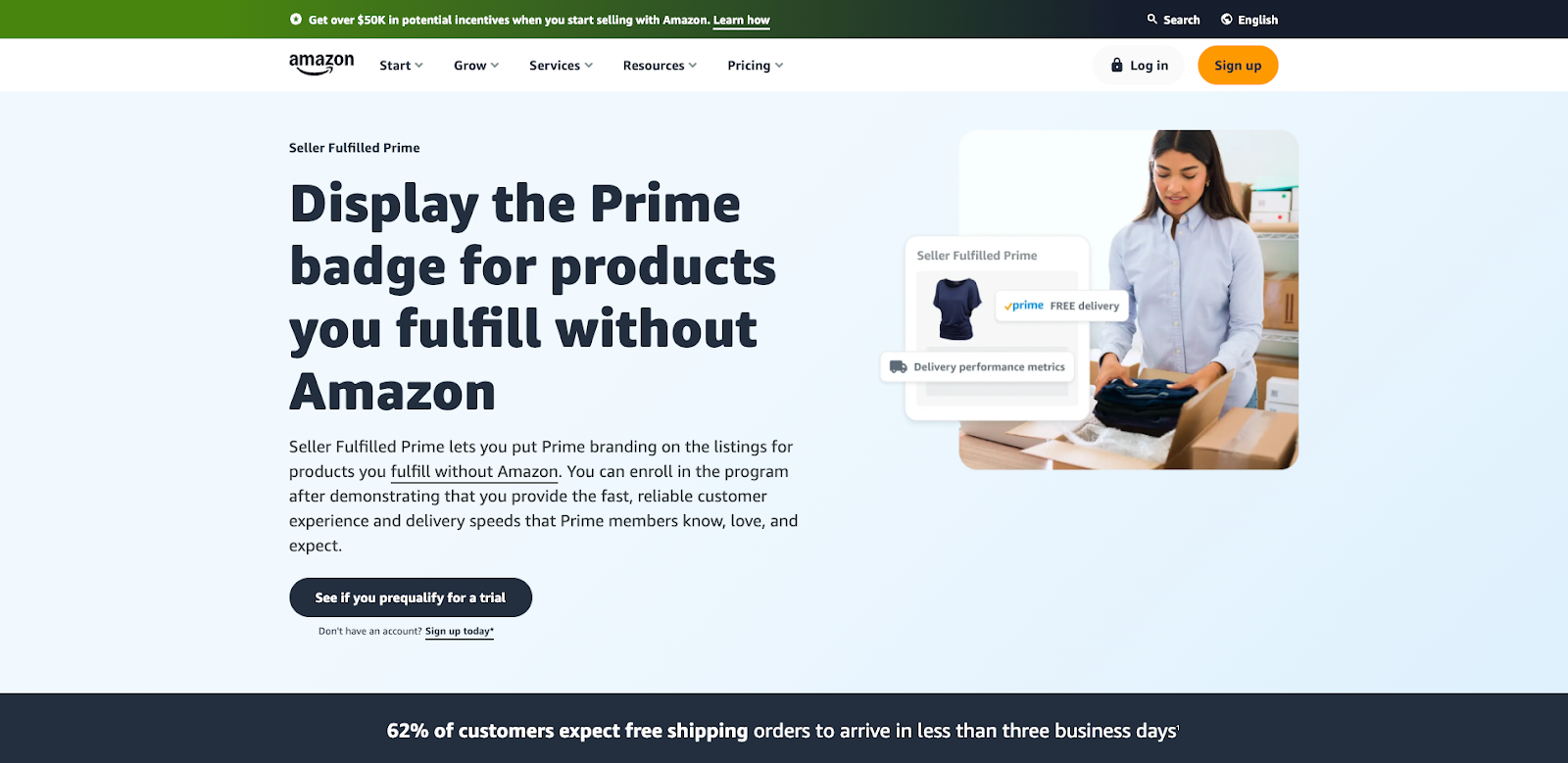
You get the Prime badge without handing your inventory to FBA.
But here's the kicker: Amazon doesn't just hand over that badge. You have to earn it in a trial, and then you have to keep it, week after week.
Let's be real. FBA works, but it is not cheap or simple. Amazon's own FBA page lists fulfillment fees, monthly storage fees, aged inventory surcharges for units stored more than 181 days, returns processing fees, and an inbound placement service fee (Amazon FBA costs). You might have noticed:
SFP gives you another option.
With SFP, you control the warehouse, the packaging, and the shipping carrier. Amazon lets you choose which products to enroll, where you store them, which Amazon-integrated carriers you use, and how you pack (Amazon).
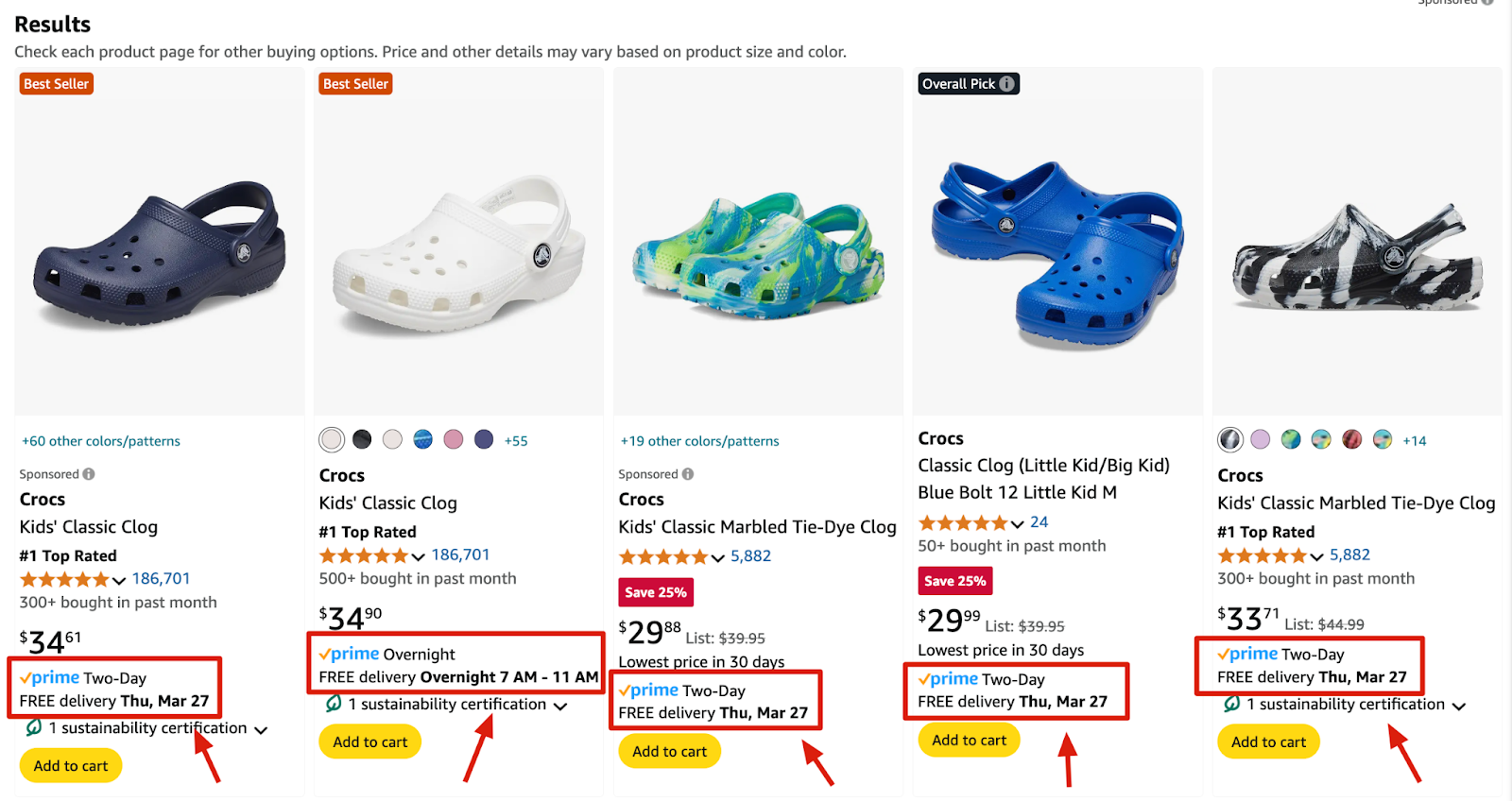
And the badge matters. Amazon says Prime branding "helps increase your likelihood of becoming the Featured Offer," which is the Buy Box by its current name (Amazon).
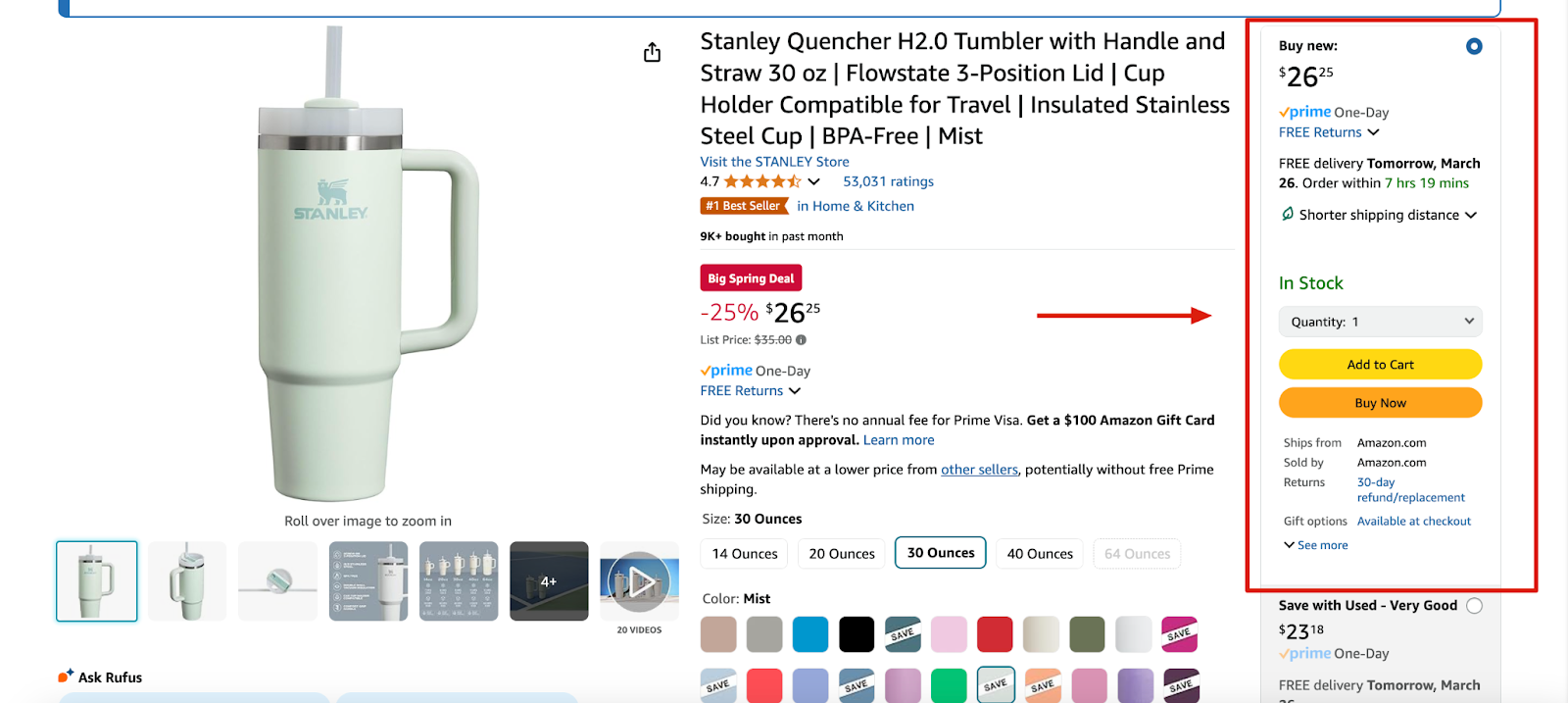
But this isn't the Wild West. There are rules… and they're strict.
Amazon splits the requirements into three gates: what you need to start the trial, what you need to pass it, and what you need to stay enrolled. Here are the numbers as Amazon publishes them in its trial and enrollment page and its performance requirements page.
| Metric | To start the trial (past 90 days) | To pass the trial and stay enrolled |
|---|---|---|
| Packages shipped | 100+ seller-fulfilled packages | 100+ Prime packages during the 4-week trial, shipped every week; then 100+ Prime packages a month, or Amazon limits your daily Prime order volume |
| Cancellation rate | Under 2.5% | 0.5% or less |
| Valid tracking rate | Over 95% | 99% or higher |
| Late shipment rate | Under 4% | Tracked as on-time shipment (supporting metric) |
| On-time delivery | Not measured | 93.5% or higher |
| Delivery speed | Not measured | Minimums by size tier (next table) |
You also need a Professional selling account in good standing and a domestic US default shipping address. The Professional plan costs $39.99 a month plus selling fees (Amazon).
Delivery speed is the share of Prime shoppers' product page views where your offer showed a delivery promise within the window. Amazon has three size tiers, and since November 5, 2025 each tier is evaluated on its own, so a miss on oversize items no longer costs you your standard-size Prime offers (Amazon).
| Size tier | 1 day or less | 2 days or less | 5 days or less |
|---|---|---|---|
| Standard size | 40%+ | 75%+ | 90%+ |
| Oversize | 15%+ | 45%+ | 80%+ |
| Extra large | N/A | 25%+ | 60%+ |
Amazon refreshes these minimums quarterly, gives 45 days' notice of any increase, and may adjust them during the holidays. It is also excluding weekends from the speed metric from May 31 to October 17, 2026, while it launches delivery dates by zip code. You still have to operate on weekends.
The speed metric is where most sellers struggle. A two-day promise depends on where your inventory sits relative to your buyers, which is a shipping zones problem before it is a warehouse problem. Amazon also notes that Standard Shipping (one handling day plus 2 to 4 transit days) always counts in the denominator but never in the one-day or two-day numerator, so wide standard-only coverage drags your score down (Amazon).
From Amazon's SFP program policy:
SFP isn't a shortcut. It's a performance badge. If you can't deliver like Amazon, you're out.
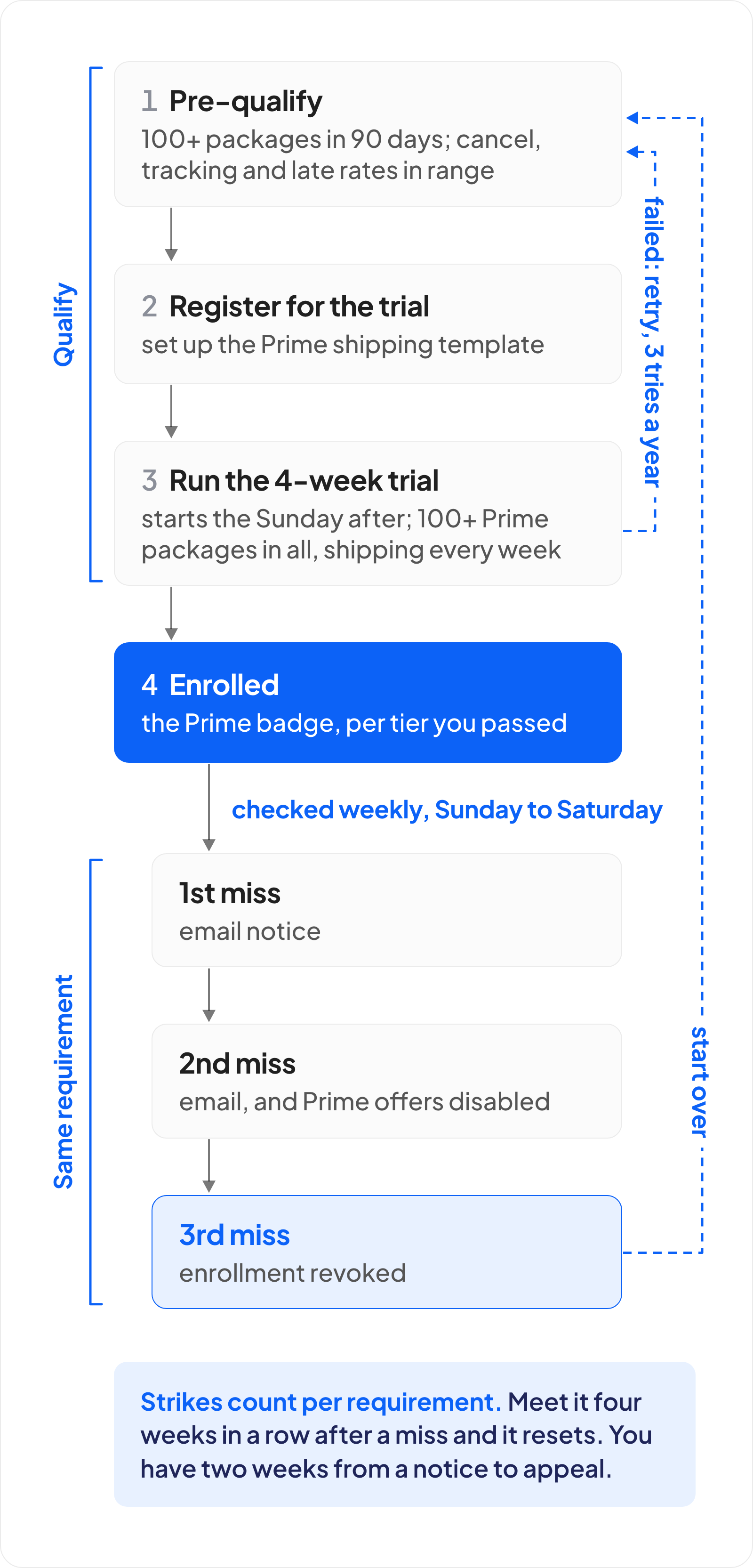
Here's the path, step by step, from Amazon's trial and enrollment page:
Miss any requirement in two of the four weeks and you fail the trial. You get three attempts per calendar year, and you can restart any time you still pre-qualify. (Amazon's marketing page still says "30-day trial"; the Seller Central help page says 4 weeks, and that is the one your account is measured against.)
Watch the calendar, too. Amazon restricts trial graduation before big sales events. For 2026, the last trial start date ahead of peak season was September 19, and graduation is restricted from October 18 to December 31, 2026. If you pass inside that window, the badge switches on after it ends.
[TEMPLATE]: 3PL Evaluation Questions →
You fulfill Prime orders from your own warehouse (or your 3PL's warehouse). Amazon still expects Prime-level service, and it measures you every week, Sunday through Saturday (Amazon).
Here's what the job looks like once you're enrolled:
Two operational questions come up with almost every SFP seller.
How do I pick a service that meets the promise without overpaying? Rate shopping has to be zone-aware: the cheapest service that still lands inside the promised date, per order. If you already ship out of ShipStation and your rules have outgrown its built-in automation, String builds and maintains custom rate selection and warehouse routing logic inside your existing ShipStation account. Whatever tool picks the service, confirm the labels still meet Amazon's valid tracking rule, and that you understand when you lose OTDR protection by buying outside Buy Shipping or Veeqo.
How do I run SFP alongside my other channels? If the same inventory also sells on Shopify, Walmart, or wholesale, a late sync means you sell units you no longer have, and every seller cancellation counts against a 0.5% ceiling. An order operations platform such as Pipe17 brings orders from your channels into one place, keeps inventory visible across them, and routes each order to the fulfillment location best placed to ship it. See our primer on multi-channel distribution for the wider picture.
And yes, Amazon checks every week. The first miss on a requirement gets an email. The second disables your Prime offers. The third revokes your enrollment, and you start over from the trial. Meet a requirement for four straight weeks after a miss and that strike resets, and you have two weeks from a notice to appeal (Amazon).
Seller Fulfilled Prime (SFP) vs Fulfillment by Amazon (FBA) is the comparison every Prime seller runs. Both put the Prime badge on your listings. They differ in who holds the inventory, who pays for what, and who carries the risk.
| Seller Fulfilled Prime | Fulfillment by Amazon | |
|---|---|---|
| Who stores and ships | You or your 3PL | Amazon's fulfillment centers |
| How you get the Prime badge | Pass a 4-week trial, then meet weekly metrics | Send eligible inventory into FBA |
| What Amazon charges | Professional plan and selling fees; you pay shipping and return labels | Fulfillment, storage, aged inventory, returns processing, and inbound placement fees on top of selling fees |
| Inventory | One pool you can use for every channel | Inventory sits inside Amazon's network |
| Customer service and returns | Amazon handles post-order contacts; returns come back to you | Amazon handles both |
| Prep before inbound | Your own packing standards | You handle any required prep and labeling before inventory arrives |
| Main risk | Losing Prime if speed or on-time delivery slips | Fee increases and capacity limits you do not control |
Sources: SFP program policy, Amazon FBA. On prep: Amazon stopped offering FBA prep and item labeling services in the US on January 1, 2026 (Supply Chain Dive). We covered what that changes in our FBA prep shutdown guide.
FBA has its moments. No question. Especially if:
But here's what Prime sellers like about SFP:
Some sellers run a hybrid model: FBA for some SKUs, SFP for others. One rule to plan around: Amazon does not allow an SFP offer and a non-Prime seller-fulfilled offer on the same ASIN.
The truth is not every seller is built for Seller Fulfilled Prime.
But you should seriously consider it if:
You should probably not bother if:
But there's a middle ground: have a 3PL run SFP for you.
Amazon lets you choose your storage facilities, so a 3PL can run SFP for you. But Amazon is blunt about who carries the risk: qualification depends only on actual delivery performance during the trial, and Amazon "is not responsible for commitments a third-party logistics provider or other partner makes to its clients regarding SFP qualification" (Amazon).
Most 3PLs say they can handle SFP. The ones that can will answer these questions without hedging:
We've seen what happens when those answers are wrong:
That's where Fulfill.com comes in. We have matched 10,000+ brands with 3PLs, and our network lists 2,600+ 3PLs. You tell us your volume, SKUs, and channels, and we introduce you to Seller Fulfilled Prime 3PLs that fit. Think of us like your logistics matchmaker: you bring your fulfillment wishlist, we bring you matches to interview with the questions above. If you plan to keep FBA for part of the catalog, see 3PLs for Amazon fulfillment as well.
Before you sign, price it out. SFP moves shipping and returns cost onto your side of the ledger, so compare quotes on the same terms. Our 3PL pricing guide breaks down what goes into a quote.
So yes, 3PLs can handle SFP requirements. But you have to choose carefully, or you could find yourself missing delivery targets, losing Prime status, and scrambling to fix customer complaints very quickly.
Not all warehouses are built to meet Amazon's Seller Fulfilled Prime standards. These four 3PLs from our network are worth a call if you want the Prime badge without FBA. Put each one through the questions above. For the full list, see our Seller Fulfilled Prime directory.

Smart Warehousing combines automation, real-time inventory visibility, and optimized fulfillment workflows, all of which matter for meeting Amazon's SFP speed and accuracy requirements.
Why it's a fit for SFP:
Smart Warehousing brings broad coverage, regional reliability, and tech-driven, scalable execution, which helps with earning and keeping your Seller Fulfilled Prime badge without relying on Amazon's warehouses.
Go Direct Global stands out for moving high volumes of lightweight, fast-moving products efficiently while keeping to the shipping timelines Seller Fulfilled Prime requires.
Why it's a fit for SFP:
Go Direct Global's speed-focused operations and shipping discipline help sellers hold their on-time delivery and valid tracking rates, two of the metrics Amazon uses to decide SFP eligibility.

DaVinci Micro Fulfillment earns its spot with automation-driven micro-fulfillment designed for speed, density, and accuracy in order processing.
Why it's a fit for SFP:
DaVinci's automation-first model cuts human error and processing delays, helping sellers meet Amazon's zero-day handling and delivery performance requirements.
ShipCalm rounds out the list with a customer-focused approach to fulfillment and experience supporting both Amazon and multi-channel sellers.
Why it's a fit for SFP:
ShipCalm's attention to detail and operational transparency help sellers hold Amazon's required tracking rates, protecting Prime status over the long term.
Amazon SFP is short for Seller Fulfilled Prime: the program that puts the Prime badge on offers you fulfill from your own warehouse or a 3PL instead of FBA. You earn it by passing a 4-week trial and keep it by meeting weekly performance metrics.
To stay enrolled: on-time delivery of 93.5% or higher, valid tracking of 99% or higher, cancellations at 0.5% or less, and the delivery speed minimums for each size tier (Amazon). The program policy adds zero-day handling for orders received before a cut-off of 2:00 p.m. or later on weekdays, weekend operations, and free Standard Shipping across the contiguous US (Amazon). Ship fewer than 100 Prime packages in a month and Amazon limits how many Prime orders you can take each day.
You need a Professional selling plan at $39.99 a month plus selling fees (Amazon). The bigger cost is operational: free shipping to Prime buyers at one-day and two-day speeds, return labels for items under 50 lb, and weekend staffing, whether in your own building or through a 3PL.
Four weeks (28 days), starting the Sunday after you register. You need 100+ Prime trial packages, shipped every week, with all performance requirements met. Two missed weeks on any requirement ends the trial.
Neither wins everywhere. SFP suits sellers with fast-moving, standard-size products, strong multi-channel inventory, and a warehouse footprint that reaches buyers in one or two days. FBA suits sellers who want Amazon to run fulfillment, customer service, and returns and can live with its fees and capacity limits.
Yes. Amazon lets you choose the storage facility, and many sellers use a 3PL. You remain responsible for the results, so pick one that can show its SFP metrics. Our SFP 3PL directory is a place to start.
You don't need to overhaul your entire logistics setup overnight. You don't even need to fully commit to SFP right away.
Start by checking your last 90 days of seller-fulfilled orders against the pre-qualification numbers. If you clear them, look at where your buyers are and whether your warehouse, or a 3PL's network, can hit the one-day and two-day speed minimums. That tells you whether SFP is a trial away or a network change away.
If you're serious about reducing FBA fees, controlling your own fulfillment, and building a more resilient supply chain, SFP is worth a long, hard look. It can work. But only if your backend is rock solid.
Tell us what you need, and we'll send you a shortlist of 3PLs that fit.
Insights on choosing a 3PL, evaluating fulfillment partners, and scaling your eCommerce operation, from the team behind Fulfill.com.
No spam, ever. You'll get our newsletter; unsubscribe anytime.
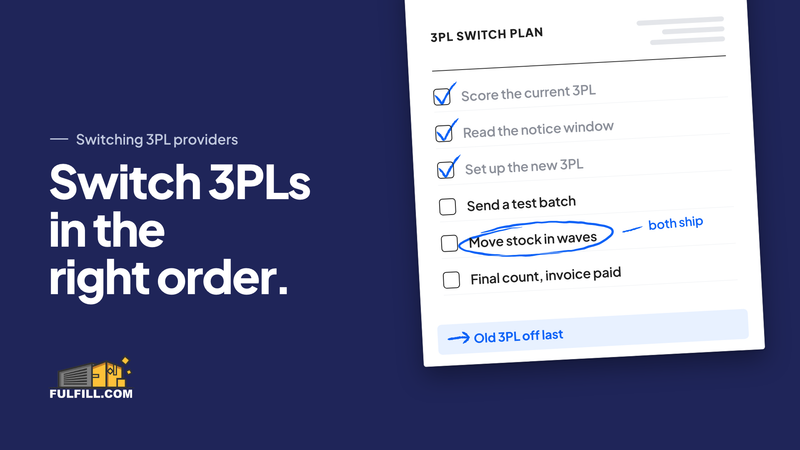
How to switch 3PL providers step by step: when to leave, contract and inventory lien traps, a parallel-run plan, and the KPIs and scorecard to track.
Choosing a 3PLFebruary 13, 202517 min read
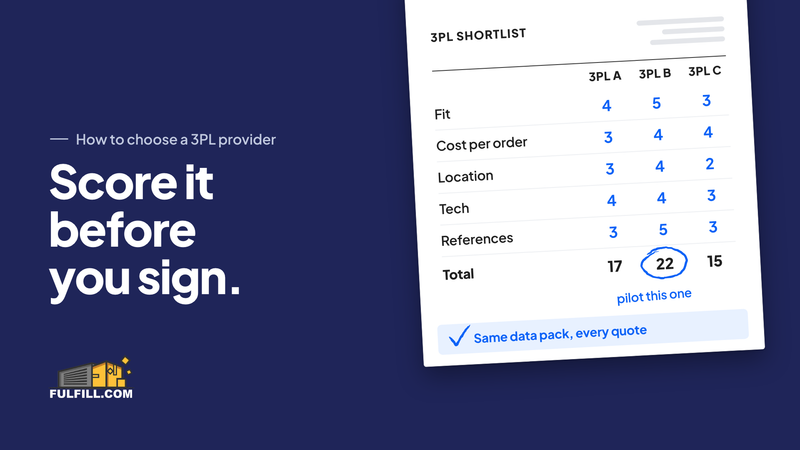
How to choose a 3PL provider in 7 steps: build a data pack, compare quotes on cost per order, check location, score providers, pilot, read the contract.
Choosing a 3PLFebruary 4, 202513 min read
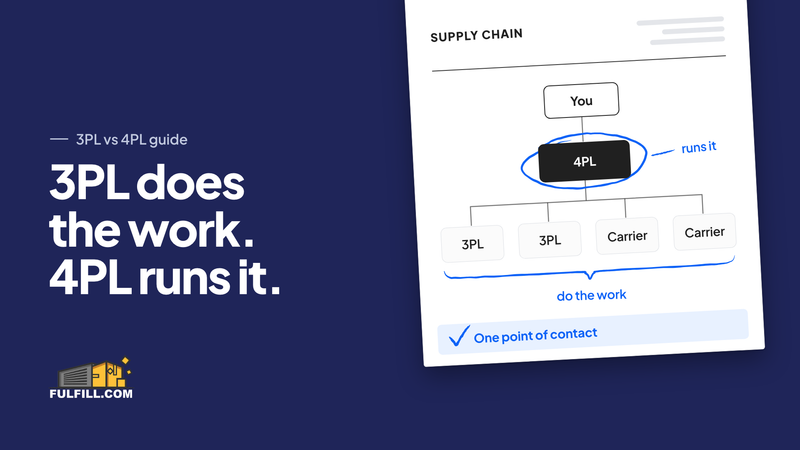
3PL vs 4PL: a 3PL stores and ships your orders, a 4PL manages every provider in your supply chain. See a comparison table, real examples, costs and 5PL.
Choosing a 3PLFebruary 4, 202512 min read