
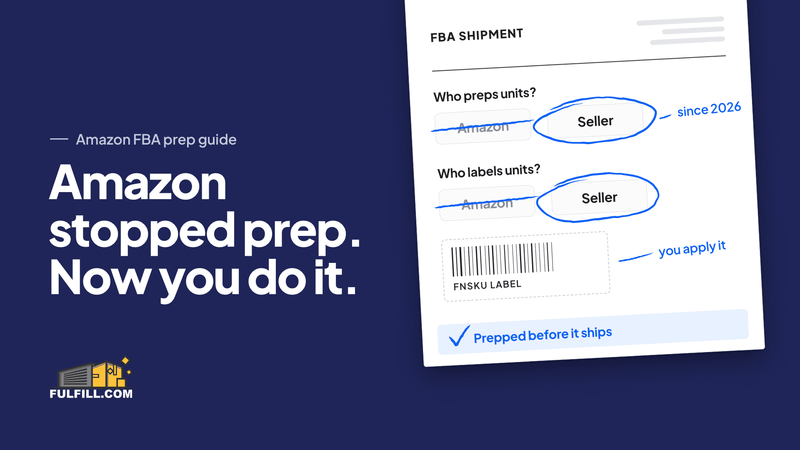
Amazon Ended FBA Prep Services: What Sellers Do Now
Amazon ended FBA prep and labeling in the US on January 1, 2026, then in Canada and Europe. See what changed and how sellers prep inventory now.
NewsAugust 25, 202511 min read
 Fulfill Team·Updated September 29, 2026·Add Fulfill as a preferred source on Google
Update (2026-09-29): Seven months on, the disruption has not ended. Brent crude neared $108 a barrel on September 28, 2026, after the U.S. rejected an Iranian proposal to reopen the Strait of Hormuz, and vessels made 132 transits of the strait from September 21 to 27, against roughly 130 crossings a day before the war (Al Jazeera, September 28, 2026). The figures below are as of March 2026.
The Iran conflict isn't just a geopolitical headline; it's a direct threat to your eCommerce margins. Here's what's happening, why it matters to your bottom line, and how a 3PL can shield your business right now.
On February 28, 2026, the United States and Israel launched coordinated strikes on Iran in what's been dubbed Operation Epic Fury. Iran's response: declaring the Strait of Hormuz, one of the world's most critical shipping chokepoints, effectively closed to Western-allied vessels.
Since March 1, the number of ships transiting the strait has collapsed from approximately 138 vessels per day down to single digits. At least 21 commercial ships have been attacked. Maersk, CMA CGM, MSC, and Hapag-Lloyd have all suspended operations through the strait. Vessels that can't pass through Hormuz are now being rerouted around Africa's Cape of Good Hope, adding 3,500 to 4,000 nautical miles and 10 to 14 days to transit times.
Brent crude oil prices surged past $120 per barrel in early March 2026, the first time above $100 in four years, briefly peaking at $126.
If you're running an eCommerce brand and thinking "that's a Middle East problem," think again. This is a shipping cost problem. And it's already making its way to your invoices.
For eCommerce brands evaluating fulfillment partners during this period of volatility, Fulfill.com's 3PL matching service can connect you with providers who offer locked-in rate structures and multi-carrier flexibility.
The connection between geopolitical conflict and your per-order shipping cost isn't abstract; it's mechanical and fast.
Everything in shipping runs on fuel. When oil prices spike, diesel prices follow almost immediately, and carriers respond with fuel surcharges: additional percentage fees applied on top of your base shipping rate.
Here's how the math works: carriers like UPS and FedEx publish weekly fuel surcharge tables tied directly to U.S. on-highway diesel prices (tracked by the U.S. Energy Information Administration). When diesel crosses a threshold, the surcharge percentage jumps to the next bracket. These updates happen weekly for most carriers. That means within days of an oil price spike, you're paying more per shipment, whether you've renegotiated your contract or not. With the rate changing weekly, auditing your carrier invoices catches a line billed at the wrong week's percentage.
In 2025 alone, before the Hormuz crisis, UPS's domestic ground fuel surcharge increased 24.3% year-over-year. Air fuel surcharges rose 23.5%. This was before Brent crude crossed $100 again.
Now multiply that against a prolonged conflict scenario.
When major container shipping lanes get disrupted, every route gets more expensive, even the ones that don't touch the Gulf.
Ships rerouting around the Cape of Good Hope burn 25 to 30% more fuel per voyage. That cost gets passed downstream through ocean freight rate increases, which then pressure domestic last-mile rates as port congestion builds up on both coasts.
In the two weeks following the Hormuz closure, container shipping rates rose 12%. Marine insurance premiums have surged over 300% for Gulf-region vessels. Air freight rates from Shanghai to Frankfurt jumped 35 to 60% as brands rushed to bypass sea shipping.
Even if your supply chain doesn't touch the Persian Gulf, you're paying the "global volatility premium" through higher carrier base rates, repositioned empties, and port congestion surcharges.
UPS already publicly lists war risk surcharges of $2.50 per kilogram of billable weight for shipments involving the Bahrain, Iraq, and UAE corridors. As conflict zones expand, so does the geographic coverage of these surcharges. That's a direct, line-item cost added to your freight invoices.
This one is less obvious but hits just as hard. About 85% of polyethylene exports from the Middle East flow through the Strait of Hormuz. Polyethylene is what your eCommerce packaging (boxes, poly mailers, and protective fills) is made of. Packaging material prices have already risen roughly 41 to 42% since the crisis began. That's your COGS going up even before the shipping invoice arrives.
Fertilizer costs are up ~43%, which signals broader food price inflation. Electronics face helium and specialty gas shortages. And any product with plastic components (which is most products) sees input cost increases.
Even before the Iran conflict, the picture was already grim. All four major carriers (UPS, FedEx, DHL, and USPS) implemented general rate increases (GRIs) of 5.9% for 2026. But the headline number is misleading. When you account for surcharge stack-ups, the effective increase for many DTC brands is 10 to 20%.
Over the past five years, U.S. shipping costs have risen more than 40% in total. Most eCommerce brands haven't adjusted their pricing models to reflect this compounding. Now add a geopolitical oil shock on top.
One of the most misunderstood aspects of carrier pricing is how surcharges compound. A single residential delivery from a DTC brand might carry:
A package that should cost $10 to ship can realistically cost $15 or more once all surcharges and fuel adjustments are added. For direct-to-consumer brands where shipping costs are already one of the biggest margin killers, this isn't a rounding error; it's a profitability crisis.
This is where the conversation shifts from problem to strategy. The brands getting squeezed hardest right now are ones managing their own fulfillment or using a single carrier without negotiating leverage. The brands weathering this well have one thing in common: a strong 3PL partnership.
Here's why:
Third-party logistics companies ship millions of packages across their entire client base. That aggregate volume gives them the negotiating power to lock in carrier rates, and discounts of 10 to 40% below retail, that an individual brand can't access. When fuel surcharges spike, the effective cost increase is applied to a lower base rate, which meaningfully limits the damage.
A brand shipping 500 orders per month has no leverage with UPS. A 3PL shipping 500,000 orders per month has an entirely different conversation.
When one carrier's surcharges spike, a good 3PL can route your volume to a competitor, dynamically, based on your shipment profile and delivery requirements. This carrier assignment flexibility is a structural hedge against the kind of volatility we're seeing right now. Most brands managing their own fulfillment are locked into one or two carrier relationships with limited ability to shift.
Fuel surcharges compound with shipping zones. A package shipped from a single warehouse on the East Coast to a customer in California travels across multiple zones, each one adding cost. A 3PL with a multi-warehousing network positions your inventory centrally (or splits it across coasts), reducing the average shipping zone per order. Fewer zones = lower base rates = a smaller surface area for fuel surcharges to hit.
The math works out: a brand moving from single-coast to distributed fulfillment can realistically reduce average shipping costs by 15 to 25%.
The best 3PLs operate proprietary warehouse management systems and shipping platforms that compare live carrier rates at the time of label generation. As fuel surcharges update weekly, these systems automatically route shipments to the most cost-effective option via rate shopping. Without this, you're essentially paying whatever your default carrier charges, including every surcharge increase, without a second option.
3PLs with strong inbound logistics capabilities can also help you navigate the ocean freight side of this crisis. Receiving flexibility, faster unloading turns, and relationships with freight forwarders can help you avoid container demurrage and detention charges that are spiking at congested ports as rerouted ships arrive in clusters.
Beyond the structural advantages of working with a 3PL, there are specific operational strategies worth implementing now:
Build Domestic Safety Stock With inbound lead times extending by 2+ weeks due to rerouting, brands with domestic safety stock buffers are in a much stronger position. If your 3PL offers bonded or extended storage arrangements, now is the time to use them.
Shift from Air to Ground Where Possible Air freight rates are surging as demand spikes on disrupted ocean routes. Where your delivery timelines permit, optimizing toward ground shipping (with the zone-reduction strategies above) can offset a significant portion of the cost increase.
Review Your DIM Factor and Packaging As base rates and surcharges rise, every cubic inch of wasted packaging is more expensive than it was six months ago. Work with your 3PL to audit your carton selection strategy. Packaging optimization can meaningfully reduce dimensional weight charges.
Use Scenario Modeling Now What happens to your margin if diesel hits $6/gallon? What if it hits $7? What if ocean freight rates double again? If you're not running these scenarios, you're navigating blind. A good 3PL partner, or a qualified 3PL matching service, can help you stress-test your cost model before the shock arrives.
Not all 3PLs are equally equipped to manage volatility. When evaluating providers during this period, prioritize:
Browse the full 3PL directory to compare providers across every specialization and location.
The 2026 Strait of Hormuz crisis is, by most measures, the largest supply chain disruption since the 1970s oil embargo. The IEA has called it "the greatest global energy security challenge in history." How long it lasts (weeks, months, or longer) is uncertain. What isn't uncertain is that every week of disruption translates directly into higher fuel costs, higher carrier surcharges, more expensive packaging, and compressed margins for eCommerce brands.
You can't control what happens in the Strait of Hormuz. You can control how your fulfillment operation is structured to absorb the shock.
Brands with distributed inventory, multi-carrier flexibility, and a 3PL with real volume leverage are in a fundamentally different position than those flying solo. If you haven't had this conversation yet, now is exactly the right time.
Find a 3PL partner built for volatility → Explore the full 3PL directory → What is a 3PL? The complete guide → eCommerce Fulfillment Guide →
How do gas prices affect shipping costs? Carriers calculate fuel surcharges as a percentage of your base shipping rate, tied directly to published diesel price indexes. When gas and diesel prices rise (due to geopolitical conflict, supply shocks, or broader energy inflation), these surcharges update weekly, meaning higher oil prices translate into higher shipping costs within days, not months.
Does war affect shipping costs? Yes, directly. War in oil-producing or transit regions (like the current Iran conflict) drives up crude oil prices, which raises diesel costs and carrier fuel surcharges globally. It also forces rerouting of container ships, adds war risk insurance premiums, disrupts port operations, and creates supply chain bottlenecks that cascade into domestic last-mile costs.
What is a fuel surcharge in shipping? A fuel surcharge is an accessorial charge added by carriers (UPS, FedEx, DHL, USPS) on top of the base shipping rate to offset fuel cost fluctuations. It's calculated as a percentage and updated weekly based on the U.S. Energy Information Administration's diesel price index. It applies cumulatively with other charges like residential, dimensional weight, and peak fees.
How can a 3PL help reduce shipping costs during high fuel prices? Third-party logistics providers use their aggregate shipping volume to negotiate significantly lower base rates with carriers, typically 10 to 40% below retail. They also enable multi-carrier rate shopping, strategic inventory positioning to reduce shipping zones, and packaging optimization, all of which limit the surface area for fuel surcharge increases to affect your per-order cost.
How long will the Hormuz shipping disruption last? As of March 2026, analysts project severe disruption for up to six months with only partial mitigation. Goldman Sachs and Capital Economics model scenarios ranging from short disruption (weeks) to prolonged conflict (months), with oil potentially averaging $130 to $150 per barrel in the prolonged case. Ceasefire negotiations are ongoing.
Which eCommerce products are most affected by the current shipping crisis? Petrochemical-dependent products are hardest hit: items with plastic packaging, synthetic fabrics, cosmetics, and electronics casings. Food products, supplements, and anything with fertilizer-dependent inputs are also affected. Businesses sourcing manufactured goods from the Gulf region face the sharpest input cost increases.
Insights on choosing a 3PL, evaluating fulfillment partners, and scaling your eCommerce operation, from the team behind Fulfill.com.
No spam, ever. Unsubscribe anytime.
Amazon ended FBA prep and labeling in the US on January 1, 2026, then in Canada and Europe. See what changed and how sellers prep inventory now.
NewsAugust 25, 202511 min read
Stord acquires Ware2Go in a major M&A deal. Fulfill.com celebrates its clients and the future of logistics consolidation.
NewsMay 20, 20254 min read
Excelsior Integrated have formed a strategic partnership with PSI.
NewsMay 30, 20243 min read
.png?width=800&resize=contain&quality=75)