How War & Gas Prices Are Hitting eCommerce Shipping Costs in 2026
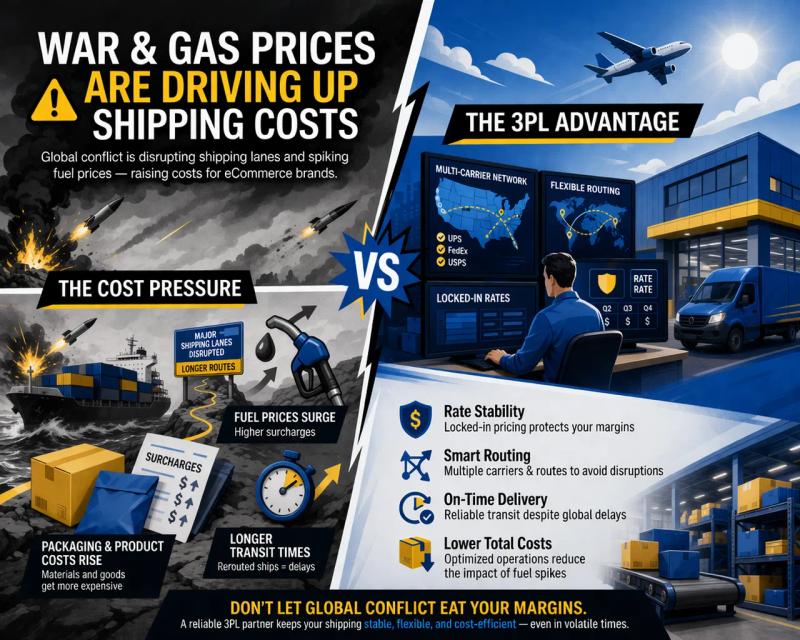
Here's how war and gas prices hit your eCommerce shipping costs — and how a 3PL can help.
NewsMarch 25, 202612 min read
 Joe Spisak·March 25, 2026·Add Fulfill as a preferred source on Google
Shopify just made millions of merchants shoppable inside ChatGPT. Stripe and Meta launched one-click checkout inside Facebook ads. Google expanded its Universal Commerce Protocol to support multi-item carts and real-time inventory across AI surfaces.
Everyone's talking about storefronts, payments, and product discovery. Almost nobody is talking about what happens after the buy button: the warehouse, the pick, the pack, the ship. Fulfillment is where this entire shift either works or falls apart.
We're Fulfill.com, a free 3PL matchmaking platform that connects ecommerce brands with fulfillment providers from a network of 2,800+ warehouses. We've spent years watching the gap between what brands sell and what warehouses can deliver. Agentic commerce is about to stretch that gap wider and faster than anything we've seen before. Here's what ecommerce brands and their 3PL partners need to understand right now.
Shopify flipped the switch on Agentic Storefronts for ChatGPT on March 24, 2026. Products from millions of Shopify merchants are now discoverable inside ChatGPT conversations by default. Shoppers browse products, compare options, and complete purchases through an in-app browser without leaving the chat. Orders flow into Shopify admin with ChatGPT referral attribution, and merchants keep full ownership of the customer relationship.
This isn't a pilot. Agentic Storefronts are active by default for eligible Shopify stores. Merchants don't need to install apps, build integrations, or pay additional transaction fees. Microsoft Copilot already has thousands of merchants selling through it, and Google AI Mode and Gemini have select brands live through the Universal Commerce Protocol that Google co-developed with Shopify and more than 20 partners including Walmart, Target, Visa, and Mastercard.
Stripe launched a native checkout experience inside Facebook ads the same week. Buyers tap "Buy now" on a Facebook ad and complete the purchase using saved Meta wallet credentials in a single step. The Agentic Commerce Protocol powers this flow, and Stripe plans to extend it to Instagram ads next. For brands running paid social, this collapses the entire path from ad impression to completed order into one tap.
These aren't isolated product launches. They're infrastructure moves. Google introduced the Universal Commerce Protocol at NRF in January, and just expanded it on March 19 with multi-item cart support, real-time catalog access, and loyalty program linking.
OpenAI and Stripe maintain the Agentic Commerce Protocol as an open standard. Visa has its Trusted Agent Protocol. The rails for AI-driven commerce are being laid across every major platform simultaneously.
The coverage of this week's news has focused almost entirely on the front end: product discovery, checkout flows, payment protocols, and what this means for advertising. That makes sense. These are flashy, consumer-facing changes that affect how people find and buy things.
But every order that originates from a ChatGPT conversation, a Gemini recommendation, or a one-tap Facebook ad still needs to be picked, packed, and shipped from a physical warehouse. The fulfillment operation behind the storefront determines whether that order arrives on time, in the right box, with accurate contents. AI can make the purchase effortless. It can't make the package appear on someone's doorstep.
Tom Schmitt, CEO of 3PL provider Radial, put it plainly in a survey released this week: "AI may change how consumers shop but fulfillment is what makes that promise real." A Radial study found that 58% of consumers are open to placing orders through an AI assistant, but only 6% have actually done so. The gap between consumer willingness and actual adoption is still enormous, which means the real volume hasn't hit yet. When it does, 3PLs need to be ready.
A typical ecommerce brand managed orders from their website, Amazon, and maybe one or two marketplaces just two years ago. Today, add Walmart, TikTok Shop, Instagram Shopping, and a handful of others. Now add ChatGPT, Google Gemini, Microsoft Copilot, and in-app purchases from Facebook and Instagram ads. Each channel generates orders that flow into the same inventory pool and the same warehouse.
Shopify's Agentic Storefronts synchronize product data, pricing, and inventory across all these AI surfaces from a single admin. That's helpful on the merchant side. But the 3PL receiving those orders needs systems that can ingest, process, and fulfill orders from a growing list of sources without mixing them up.
Attribution matters too. Brands need to know which channel drove which orders so they can measure performance and plan inventory. A 3PL running on manual processes or outdated software will struggle to keep up.
AI agents pull from structured product data that includes real-time pricing and availability. If that data says you have 50 units in stock and your warehouse actually has 12, you're going to oversell 38 units and create 38 angry customers. AI surfaces don't have the patience for "sorry, that item is actually out of stock." The agent moves on to the next brand.
Real-time inventory sync was already important. Agentic commerce makes it non-negotiable. Your 3PL's warehouse management system needs to update inventory counts the moment a pick happens, not at the end of the day or the end of the shift. Brands selling across multiple AI channels simultaneously need inventory accuracy rates above 99% to avoid the compounding effect of small errors across many surfaces.
The entire experience from discovery to checkout takes minutes in a ChatGPT conversation. There's no browsing a website, no adding to cart and coming back later, no comparison shopping across tabs. The purchase feels instant. That creates an implicit expectation that delivery should feel similarly fast.
Same-day fulfillment and 2-day shipping are already table stakes for competitive ecommerce brands. Agentic commerce will push those expectations further because the buying experience itself has been compressed. A 3PL that takes 48 hours just to get an order out the door will cost brands repeat customers. Warehouse location matters more than ever. A Columbus, Ohio warehouse that reaches 60% of the US within 600 miles is more valuable than a single coastal facility when speed is the differentiator.
AI-driven shopping compresses the discovery-to-purchase timeline into a single conversation. That changes what orders look like. Expect more impulse purchases, more single-item orders, and potentially different product mixes than what brands see from their traditional channels. A shopper who asks ChatGPT "what's a good gift for a runner under $50" and buys on the spot has a different return profile than someone who researched for two weeks before ordering.
3PLs need to watch how AI-channel orders differ from traditional orders in terms of average items per order, return rates, and product mix. These patterns will inform how warehouses organize inventory, staff shifts, and plan for peak periods. The brands that track this early will have better data to share with their fulfillment partners.
Agentic commerce protocols like ACP and UCP include fulfillment data in their specifications. The Agentic Commerce Protocol literally has a spec version labeled "Fulfillment enhancements." These protocols expect structured data about shipping options, delivery timelines, and order status that flows back to the AI agent and ultimately to the customer.
A 3PL with strong API integrations, real-time order tracking, and automated status updates gives brands the data layer they need to participate fully in agentic commerce. A 3PL that communicates via email and spreadsheets can't feed data back into these systems.
McKinsey has specifically called out that fulfillment-and-return systems will need "agent-ready fulfillment orchestration APIs and integration with multicarrier and last-mile brokers" to operate in the agentic era. Your 3PL's technology is no longer a back-office concern. It's a front-line competitive advantage.
Ecommerce was already complex before AI shopping entered the picture. The number of variables that determine whether a 3PL is right for your brand, including warehouse locations, tech integrations, channel expertise, scalability, and returns handling, was already too long for most brands to evaluate on their own. Agentic commerce adds new requirements to that list: real-time inventory APIs, multi-channel order ingestion, structured fulfillment data for commerce protocols, and the operational speed to match compressed buying cycles.
The brands that picked a 3PL two years ago based on price and proximity may find that partner can't keep up with orders flowing in from ChatGPT, Copilot, and Facebook ads simultaneously. The pace of change in ecommerce is accelerating, and the gap between 3PLs that are building for this future and those that aren't is widening fast.
This is the reality we see every day at Fulfill.com. Our team includes people who built and sold their own 3PLs, and they evaluate fulfillment operations from the inside. We don't just match brands with warehouses. We match them with partners whose technology, operations, and growth trajectory align with where ecommerce is heading.
Start by auditing your current 3PL's integration capabilities. Can their systems ingest orders from Shopify's Agentic Storefronts automatically? Do they provide real-time inventory feeds that sync across all your sales channels? If you're selling on Shopify and haven't checked whether your fulfillment partner can handle AI-channel attribution and order routing, that's your first conversation.
Ask your 3PL about their inventory accuracy rate. Anything below 99% is a liability in a world where AI agents are pulling live availability data. Ask how quickly they update inventory counts after a pick. Ask whether their WMS integrates with your ecommerce platform via API or whether updates happen through manual uploads. If you need a framework for these conversations, our 3PL evaluation questions cover the full checklist.
Look at your warehouse footprint relative to your customer base. Agentic commerce compresses delivery expectations. If your 3PL operates from a single warehouse on one coast, you may need to add a second location to cover 2-day ground shipping to most of the country. Use our fulfillment cost calculator to estimate what that expansion looks like financially.
Fulfill.com's matchmaking service is free for brands, and we can help you figure out whether your current 3PL can handle what's coming. We connect you with 3PLs from our network of 2,800+ warehouses who are built for the speed, accuracy, and integration demands of modern ecommerce.
Get your free 3PL match and start the conversation before the volume hits.
Insights on choosing a 3PL, evaluating fulfillment partners, and scaling your eCommerce operation, from the team behind Fulfill.com.
No spam, ever. Unsubscribe anytime.
Here's how war and gas prices hit your eCommerce shipping costs — and how a 3PL can help.
NewsMarch 25, 202612 min read
Amazon ends FBA prep services January 1, 2026. Learn what's changing for sellers, 3PL opportunities, and your complete transition action plan.
NewsAugust 25, 202512 min read
Stord acquires Ware2Go in a major M&A deal. Fulfill.com celebrates its clients and the future of logistics consolidation.
NewsMay 20, 20254 min read