How Much Does a 3PL Cost in 2026?

In 2026, most ecommerce brands pay a 3PL roughly $2 to $3 per B2C order picked and packed (survey average $3.20, B2B about $4.80), $18 to $25 per pallet per month for storage, $5 to $15 per pallet for receiving, and, at roughly half of providers, a $250 to $1,000 setup fee, before shipping. Monthly minimums now average about $517.
These benchmarks combine the industry's largest warehouse pricing survey, published 2026 rate cards we verified directly, and demand data from more than 5,000 brands that searched for a 3PL through Fulfill.com, not the price list of any single provider selling itself. Every benchmark figure carries its source and date. Still early in your research? Start with what a 3PL is and come back when you are ready to talk numbers.
2026 3PL Pricing at a Glance: The Benchmark Rate Table
Sixteen common 3PL fees in 2026 range from $0.48 per additional item picked to about $500 per container unload, per The Fulfillment Advisor's 2025 Costs and Pricing Survey of more than 600 warehouses, the dataset nearly every pricing guide in the industry ultimately cites. The "typical range" column blends that survey with independently published guides and rate cards we fetched and verified in June 2026.
Sources: The Fulfillment Advisor (formerly Warehousing & Fulfillment) annual Costs and Pricing Survey, 600+ warehouses, 2025 edition; Red Stag Fulfillment 3PL Pricing Guide, updated August 2025; provider rate cards fetched directly in June 2026. The Fulfillment Advisor's market report and live rates pages differ slightly on some averages (for example, B2C pick $3.20 vs $3.25; setup is cited as a $333-$425 range because the two pages disagree); we cite the market-report values elsewhere. Verified container rate cards run below the survey average: Fulfillment San Diego publishes $299 for a 20-foot and $499 for a 40-foot container. One caveat on reading the table: 3PLs that publish full rate cards tend to price below the survey averages on pick and pack, but not on storage, where published pallet rates fall both above and below the survey average, so treat the survey column as a midpoint, not a ceiling.
3PL Setup and Onboarding Fees
About half of 3PL warehouses (51% in the 2025 survey) charge a setup fee, averaging roughly $333 to $425, with full ranges of $250 to $1,000 or more when advanced integrations are involved. Source: The Fulfillment Advisor 2025 survey; Red Stag Fulfillment, 2025.
Setup covers account creation, warehouse slotting, connecting your store, and configuring packing rules. Some providers charge nothing: Fulfillment San Diego and Simpl Fulfillment both publish $0 setup on their pricing pages (verified June 2026). The expensive end is almost always integration work, and the biggest single driver is EDI, the electronic data interchange standard that big-box retailers require; about 1 in 11 brands completing a full Fulfill.com intake require it (9.1%, n=4,035, Dec 2024 to Jan 2026; a floor, since intake booleans default to no). If you only sell through Shopify or Amazon, your integration is usually plug-and-play and you should push back on any setup quote above $500.
3PL Receiving Fees
3PL receiving fees run $5 to $15 per pallet in the US (2025 survey average $10.52) or $30 to $60 per hour, and $250 to $600 per container unload. Source: The Fulfillment Advisor 2025 survey; Red Stag Fulfillment, 2025.
Receiving is what the warehouse charges to take your inventory off a truck, count it, inspect it, and put it away. Pallet-based billing is the norm for palletized freight; Canadian warehouses average slightly higher at $15.20 per pallet (The Fulfillment Advisor 2025 survey), a useful reminder that 3PL pricing is a global market and non-US providers are fully comparable options. Container unloads are the wide-variance item: the 2025 survey average is $500, and verified 2026 rate cards run lower still, with Fulfillment San Diego publishing $299 for a 20-foot container and $499 for a 40-foot.
One red flag before you sign: hourly receiving billed on standard palletized freight. Hourly rates are appropriate for messy, floor-loaded, or unscheduled shipments. If a 3PL quotes hourly receiving for clean, labeled pallets, ask why; per-pallet billing is cheaper and more predictable for that work.
3PL Storage Fees
Pallet storage averages $20.17 per pallet per month in 2025, with most warehouses charging $18 to $25; bins run $1 to $5 (survey average $3.08) and cubic-foot billing about $0.46. Source: The Fulfillment Advisor 2025 survey.
3PLs bill storage in four units, and the unit matters more than the rate. Pallet billing ($15 to $40 per pallet per month) suits bulk inventory. Bin or shelf billing ($1 to $5 per bin) suits small catalogs with low per-SKU depth. Cubic-foot billing (around $0.46 monthly) flexes with volume, and square-foot billing ($1.73 average) suits dedicated floor space. A 10-SKU brand forced into pallet billing for inventory that fits in 10 bins is overpaying by 5 to 10 times.
Two storage trends define 2026. First, long-term storage surcharges have gone mainstream: the share of warehouses charging them more than doubled, from 23.3% to 48.6% in one year (The Fulfillment Advisor 2025 survey). The survey tracks how many warehouses charge the fee, not how large it is, and schedules vary widely by provider (Amazon's published aged-inventory surcharges are the most visible example), but either way, slow-turning stock now costs meaningfully more than it did two years ago. Second, location premiums are real: Ware-Pak's 2026 storage outlook puts Los Angeles and NYC/New Jersey metro rates 30 to 50% above baseline (single-vendor estimate, treat as directional). If you are comparing coastal options, the gap shows up across providers in markets like Los Angeles and New Jersey.
3PL Pick and Pack Fees
B2C pick and pack averages $3.20 per order (2025 survey) with $0.48 per additional item, while 3PLs that publish rate cards list rates as low as $0.99 to $2.00 per order. Source: The Fulfillment Advisor 2025 survey; HermesLines and Fulfillment San Diego rate cards verified June 2026.
Pick and pack is the per-order labor of pulling items off shelves and boxing them, usually the second-largest line on your invoice after shipping. The standard structure is a first-item fee plus a smaller fee per additional item ($0.30 to $0.75, survey average $0.48). B2B orders (case picks, pallet building, retailer routing guides) average $4.80. Kitting and special projects bill hourly at $35 to $60.
The gap between survey averages and published rate cards needs explaining. The 2025 survey of 600+ warehouses averages $3.20 per B2C order, yet the two full public rate cards we verified in June 2026 publish far less: HermesLines lists $0.99 to $1.57 per order and Fulfillment San Diego works out to roughly $1.50 to $2.00 all-in ($0.50 pick plus a $0.75 to $1.50 pack fee by volume tier). Both readings are true: survey respondents skew toward full-service operators with bundled labor, while 3PLs that publish prices tend to compete on them. One trade-off to watch: a low published pick fee does not guarantee a low total bill. Fulfillment San Diego's pallet storage ($29 to $49 per month) runs above the $20.17 survey average, so operators with aggressive pick pricing may recover margin on storage; model the whole invoice, not one line. The practical takeaway: $2 to $3 per single-item order is normal, under $2 is achievable, and quotes well above $3.50 for simple orders need a written explanation of what is included.
A third data set points the same way. Across more than 25 real 3PL rate cards and proposals Fulfill.com reviewed in 2025 and 2026, the median effective first-item rate was about $2.00 per order, with a typical additional-item fee of about $0.40. Real quoted rates cluster closer to the published rate cards than to the survey average. Source: Fulfill.com rate-card analysis library, 2025-2026, aggregated medians only.
Shipping Costs Through a 3PL
Shipping is billed as carrier rates passed through, sometimes with a markup or a discount from the 3PL's negotiated rates, and both FedEx and UPS raised 2026 general rates 5.9% for the third consecutive year. Source: FedEx and UPS 2026 general rate increase announcements, effective December 2025 and January 2026.
No benchmark table can quote your shipping cost because it depends on package weight, dimensions, zones, and the 3PL's carrier contracts. What is consistent: shipping is typically the largest single line item on a fulfillment invoice, and it is rising faster than the headline 5.9%, because accessorial surcharges (Delivery Area, Residential, Additional Handling) are increasing faster than base rates. A good 3PL's carrier discounts can beat what a small brand negotiates alone; a bad one quietly marks postage up.
Know what a normal arrangement looks like before you ask. Three structures are common: postage passed through at the 3PL's cost, a shared-discount model where the 3PL passes along part of its negotiated carrier discount, or a disclosed fixed markup over the 3PL's negotiated rate. Any of those can be fair; the red flag is an undisclosed markup. So the single most valuable shipping question for any 3PL: which structure do you use, and will you show the carrier invoice? A provider that hesitates is telling you something.
Returns, Account Management, and Technology Fees
Returns processing averages $4.06 per return (range $1 to $7), and 35% of warehouses charge account management fees averaging $102.88 per month. Source: The Fulfillment Advisor 2025 survey.
Returns fees cover receiving the package, inspecting the item, and restocking or disposing of it; published cards bracket the survey average, with HermesLines listing $0.99 to $6.95 by weight (verified June 2026). Account management, the recurring fee for a named contact and reporting, spans $30 to $1,000+ per month with the average just over $100. Technology fees are increasingly a competitive giveaway: many 3PLs advertise $0 software fees, so a separate monthly platform charge is worth challenging unless it buys something specific, like EDI document fees or custom reporting. Integration fees (survey average $275, one-time) sit in the same bucket: standard for complex setups, negotiable to zero for a plain Shopify connection.
Am I Big Enough for a 3PL? Monthly Minimums in 2026
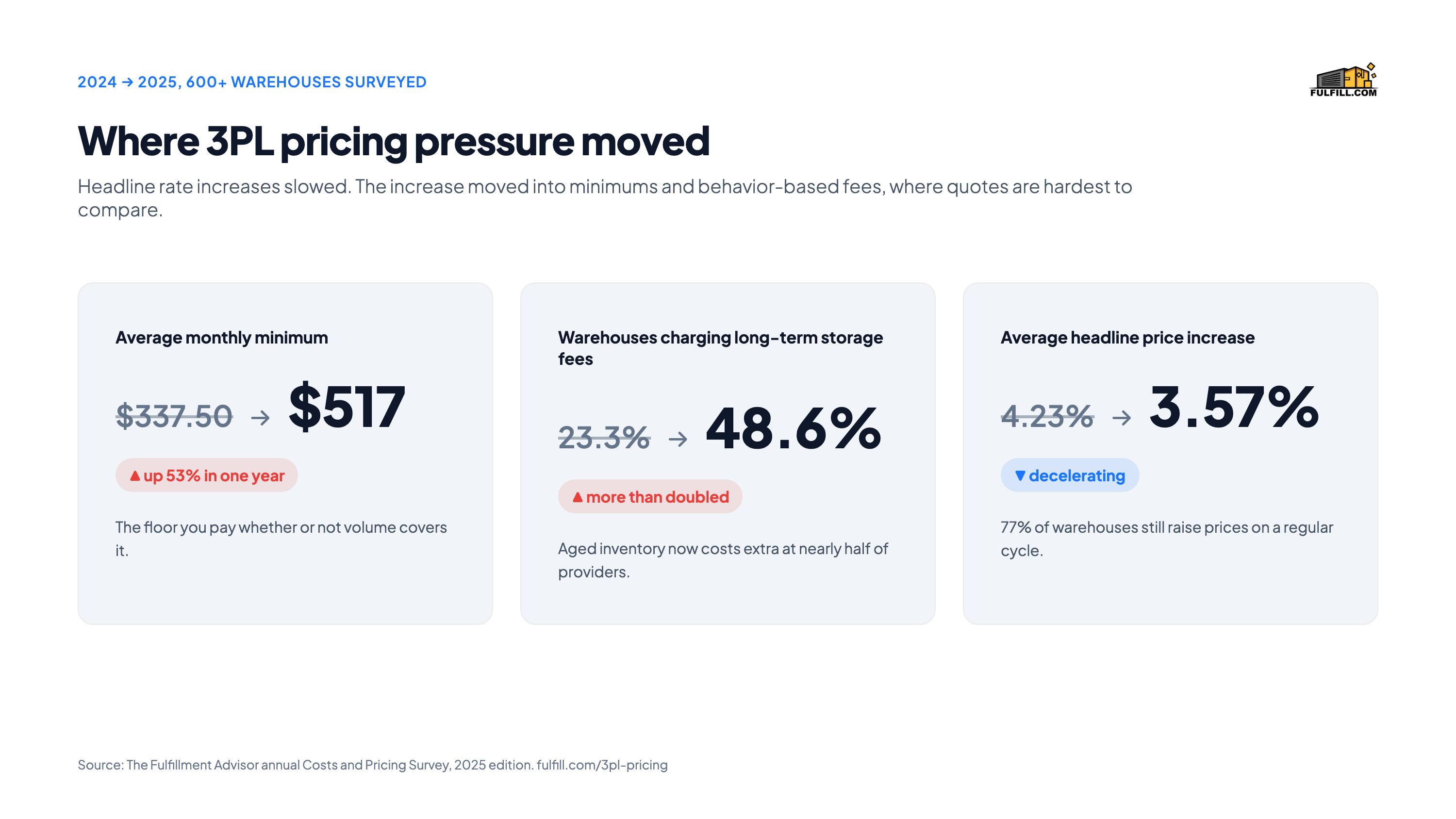
The average 3PL monthly minimum jumped 53% in one year, from $337.50 in 2024 to $517 in 2025, but plenty of providers still take small brands, and some publish no minimum at all. Source: The Fulfillment Advisor 2025 survey.
Minimums are where 3PL pricing pressure is actually showing up. Headline price increases decelerated to 3.57% in 2025 from 4.23% in 2024, yet 77% of warehouses now raise prices regularly (The Fulfillment Advisor 2025 survey). Rather than raising the per-pick fee everyone comparison-shops, warehouses are raising the floor: the monthly minimum you pay whether or not your volume covers it.
Verified examples from June 2026 show the spread. Simpl Fulfillment publishes a $750 per month minimum. ShipMonk publishes a formula instead of a floor: monthly order volume times the first-item pick fee, minus 20%. HermesLines and Fulfillment San Diego advertise no minimums. Most providers sit in between and do not say so publicly: in a June 2026 sample of 300 active 3PL websites in Fulfill.com's network, only about 6% mentioned minimums at all.
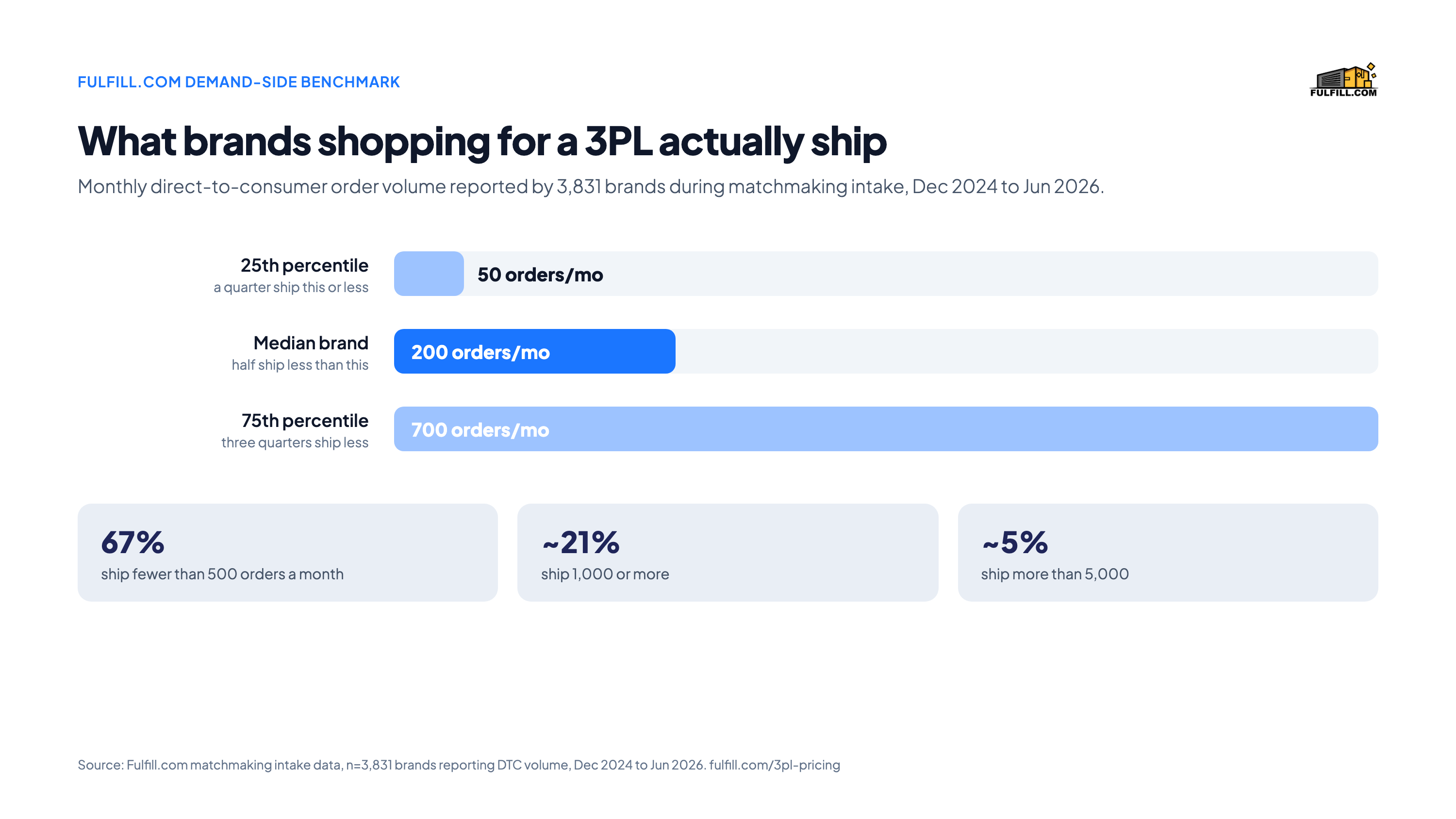
Minimums matter more than rates for most real brands: two-thirds of brands searching for a 3PL ship fewer than 500 DTC orders a month, and a quarter ship 50 or fewer (n=3,831 reporting volume, Dec 2024 to Jun 2026), so the minimum, not the per-order rate, decides whether a 3PL is viable for you.
If you are worried you are too small, the market structure favors you: 52% of 3PLs in Fulfill.com's network reporting warehouse counts operate a single facility (n=2,605, June 2026). Fulfillment is a fragmented market of small regional operators built for small brands, in the US and internationally; the network includes more than 1,400 US-based 3PLs and hundreds more across the UK, Canada, Australia, and other markets.
What Real 2026 Rate Cards Look Like
Of ten major 3PL pricing pages we checked in June 2026, only two publish full dollar rate cards; the big national providers (ShipBob, ShipMonk, Red Stag, Fulfillrite) are entirely quote-gated. This audit records what each pricing page actually shows, verified by fetching every page directly.
Source: each provider's public pricing page, fetched and verified June 2026.
One caveat: the two full rate cards come from smaller operators, so treat them as transparency examples, not market averages. The industry pattern is unambiguous, though: the bigger the provider, the less it tells you before a sales call. That is not necessarily sinister, since custom pricing can genuinely fit complex brands better, but it shifts the entire burden of comparison onto you. For a broader view of the major providers themselves, see our guide to the top 3PL companies.
Fulfill.com collects your requirements once and matches you with a median of 9 vetted 3PLs. Brands move from options presented to a first introduction in a median of 4.3 days. It is free for brands, and you compare real quotes instead of published ranges.
Get matched with vetted 3PLs →What Do Brands Like Mine Actually Ship?
Among 3,831 brands reporting direct-to-consumer volume to Fulfill.com between December 2024 and June 2026, the median brand ships about 200 DTC orders per month and manages just 10 SKUs, far smaller than most pricing guides assume.
Every pricing guide in this market recycles the same supply-side survey; none can show the demand side, meaning what the brands actually shopping for a 3PL look like. More than 5,000 qualified brands (5,111, October 2024 through June 2026) have used Fulfill.com to search for a 3PL, and their intake data is the benchmark below.
Source: Fulfill.com matchmaking intake data. Brands self-report during matchmaking intake; bases differ by question. Channel shares overlap because brands select several channels, so they do not sum to 100%.
Each row changes how you should read the 2026 benchmark rates. A 200-order, 10-SKU brand shops in bin-storage and minimum-fee territory, so the $3.08 bin rate and the $517 average minimum matter more than the pallet benchmarks. The 33% selling B2B should weight the $4.80 B2B order fee and EDI setup costs. And if you are an early-stage brand feeling too small for outsourced fulfillment, you are the median customer in this market, not the exception. You can browse the network itself at our 3PL directory.
How to Estimate Your 3PL Cost Per Order
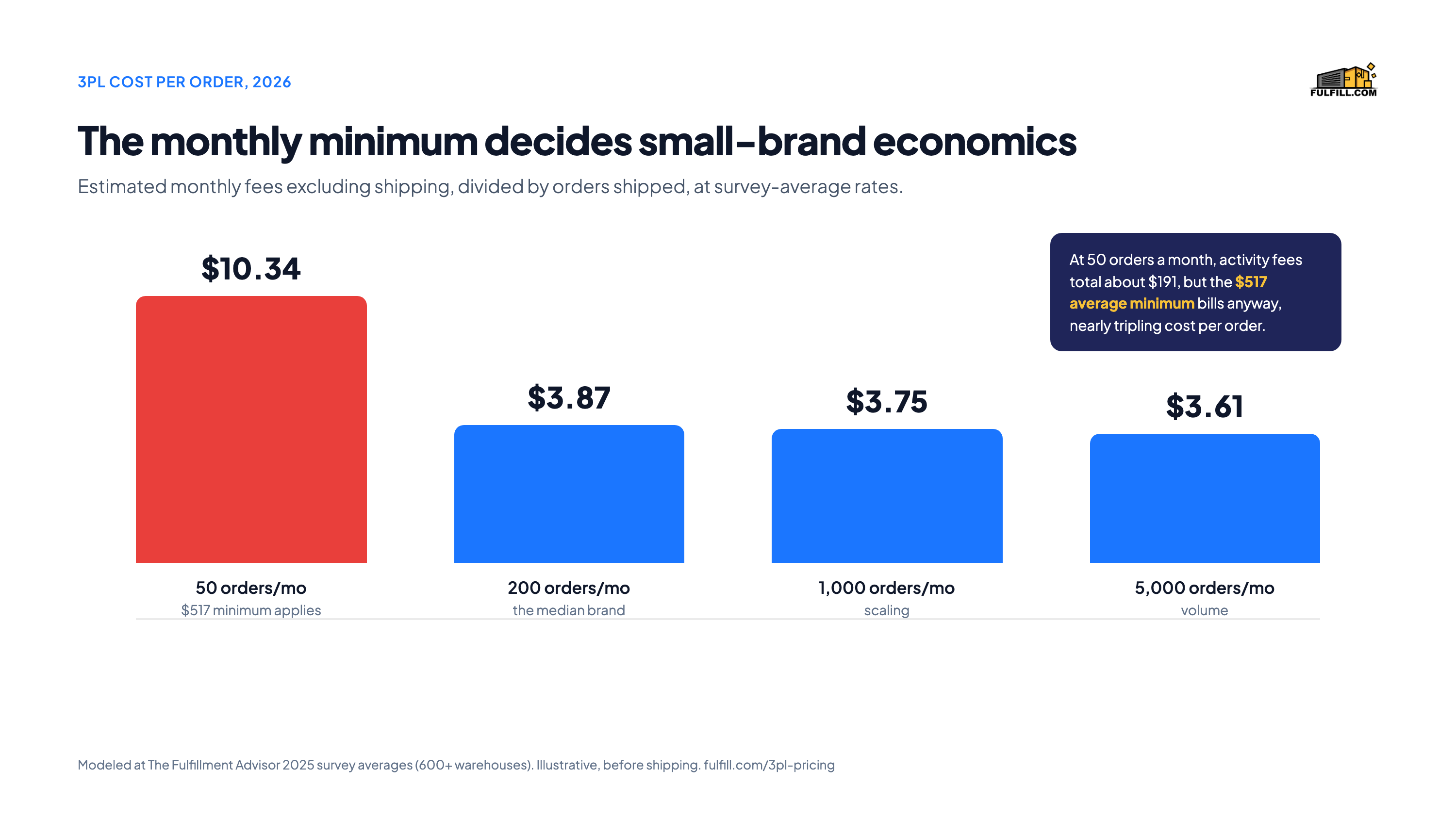
3PL cost per order equals total monthly fees (pick and pack, storage, account fees, and amortized one-time fees) divided by orders shipped that month; at survey-average 2026 rates that lands between $3.61 and $10.34 depending on volume.
Cost per order = (pick and pack fees + storage fees + account and technology fees + amortized one-time fees) / orders shipped per month
Shipping sits on top as a pass-through, so run the math without it first; that isolates the part of the bill the 3PL actually controls. The four worked examples below apply the formula at survey-average rates.
Source: illustrative estimates modeled at The Fulfillment Advisor 2025 survey average rates from the 2026 benchmark table, before shipping; not Fulfill.com quote data; actual quotes vary. High-volume brands typically negotiate below survey averages.
The starter row is the lesson most guides skip. At 50 orders a month, your activity fees total about $191, but the average minimum bills you $517 anyway, nearly tripling your effective cost per order. A quarter of brands searching through Fulfill.com ship at this volume. Below a few hundred orders a month, the smartest move is not a lower pick fee; it is a provider with a low or no minimum. Our 3PL cost calculator applies the same formula to your own volumes.
3PL Pricing Models Explained
3PLs price in four ways: per-transaction fees, flat-rate subscriptions, cost-plus arrangements, and hybrid models, and most ecommerce brands under 5,000 orders a month end up on per-transaction pricing.
Per-transaction (a la carte) pricing bills each activity separately: every pick, every pallet stored, every return. Costs scale directly with volume, which keeps slow months cheap but makes busy months expensive, and it suits unpredictable volume.
Subscription pricing bundles fulfillment into a flat monthly fee, sometimes tiered by volume band. It fits stable, predictable volume like subscription boxes; the risk is that if your volume drops, the flat fee does not.
Cost-plus pricing passes the warehouse's actual labor and space costs through with an agreed margin on top. It is common in dedicated or high-volume arrangements and rewards brands willing to audit invoices.
Hybrid models mix the above, most often a base subscription plus per-transaction fees beyond an included allowance, or a percentage of order value. Amazon Multi-Channel Fulfillment is its own variant, a published per-unit rate card by size tier; MCF fees rose an average of $0.30 per unit for 2026 with a 3.5% fuel and logistics surcharge from May 2026 (Source: Amazon Supply Chain Services, 2026).
Within any model, classify every quote line into one of three buckets: fixed costs that never vary (setup, integration, minimums), variable costs that scale with activity (pick and pack, storage, receiving, returns), and step costs that jump at thresholds (space tiers, support levels, insurance bands). The fixed bucket is what punishes you in slow months.
Source: model definitions per The Fulfillment Advisor and Red Stag pricing guides, 2025; Amazon MCF pricing page, 2026.
Why 3PL Prices Are Rising in 2026
Headline warehouse price increases actually slowed to 3.57% in 2025 from 4.23% in 2024, but 77% of warehouses now raise prices regularly, and the pressure has shifted into minimums and behavior-based fees. Source: The Fulfillment Advisor 2025 survey.
The inputs explain why. Warehouses' own space costs rose 11.9% in a year, from $8.31 to $9.30 per square foot annually, and warehouse wages reached $17.15 per hour (The Fulfillment Advisor 2025 survey). The broader industrial market backs that up: Q1 2026 vacancy sits at 6.7 to 7.0% with asking rents of $10.20 to $11.08 per square foot (Source: CBRE and Cushman & Wakefield, Q1 2026). On the transportation side, FedEx and UPS both raised general rates 5.9% for 2026, with surcharges rising faster, and Amazon MCF added $0.30 per unit plus a fuel surcharge. Extensiv's earlier benchmark of 200+ 3PL warehouses found 70% fighting higher labor costs (Source: Extensiv, October 2024 edition).
Put together, pricing pressure is migrating from headline rates into minimums, which jumped from $337.50 to $517, and into behavior-based fees like long-term storage, now charged by 49% of warehouses versus 23% a year earlier. The quote you compare is staying polite; the invoice is where the increase lives.
Hidden 3PL Fees and Pricing Red Flags
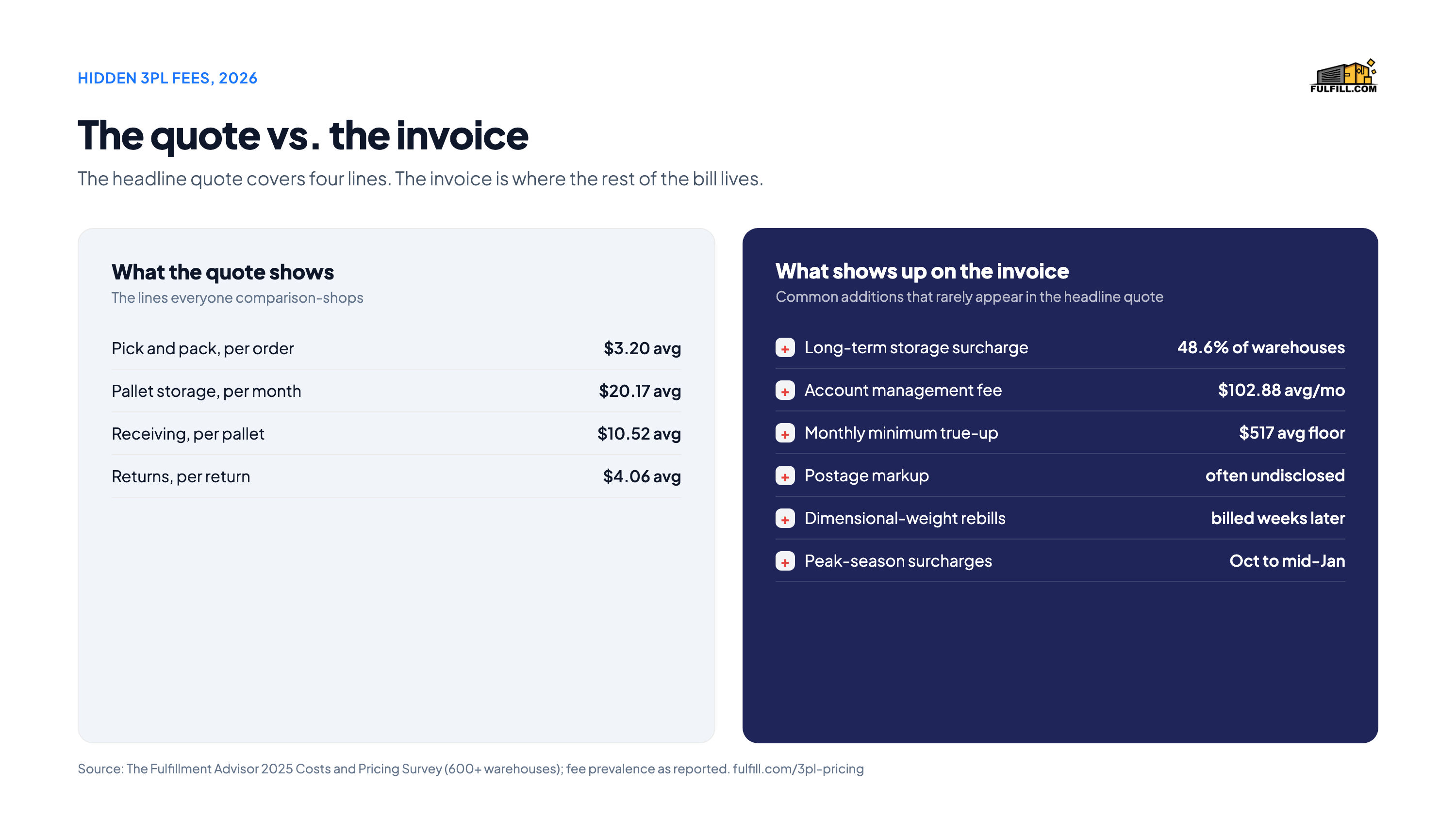
The most common hidden 3PL costs are long-term storage surcharges, postage markups, account management fees, peak-season surcharges, and exit costs like inventory-removal fees that never appear in the headline quote.
The prevalence data says these are not edge cases: 48.6% of warehouses now charge long-term storage fees and 35% charge account management fees averaging $102.88 per month (The Fulfillment Advisor 2025 survey). Add dimensional-weight rebills, where the carrier reweighs a package and bills the difference weeks later, and address-correction surcharges that only ever surface on the invoice.
Peak-season surcharges
Q4 is its own pricing regime. Carriers layer demand surcharges on top of base rates from roughly October to mid-January, and those accessorials have been rising faster than the headline 5.9% general rate increases (FedEx and UPS 2026 rate announcements). Amazon's published storage rates also step up sharply for October through December, a public reference for how aggressively peak space gets repriced. Many 3PLs pass carrier demand surcharges through, and some add their own peak labor or storage premiums. Two contract questions settle it: are carrier peak surcharges passed through at cost, and are any 3PL-added peak fees capped in writing?
Signs of good 3PL pricing:
- A complete written fee schedule, including surcharges, before you sign
- Postage billed at cost or with a disclosed, fixed markup
- Storage prorated daily, billed in the unit that fits your inventory
- An annual rate-increase cap written into the agreement
Signs of bad 3PL pricing:
- A headline pick fee with "ask us" for everything else
- Hourly billing on routine, palletized work
- Undisclosed postage markups or refusal to show carrier invoices
- Minimums that appear at contract stage but not in the quote
- New surcharges introduced mid-contract without negotiation
Unclear or inflated fee structures do more than pad an invoice; they make quotes impossible to compare, which is exactly why they persist.
3PL Contract Terms and What Happens at Renewal
3PL agreements are getting longer: month-to-month arrangements fell from 56.7% of warehouses in 2024 to 30.2% in 2025, so the terms you sign now bind you through the next price increase. Source: The Fulfillment Advisor 2025 survey.
That shift matters because 77% of warehouses raise prices on a regular cycle. Negotiate the renewal before you sign: an annual rate-increase cap written into the agreement (the 2025 industry average increase was 3.57%, so cap at or below it), a defined notice period for any new fee, and clear termination terms. Then price the exit while you still have leverage: final inventory removal or pallet-out fees, data export, and wind-down storage are quoted highest when you have nowhere else to go. A contract that is cheap to enter and expensive to leave is not cheap.
Why Do 3PL Quotes Vary So Much, and How Do I Compare Them?
Two 3PLs can quote the same brand prices that differ by 2x or more because location, labor model, packaging assumptions, and what each fee includes all differ, so quotes only compare after you normalize them to all-in cost per order at your real volume.
The dispersion has structural causes. Metro storage premiums, which one 2026 storage outlook (Ware-Pak) puts at 30 to 50% in markets like LA and the NYC/New Jersey corridor, flow straight into quotes. Some providers bundle packaging into the pick fee while others line-item every mailer. "Pick fee" can mean first item only or a whole order. Postage can be passed through at cost or marked up. And because half of 3PLs operate a single warehouse, providers genuinely have different cost bases.
Normalizing is mechanical: request the full fee schedule, not a summary quote; model your last three months of real orders against each schedule, line by line; divide each total by your order count. Now every quote is one number, cost per order, and the comparison is like-for-like.
Then negotiate. The levers that work in 2026: volume tiers that kick in as you grow, a minimum waiver for your first 90 days or seasonal dips, daily storage proration, written postage transparency, and the rate-increase cap and exit terms covered in the contract section. Re-quote regularly: 77% of warehouses raise prices on a regular cycle, and loyalty is not rewarded.
Comparing at this depth across many providers is real work, which is the problem matchmaking exists to solve. Fulfill.com matches each brand with a median of 9 vetted 3PLs, and brands move from options presented to a first introduction in a median of 4.3 days (n=3,653, December 2024 to January 2026). For the comparison itself, use our RFP template, the questions to ask a 3PL, and our guide on how to choose between the shortlisted 3PLs.
Is a 3PL Cheaper Than Amazon FBA or In-House Fulfillment?
A 3PL is usually cheaper than FBA for multi-channel brands with slow-turning or oversized inventory, while FBA wins on pure Prime-eligible velocity; in-house wins only when founder labor is free and volume is low.
Against FBA, the math turns on channel mix and inventory turn. FBA's per-unit fees are competitive for fast-turning, standard-size products sold on Amazon, but its long-term storage penalties are aggressive, and using FBA inventory to fill non-Amazon orders means Multi-Channel Fulfillment fees, which rose an average of $0.30 per unit for 2026 plus a 3.5% fuel and logistics surcharge from May 2026 (Source: Amazon Supply Chain Services). A 3PL handles every channel from one inventory pool. In practice this is often "and" rather than "or": among brands completing a Fulfill.com intake (n=4,035, Dec 2024 to Jan 2026), 23% already use FBA alongside other channels, and many run FBA for Amazon velocity with a 3PL for everything else.
Against in-house, count your own labor. Packing orders from a garage at 50 orders a month is often genuinely the cheapest option, if you do not price your own time. Once you rent space and hire help, you absorb the same rising inputs squeezing 3PLs (Q1 2026 industrial asking rents of $10.20 to $11.08 per square foot, warehouse wages around $17.15 per hour) without a 3PL's economies of scale. The breakeven test is the cost-per-order formula: total monthly fulfillment cost, including the value of your own time, divided by orders shipped, compared against a 3PL quote at your volume.
3PL Pricing FAQ
How much does a 3PL cost per order?
Most brands pay roughly $2 to $3 per single-item B2C order for pick and pack, before shipping (The Fulfillment Advisor 2025 survey average: $3.20); B2B orders average $4.80. All-in cost per order, including storage, account fees, and amortized minimums, lands between roughly $3.61 and $10.34 at survey-average rates; small brands under a monthly minimum pay the most.
How do you calculate 3PL cost?
Add all monthly 3PL fees (pick and pack, storage, returns, account management, plus amortized one-time fees) and divide by orders shipped that month. The result is your cost per order, the only number that compares fairly across providers. Model your last three months of real orders against each provider's full fee schedule, then compare shipping separately as a pass-through.
How much does 3PL storage cost per month?
Pallet storage averages $20.17 per pallet per month, with most warehouses charging $18 to $25 (The Fulfillment Advisor 2025 survey of 600+ warehouses). Bin storage averages $3.08, and cubic-foot billing about $0.46. Nearly half of warehouses (48.6%) now add long-term storage surcharges on aged inventory, so slow-turning stock costs more than the base rate.
What are average pick and pack fees in 2026?
The 2025 industry survey average is $3.20 per B2C order plus $0.48 per additional item; B2B orders average $4.80 (The Fulfillment Advisor, 600+ warehouses). 3PLs that publish rate cards list lower rates, $0.99 to $2.00 per order verified in June 2026, so quotes above $3.50 for simple single-item orders deserve scrutiny.
What monthly minimums do 3PLs require?
The average monthly minimum is $517 in 2025, up 53% from $337.50 in 2024 (The Fulfillment Advisor survey). Verified 2026 examples range from $0 (HermesLines, Fulfillment San Diego) to $750 per month (Simpl Fulfillment); ShipMonk publishes a volume-based formula instead. Minimums, not per-order rates, usually decide whether a 3PL is viable for a small brand.
What hidden fees do 3PLs charge?
The most common are long-term storage surcharges (charged by 48.6% of warehouses), postage markups, account management fees (35% of warehouses, averaging $102.88 per month), dimensional-weight rebills, address-correction charges, peak-season surcharges, and exit costs like inventory-removal fees. Request the complete fee schedule in writing before signing; a headline pick fee is not a price.
At what order volume does a 3PL make sense?
There is no hard floor, but minimums set the practical one. The median brand searching for a 3PL through Fulfill.com ships about 200 DTC orders per month, 67% ship fewer than 500, and a quarter ship 50 or fewer (n=3,831 reporting volume, Dec 2024 to Jun 2026). Below a few hundred orders, prioritize providers with low or no minimums.
Are 3PL fees negotiable?
Yes. The levers that work in 2026 are volume tiers, an annual rate-increase cap at or below the 3.57% industry average, minimum waivers for your first 90 days or seasonal dips, daily storage proration, and written postage transparency. Re-quote on a regular cycle; 77% of warehouses raise prices regularly and incumbents rarely volunteer better terms.
Do 3PLs publish their prices?
Mostly no. Of ten major 3PL pricing pages checked in June 2026, only two smaller operators published full rate cards; ShipBob, ShipMonk, Red Stag, and Fulfillrite were entirely quote-gated. Across a June 2026 sample of 300 active 3PL websites in Fulfill.com's network, only about 6% mentioned minimums at all.
Tell us your volumes, SKUs, and channels, and Fulfill.com's matchmaking team shortlists vetted providers for you from a network of 2,800+ 3PLs, free for brands. More than 5,000 brands have searched for a 3PL through Fulfill.com.
Find your 3PL →Methodology and Sources
This guide draws on four source classes, each dated. Industry rate benchmarks come from The Fulfillment Advisor's annual Costs and Pricing Survey of more than 600 warehouses, 2025 edition (The Fulfillment Advisor is the renamed warehousingandfulfillment.com, the survey most pricing guides cite), cross-checked against Red Stag Fulfillment's pricing guide, updated August 2025. Provider rate cards were fetched and verified directly from each pricing page in June 2026. Macro context comes from CBRE and Cushman & Wakefield Q1 2026 industrial reports and the FedEx and UPS 2026 rate announcements.
Demand-side benchmarks come from Fulfill.com matchmaking intake data. The qualified-brand count covers October 2024 to June 2026, intake benchmarks cover December 2024 to June 2026, and matchmaking outcomes cover December 2024 to January 2026, with sample sizes stated inline. Matchmaking outcome figures derive from 49,602 brand-to-3PL matches across 4,796 brands in that window; among brands that signed, the median time from first match to a signed agreement was about 38 to 39 days (n=336). Separately, and as a later funnel stage than matches, Fulfill.com made more than 7,900 brand-to-3PL introductions between December 2024 and June 2026; the two metrics are not interchangeable.
Fulfill.com is a free 3PL matchmaking platform that connects ecommerce brands with vetted fulfillment providers from a network of 2,800+ 3PLs. Fulfill.com does not sell fulfillment services. No 3PL pays for placement in this guide, and no advertiser placement appears on this page.
Updated June 2026.
Benchmarks were additionally cross-checked against an internal library of more than 25 real 3PL rate cards and proposals reviewed by Fulfill.com in 2025 and 2026. Only aggregated medians from that library are published, and no individual operator's rates are identifiable.
Sources
- The Fulfillment Advisor (formerly warehousingandfulfillment.com), 2025 Costs and Pricing Survey of 600+ warehouses: all "survey average" figures (setup $333-$425, integration $275, receiving $10.52 US / $15.20 Canada / $39.88 per hour, container unload $500, storage $20.17 pallet / $3.08 bin / $0.46 cu ft / $1.73 sq ft, B2C pick $3.20, additional item $0.48, B2B $4.80, kitting $39-$43, returns $4.06, account management $102.88, minimum $517 vs $337.50, 51% charging setup, 35% charging account management, long-term storage prevalence 23.3% to 48.6%, price increases 3.57% vs 4.23%, 77% raising prices regularly, month-to-month contracts 56.7% to 30.2%, space cost $8.31 to $9.30, wages $17.15): https://thefulfillmentadvisor.com/warehousing-services-costs-pricing-rates-and-fees/ (rates page; survey writeup linked from same site). Verified June 2026; the market report and rates pages differ slightly on some averages, market-report values cited.
- Red Stag Fulfillment, 3PL Pricing Guide (updated August 2025): cross-check for setup, receiving, and storage ranges: https://redstagfulfillment.com/3pl-pricing/
- HermesLines published rate card ($0.99-$1.57 pick and pack, $13.01-$15.99 pallet storage, $10 receiving, $0.99-$6.95 returns, no minimum): https://www.hermeslines.com/pricing (fetched June 2026)
- Fulfillment San Diego published rate card ($0 setup, $0.50 pick plus $0.75-$1.50 pack by tier, $4 bin / $29-$49 pallet storage, $15 pallet receiving, $299/$499 container unload, no minimum): https://www.fulfillmentsandiego.com/pricing (fetched June 2026)
- Simpl Fulfillment pricing page ($750 monthly minimum, $0 setup): https://www.simplfulfillment.com/pricing (fetched June 2026)
- ShipMonk pricing page (minimum formula): https://www.shipmonk.com/pricing (fetched June 2026)
- ShipBob pricing page (quote-gated): https://www.shipbob.com/pricing/ (fetched June 2026)
- Fulfillrite pricing page (quote-gated): https://www.fulfillrite.com/pricing/ (fetched June 2026)
- eFulfillment Service pricing page (password-gated): https://www.efulfillmentservice.com/pricing/ (checked June 2026)
- ShipHero pricing page (fulfillment rates not published): https://shiphero.com/pricing/ (checked June 2026)
- Amazon Supply Chain Services, 2026 Multi-Channel Fulfillment fee update (average $0.30 per unit increase; 3.5% fuel and logistics surcharge effective May 2, 2026): https://supplychain.amazon.com/pricing (re-verify against the live announcement before publish)
- FedEx 2026 general rate increase (5.9%, effective December 2025; accessorial surcharges rising faster than base rates): https://www.fedex.com/en-us/shipping/rate-changes.html
- UPS 2026 general rate increase (5.9%, effective January 2026): https://www.ups.com/us/en/support/shipping-support/shipping-costs-rates.page
- CBRE, Q1 2026 US Industrial Figures (vacancy, asking rents): https://www.cbre.com/insights/figures/q1-2026-us-industrial-figures
- Cushman & Wakefield, Q1 2026 US Industrial MarketBeat (vacancy 6.7-7.0%, asking rents $10.20-$11.08 per sq ft, jointly with CBRE): https://www.cushmanwakefield.com/en/united-states/insights/us-marketbeats/us-industrial-marketbeat
- Ware-Pak, 2026 storage cost outlook (metro premiums 30-50%, single-vendor estimate, directional): https://www.ware-pak.com/
- Extensiv, Third-Party Logistics Warehouse Benchmark Report, October 2024 edition (70% of 200+ warehouses citing higher labor costs): https://www.extensiv.com/third-party-logistics-warehouse-benchmark-report
- Fulfill.com matchmaking intake and outcomes data (all demand-side benchmarks, sample sizes and windows stated inline): internal first-party data, methodology above.